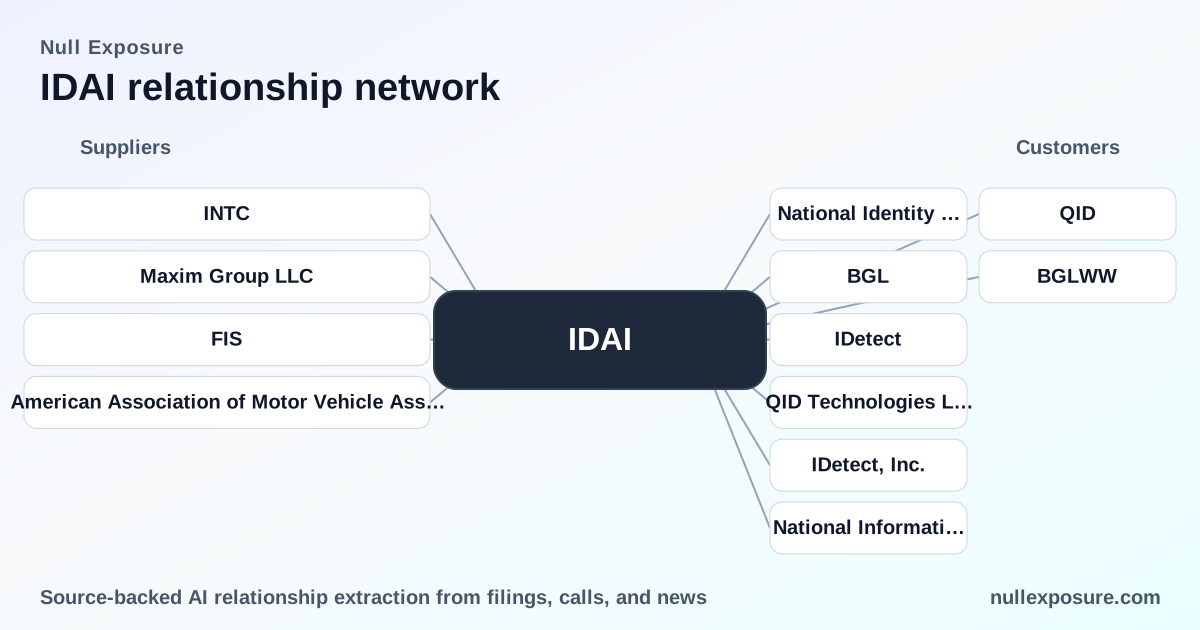
Trust Stamp (IDAI): Customer Relationships that Drive the Identity-Security Growth Story
Trust Stamp operates a privacy-first identity-authentication platform that it monetizes through a mix of software licensing, SaaS subscriptions, usage-based orchestration fees and one-off professional services. The company sells core AI-driven tokenization and biometric verification capabilities to governments, large enterprises and fintechs, and increasingly channels revenue through its low-code Orchestration Layer to scale recurring, per-use payments and enterprise subscriptions. For investors, the revenue mix is important: concentration in a handful of large customers coexists with a deliberate shift to recurring SaaS and usage pricing, which drives gross-margin leverage if adoption broadens.
Explore further at https://nullexposure.com/.
Why the customer map matters for valuation
Trust Stamp’s contracts span licensing, subscription and usage-based models; that structure produces a hybrid profile: some predictable recurring revenue with meaningful client concentration and periodic large one-time license fees. Financially, this explains relatively modest TTM revenue yet attractive Price-to-Sales and the potential for rapid margin expansion as Orchestration Layer adoption deepens.
Full roster: what every reported relationship means for revenue and risk
Below I cover every customer relationship captured in the available reporting. Each entry is a plain-English take on what Trust Stamp is doing with the counterparty and where value or risk sits.
Blue Gold / BGL (Blue Gold Limited / BGLWW)
Trust Stamp executed a Letter of Intent to build a biometrically verified, passwordless “Wallet-of-Wallets” for Blue Gold VIP holders of Standard Gold Coins, positioning Trust Stamp as the identity layer for a vertically integrated gold-fintech use case. This is a commercial product deployment aimed at a payments/crypto-adjacent customer and represents a potential new revenue stream tied to fintech wallet services. Source: Sahm Capital press release announcing the LOI, December 22, 2025.
National Identity Agency of the Republic of Ghana (NIA)
Trust Stamp signed an exclusive Memorandum of Understanding to provide identity tokenization services for the NIA and the government ministries and agencies it supports, establishing a government-level contract pathway for national identity programs. This is a strategic government engagement that validates Trust Stamp’s tokenization approach and opens a high-criticality client type for recurring sovereign-scale work. Source: Proactive Investors coverage of the MOU, March 2026.
IDetect, Inc.
Trust Stamp contracted to provide IDetect with access to the AAMVA Driver’s License Data Verification (DLDV) service and real‑time DMV verification for IDetect’s ID scanners, with IDetect projecting millions of monthly transactions at full capacity. This is a volume-driven service relationship that will scale usage-based fees materially if traffic projections are realized and is a near-term revenue ramp opportunity. Source: Sahm Capital / Proactive Investors announcements, February–March 2026.
IDirect
Trust Stamp entered an agreement to provide SaaS authentication services to IDirect, a long-standing US security operator, leveraging contracted access to AAMVA DLDV. This positions Trust Stamp as the backend identity provider for high-volume physical access/security use cases and reinforces the company’s play in security services beyond pure fintech. Source: Trust Stamp Q1 2026 business briefing reported by Sahm Capital, March 31, 2026.
Digital Platformer (with Partisia participation)
Trust Stamp signed a commercial agreement with Digital Platformer (with Partisia noted as MPC partner) to deploy biometric tokenization and MPC technologies across Japan’s financial services sector, marking the company’s first revenue-generating contract in Japan. This is an APAC expansion milestone that leverages privacy-preserving cryptography (MPC) to address regulated financial clients; it is a strategic geographic diversification and product adjacence for the Orchestration Layer. Source: Sahm Capital press release, April 23, 2026.
QID Technologies LLC (QID)
Trust Stamp granted QID a non‑exclusive license for its AI identity technologies in exchange for a $1.0 million license fee (promissory note installments) and signed a Master Technology Services Agreement under which QID will contract for product development and operations capped at multi‑million annual fees. This is a clear example of Trust Stamp acting as licensor and service provider: immediate license revenue plus a capped recurring services stream that demonstrates the company’s license + services monetization model. Source: InsiderMonkey summary and Trust Stamp filings / Q1 2026 briefing (license and master agreement disclosure), late 2024–March 2026.
INTEC
Trust Stamp completed a proof-of-concept with INTEC, a Japanese certification and secure-authentication specialist focused on government and regulated markets, supporting its Japan/APAC push. This POC indicates local market validation with a partner that has government/regulatory credentials and creates a pathway for formal commercial deployments in highly regulated verticals. Source: Trust Stamp Q1 2026 business briefing reported by Sahm Capital, March 31, 2026.
Operating-model constraints and what they imply for investors
Trust Stamp’s contract archetypes and risk profile are visible across the disclosures:
- Contracting posture: The company sells a mix of one-time license fees, medium-term professional services and recurring SaaS/usage contracts. This hybrid posture produces episodic large receipts (licenses/promissory notes) alongside lower‑volatility SaaS and per‑use revenue. The firm explicitly uses ASC 606 practical expedients for contracts ≤ 12 months, indicating many short-term engagements alongside longer master agreements.
- Concentration and criticality: Company filings state that three customers historically accounted for the bulk of revenue, a high concentration that increases counterparty risk but also concentrates gross-profitability if those customers scale usage. The presence of government and large‑enterprise customers increases contract criticality and reduces churn probability once integrated.
- Contract maturity and stage: Relationships range from proof-of-concept and pilots to active and ramping SaaS deployments; the Orchestration Layer shows numerous onboarded enterprises but partial conversion to full production to date. This mix implies upside from conversion of ramping clients but also timing risk.
- Commercial structure and spend bands: Public disclosures show license and service receipts in the $1m–$10m band for some transactions (e.g., QID license, prepaid warrants for Boumarang in filings) and smaller $100k–$1m engagements for early Orchestration Layer clients—consistent with a strategy that balances scalable SaaS with select large commercial licenses.
- Counterparty types and geography: Trust Stamp sells to governments, large enterprises and security operators across North America, EMEA and APAC; international expansion (Japan, Ghana, Nigeria discussions) reduces single-market exposure but increases regulatory complexity.
Key takeaways for investors
- Revenue model transitioning toward recurring SaaS and usage pricing via the Orchestration Layer; if enterprise pilots convert at scale, margin expansion will follow.
- Customer concentration is high; three customers historically drive most revenue, which magnifies both upside from expansion and downside from churn.
- Government and large-enterprise wins (Ghana NIA, DLDV partners, Japan deals) validate product-market fit in regulated segments where identity security is mission-critical.
- Near-term catalysts include volume scaling with IDetect/IDirect and commercial rollouts in Japan and Ghana; monitor conversion of onboarded financial institutions into production.
For a concise, investor‑grade dossier on these relationships and how they affect IDAI’s revenue mix, visit https://nullexposure.com/ for the full coverage and data-driven insight.