Intellicheck (IDN): Customer Relationships, Revenue Mix, and What Investors Should Know
Intellicheck develops identity validation and threat-identification software and monetizes primarily through SaaS subscriptions, per-scan usage fees, and licensing, with a small component of one-time hardware sales and implementation services. Its business model sells access to cloud-hosted identity verification services to large retailers, financial institutions and government agencies, generating recurring revenue that is recognized monthly or over time as scans occur. For deeper background on the company and data coverage, see https://nullexposure.com/.
The clear revenue play: subscriptions plus usage, with licensing on the side
Intellicheck’s commercial model is intentionally hybrid: fixed monthly subscriptions provide predictable base revenue while per-scan fees capture variable volume upside as customer transaction activity grows. The company discloses that SaaS revenue grew to $19.81 million in 2024, up from $18.60 million in 2023, reflecting that subscriptions are the revenue backbone while usage-based billing amplifies throughput-driven revenue. According to the company’s FY2024 filings, deferred revenue and accounts receivable dynamics show revenue recognized monthly and over time consistent with SaaS and per-transaction recognition.
- Business implication: the subscription layer improves recurring revenue visibility; the per-scan element creates revenue sensitivity to customer transaction volumes and seasonality.
Contracting posture: short-term flexibility with recurring obligations
Company-level disclosures indicate that many contracts are monthly and short-term in practice, with termination clauses that lead the company to recognize variable consideration at contract end rather than upfront. Intellicheck also explicitly offers licensing and SDK arrangements and recognizes some hardware revenue at a point in time. This mix produces a contracting posture that is flexible for customers but places the onus on the company to win renewals and sustain volumes.
- Investor takeaway: revenue visibility is moderate — recurring, but with shorter contract tenors that increase churn risk relative to multi-year enterprise deals.
Customer concentration and criticality: concentrated and consequential
Intellicheck reports a high concentration of revenue: the top ten customers accounted for roughly 71% of total revenues in both 2023 and 2024, and three customers made up about 50% of 2024 revenue. The company characterizes this concentration as material and potentially critical. That structure means loss of one major client would be immediately consequential to reported top-line and margins.
- Investor takeaway: concentration elevates idiosyncratic risk; monitor customer retention metrics and any sign of single-customer revenue erosion.
Counterparty mix and go-to-market: large enterprises and government agencies
Intellicheck targets large retailers, financial institutions and U.S. government entities. Company disclosures list government and large-enterprise customers as core targets; the product suite is used in retail POS, financial onboarding, age verification and law enforcement contexts across North America. This customer profile drives longer sales cycles for large enterprise and government accounts, while smaller retail age-verification use cases sell faster.
- Investor takeaway: sales efficiency and implementation timelines will differ materially across segments — expect slower but larger deals for enterprise/government and faster, lower-ticket sales for retail.
Geography and addressable market: North America focus with global capability
The company positions itself as North America-centric—both the product focus (driver’s license coverage across U.S. jurisdictions) and customer concentration are U.S.-weighted—yet Intellicheck also notes global document validation capability for over 10,000 document types when integrated with third-party data. The practical revenue base remains concentrated in North America.
- Investor takeaway: TAM expansion outside North America is possible but currently secondary to domestic penetration and large-account wins.
Product segmentation: software first, services second, hardware marginal
Intellicheck’s revenue segmentation shows software (SaaS) as the dominant line, services (support, customization and analytics) as meaningful, and hardware/equipment as immaterial by comparison. The company licenses SDKs for multiple operating systems and sells hosted subscription access, plus occasional bundled hardware that is recognized at a point in time.
- Investor takeaway: gross margin profile will be driven by software economics; hardware sales introduce low-margin, one-time revenue but do not materially change recurring revenue economics.
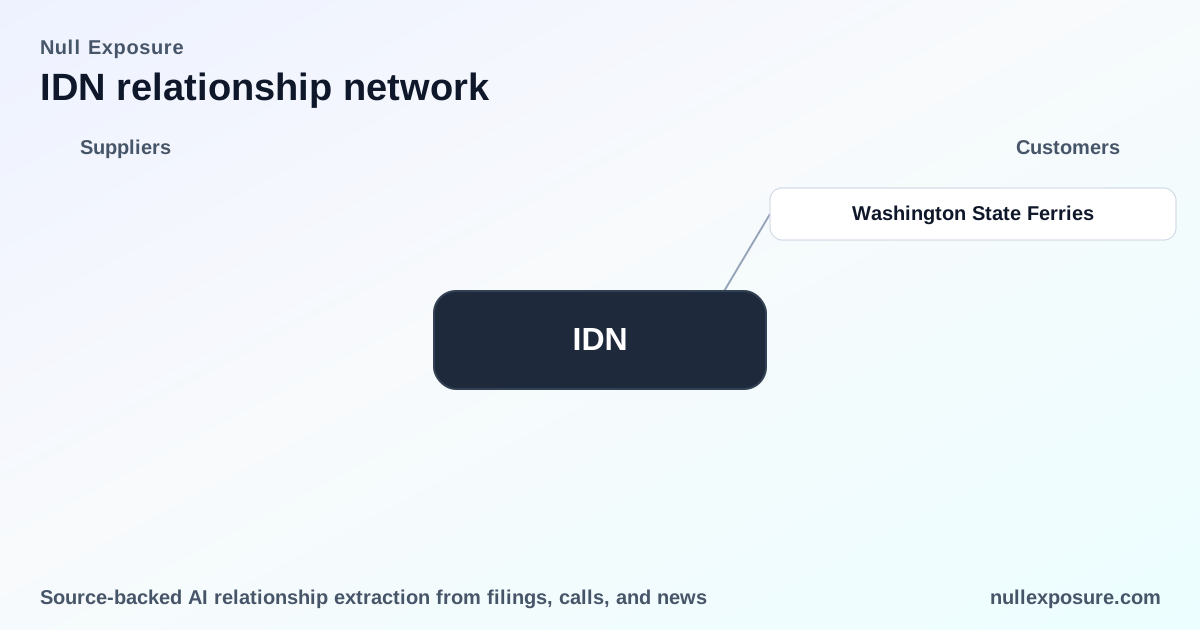
Relationship snapshot: Washington State Ferries
Intellicheck’s public record includes an early public-sector deployment: the company engineered a wireless service for Washington State Ferries in 2008, supplying it for free for about a year before the technology was sold to vendors who later charged subscription fees. This historical engagement illustrates Intellicheck’s ability to prototype public-sector solutions and transition to a subscription monetization model. Source: Peninsula Daily News reporting on the company’s historic activity (reported 2014). https://www.peninsuladailynews.com/news/mobilisa-founder-steps-down-to-focus-on-thought-technology/
Operational constraints that shape the model
Several company-level signals from filings define the operating envelope investors should evaluate:
- Contract types: Predominantly subscription and usage-based (per-scan) contracts, with some licensing and occasional spot hardware sales. The company recognizes revenue monthly or over time, and treats short-term monthly termination clauses as material to revenue recognition practice.
- Concentration: Top-ten and top-three customer concentrations are high; the business is sensitive to the departure of one or more large clients.
- Counterparty risk: A meaningful portion of revenue is sold to large enterprise and government buyers, implying longer sales cycles and contract negotiation complexity.
- Geography: Core market is North America, with technology built to support global document types via integrations.
- Materiality thresholds: The company labels its top customers’ contribution as material to critical; ancillary revenues (returns, hardware) are immaterial in aggregate.
- Relationship stage: Most meaningful revenue relationships are active, though the company remains in continuous prospecting and product maturation cycles for new customers.
Investment implications: runway, risks, and what to watch
Intellicheck’s model delivers recurring revenue growth while exposing investors to customer-concentration risk and transaction-volume sensitivity. Key metrics to monitor:
- Retention rates and churn among the top three customers.
- Monthly scan volumes versus fixed subscription baselines.
- New large-enterprise or government wins that diversify the top-ten concentration.
- Deferred revenue trends and accounts receivable collectability (the company records allowances and monitors collections).
- Product expansion into global document coverage and ancillary analytics services that can deepen wallet share.
A concise summary: Intellicheck offers a growth-oriented SaaS business with predictable subscription revenue, additive per-transaction upside, and elevated concentration risk that compresses downside protection.
For a structured tracker of customer relationships and to see how this profile evolves across filings and public reporting, explore our company pages at https://nullexposure.com/.
Bottom line and suggested next steps
Intellicheck is a software-first identity verification company with a hybrid revenue model that balances predictability and volume sensitivity. Institutional investors should balance the attractive recurring revenue composition against high customer concentration and North America dependency. Monitor upcoming filings for customer concentration changes, deferred revenue movement, and any disclosure of multi-year enterprise contracts that would materially increase revenue visibility.
If you want a focused monitoring feed and comparative customer-risk scoring for IDN and its peers, visit https://nullexposure.com/ to sign up for alerts and relationship analytics.