Idaho Strategic Resources (IDR): customer relationships, concentration, and what investors should price in
Idaho Strategic Resources (IDR) operates as a small but profitable precious- and strategic‑metals producer that generates the bulk of its near‑term cash flows by producing flotation gold concentrate and selling it in open market transactions. The company monetizes through spot and short‑term concentrate sales and doré shipments, with the majority of concentrate revenues flowing to a single broker; investors should treat IDR as a production‑stage mining operator whose revenue volatility is dominated by commodity price swings and counterparty concentration. For a quick look at the company’s public profile, see the company website at https://nullexposure.com/.
Single‑counterparty exposure: H&H Metals Corp.
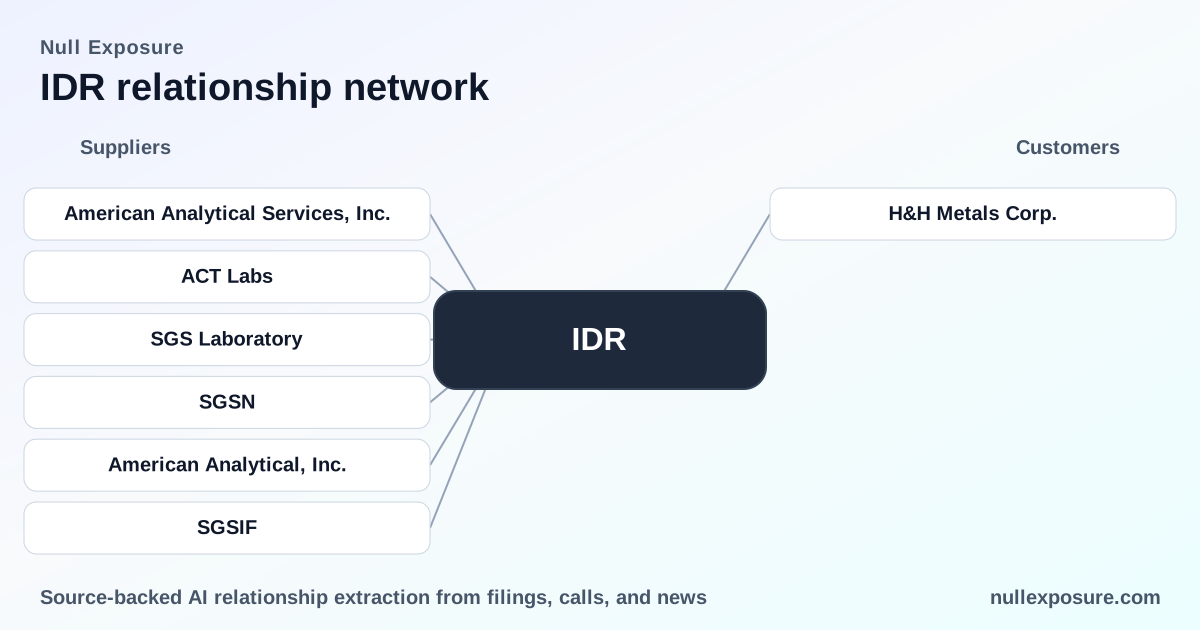
IDR sells the vast majority of its gold flotation concentrate to a single broker, H&H Metals Corp., which accounted for roughly 99% of gold concentrate sales in 2024 and represented the single largest outlet for IDR’s concentrate production. According to the company’s 2024 Form 10‑K, concentrate sales to H&H were $25,492,380 of the $25,765,373 total concentrate revenue reported for 2024, and gold sales receivables are concentrated with amounts due from H&H at year‑end (receivable balance $1,578,694 at 12/31/2024). (Source: IDR Form 10‑K, FY2024.)
A number of market write‑ups and summaries echo the concentration point, noting that almost all gold sales in 2025 and 2024 flowed through H&H, which creates a near‑term commercial dependency that materially affects cash flow and pricing exposure. For example, a 2026 industry piece cited in Ad‑Hoc News described a 98% share of gold sales to a single partner in 2025. (Source: Ad‑Hoc News, May 2026.)
Key takeaway: H&H is a critical commercial counterparty for IDR’s concentrate channel; any disruption, change in pricing terms, or counterparty performance issue with H&H would have an outsized impact on IDR’s revenue and working capital.
Institutional partnership mention: “CNS” partnership with IDR
IDR is referenced as a partner in an institutional product launched by an asset manager, identified in a Q4 2025 earnings‑call transcript as “CNS” working with IDR to combine a listed real‑estate strategy with indexed private property funds. The mention is brief and positions IDR as a partner in an investment vehicle rather than a customer or purchaser relationship. (Source: Cohen & Steers / InsiderMonkey Q4 2025 call transcript, cited Mar 2026.)
In plain terms, this signals that IDR’s brand or balance‑sheet activities intersect with institutional product initiatives, but the public reference does not establish a revenue or operational dependence and should be treated as a strategic/marketing juxtaposition rather than a material commercial arrangement at this time.
How the documented relationships map to IDR’s operating model
The combination of filings and press coverage yields a compact, consistent picture of how IDR sells product and where the operational levers and risks sit.
-
Contracting posture: primarily spot and short‑term. The company recognizes revenue at shipment or upon final settlement and routinely receives provisional payments; doré is paid at transfer of control and concentrate pricing is finalized on settlement months after shipment. This establishes a transactional, price‑sensitive commercial model rather than long‑dated off‑take contracts. (Source: IDR Form 10‑K revenue recognition policy excerpts, FY2024.)
-
Revenue concentration is critical. Multiple excerpts in the 10‑K explicitly name H&H and quantify concentrate sales to that single broker as essentially the entire concentrate channel in 2024, representing a critical single‑counterparty dependency. That concentration elevates counterparty and collection risk and links IDR cash flow volatility tightly to a single commercial arrangement. (Source: IDR Form 10‑K, FY2024; market reporting Mar–May 2026.)
-
Geographic footprint is mixed: domestic operations, overseas smelters. Operations and mining are Idaho‑centric, but IDR ships flotation concentrate overseas to smelters in South Korea and Japan and sells to smelters in Asia, giving the company exposure to APAC processing markets and global trade flows. This is a dual‑geography exposure: domestic production with international settlement and processing risk. (Source: IDR Form 10‑K, FY2024.)
-
Relationship stage and role profile. IDR is an active seller/manufacturer—operating the Golden Chest production complex and recognizing material concentrate revenue—and functions as a supplier into smelter/refinery channels. Filings also record an historical terminated lessee relationship (the 2015 Juniper lease termination) that is not operational today but demonstrates the company’s capacity to re‑assume assets. (Source: IDR Form 10‑K, FY2024.)
-
Materiality and spend band. Concentrate sales represent a meaningful part of IDR’s reported revenues (concentrate revenue of ~$25.8m in 2024), placing the company in a mid‑range spend/revenue band where counterparty terms and settlement mechanics materially influence liquidity and working capital. (Source: IDR Form 10‑K tables, FY2024.)
Risk framing: what investors should stress‑test
-
Counterparty concentration risk is the dominant operational hazard. With H&H capturing the overwhelming portion of concentrate sales, investors must assume single‑counterparty negotiation leverage, credit risk on receivables, and potential liquidity squeeze scenarios if provisional payments or settlement timing change. (Source: IDR Form 10‑K; Ad‑Hoc News reporting, 2026.)
-
Price and short‑term settlement exposure. IDR’s practice of provisional payments and settlement at future prices means revenue and working capital are sensitive to intra‑month and month‑to‑settlement price moves; the company routinely estimates final recoveries and accepts variability between mill and smelter sampling. (Source: IDR Form 10‑K, FY2024.)
-
Operational/geopolitical vector via APAC processors. Shipping concentrate to smelters in South Korea/Japan and selling in Asian markets exposes IDR to transport, trade policy, and foreign processing practices; these are second‑order risks but relevant for margin and settlement timing. (Source: IDR Form 10‑K, FY2024.)
Investor implications and recommended monitoring
Investors evaluating IDR should treat the company as a small, production‑stage metal producer whose valuation is highly sensitive to three levers: concentrate volumes, realized prices at settlement, and the stability of the H&H channel. Monitor these items quarterly:
- Receivable balances and provisional payment trends from H&H.
- Any shift in counterparty mix (new brokers, direct smelter sales, or long‑dated offtakes).
- Changes to revenue recognition language or sampling disputes that could affect final settlement.
For a concise company overview and continued tracking of counterparty signals, visit https://nullexposure.com/.
Bottom line: IDR delivers real operating cash flow today via concentrate and doré sales, but its near‑term financial stability is concentrated around a single broker relationship and short‑term price settlement mechanics—an attractive operating lever when prices are stable, and a material risk when markets or counterparty terms change.