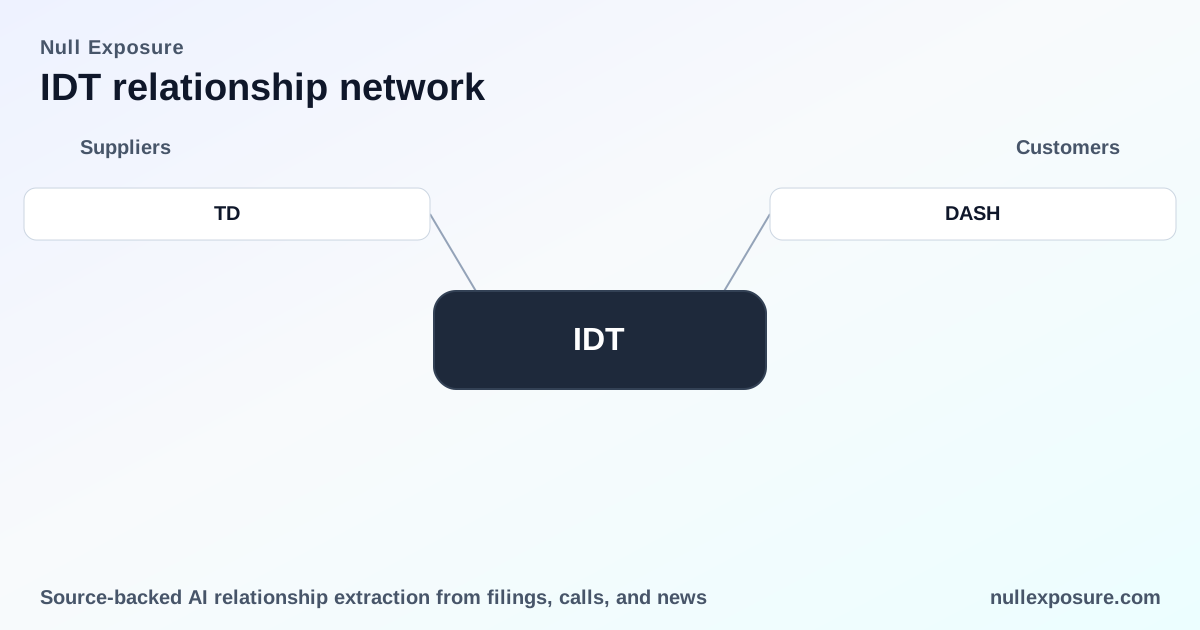
IDT Corporation: customer map, contract posture, and what relationships mean for investors
IDT is a diversified communications and payments company that monetizes through three core vectors: subscription and usage fees for cloud communications (net2phone), transaction and remittance fees for digital payments (BOSS Money / IDT Digital Payments), and hardware-plus-software POS deployments for small retailers (NRS). Revenue flows are a mix of recurring, per-seat subscription income and transaction-driven remittances and top-ups; this hybrid model creates both stable recurring cash flow and variable margin tied to transaction volumes. Learn more about how we surface these customer links at https://nullexposure.com/.
Why customer relationships drive the valuation story
Investors should view IDT’s top-line as the interplay of recurring cloud contracts and high-volume, low-margin payment flows. net2phone contributes subscription economics (per-seat monthly or annual billing) that lift revenue visibility and multiple expansion, while BOSS Money and IDT Digital Payments deliver scale and cash conversion from millions of remittances and mobile top-ups. The company reported Revenue TTM of roughly $1.26 billion and an Operating Margin around 8.8%, which reflect this split between steady SaaS-like income and payment-processing throughput.
- Subscription heft: net2phone’s billing model is predominantly monthly per-seat subscription revenue, which is recognized over service periods and often sold with monthly, annual, or multi-year terms.
- Transaction leverage: BOSS Money and Digital Payments generate high-frequency flows that scale gross profit but are sensitive to payout costs and network relationships.
- Hardware/software mix: NRS combines POS hardware sales with SaaS software plans and payment processing—creating mixed margin profiles and differing customer lifetime dynamics.
If you want a compact view of IDT customer relationships and their implications for revenue durability, visit https://nullexposure.com/ for our full coverage.
Operating-model signals investors should watch
Translate the company disclosures into investment signals: contracting posture is predominantly subscription with pockets of long-term customer commitments, geographic reach is global with North America concentration, and counterparty exposure is diversified across individual consumers and enterprises.
- Contracting posture: net2phone customers typically sign monthly to multi-year subscriptions, with initial service periods often between two and three years for certain enterprise clients (company disclosures on net2phone).
- Revenue concentration: no single customer accounted for more than 10% of consolidated revenue in FY2025, signaling low customer concentration risk at the consolidated level.
- Counterparty mix: IDT’s businesses sell both to individual consumers (remittances, prepaid customers) and to enterprise/mid-market customers (UCaaS/CCaaS, carriers); that diversity reduces single-sector exposure but enlarges operational complexity.
- Geography and scale: Payments and telephony traffic extend to more than 200 countries and BOSS Money reported broad remittance coverage, reinforcing cross-border payout and FX operational risk.
- Relationship roles: IDT acts predominantly as a seller/principal in most of its transactions, though it operates as an agent in specific payment flows where it does not control pricing or customer service responsibilities.
These signals point to a business with recurring revenue underpinned by transaction scale, limited customer concentration, and operational complexity from global payout networks.
Mapping each named customer or partner
Below I cover every relationship cited in the source set, with concise, plain-English takeaways and source notes.
SYBX (Synlogic) — a one-off supplier role in biotech work
IDT provided gene synthesis and codon-optimized DNA constructs used by Synlogic researchers, indicating IDT acted as a scientific reagent/service provider in that instance. According to a Nature Communications paper describing molecular methods (FY2020), IDT synthesized and subcloned several codon-optimized genes for the study (Nature Communications, 2020).
DoorDash (DASH) — integration partner for retail order flow
IDT began integrating select retailers with DoorDash in fiscal 2025, and management reported that retailers are seeing incremental orders from DoorDash, implying IDT is leveraging third-party delivery platforms to increase merchant throughput and revenue. This detail comes from IDT’s FY2025 Q4 earnings call transcript (March 2026).
GVC Networks LLC — buyer of legacy Winstar assets
IDT sold its Winstar subsidiaries (Winstar Communications, Winstar Government Solutions, and Winstar Wireless) to GVC Networks LLC, a transaction that removes legacy carrier assets from the IDT portfolio and crystallizes proceeds/exit economics. The sale was disclosed in a Light Reading news report covering the FY2023 divestiture (Light Reading, announcement).
Genie Energy (GNE) — intercompany or vendor receivable noted in filings
A Genie Energy filing referenced an amount "Due to IDT Corporation" (net 317,135), which signals a payable/receivable linkage between the two companies recorded in FY2025 filings. This item was highlighted in a QuiverQuant news aggregation of Genie Energy’s Q3 2025 report (QuiverQuant, FY2025).
What these relationships collectively tell investors
- Diversified counterparty exposure: IDT deals with a broad set of customers—consumers, enterprises, carriers, and third-party platforms—dampening the earnings risk of any single partner.
- Low concentration, high operational complexity: With no single customer >10% of revenue and global payout networks, the company trades concentration risk for operational execution risk across geographies and partners.
- Contracting profile supports recurring cash flow: Subscription and multi-year arrangements in net2phone establish revenue durability, while payments and POS sales inject variable margin and growth optionality.
- Strategic portfolio pruning: The Winstar sale to GVC Networks reduces legacy carrier exposure and clarifies management focus toward higher-growth communications and payments businesses.
Risk checklist for the investor model
- Execution risk on remittance networks: Global disbursement partners and payout locations drive volume but require careful liquidity and compliance management.
- Channel complexity: Distributors, resellers, and direct channels for IDT Digital Payments and NRS create margin pressure and integration friction.
- Revenue mix volatility: Transaction volumes and hardware sales introduce cyclicality versus the predictability of subscription revenue.
Bottom line and next steps
IDT’s revenue model combines the stability of subscription UCaaS revenues with the scale benefits—and operational volatility—of payment and POS businesses. For valuation, emphasize net2phone’s recurring cash flow while modeling remittances and hardware as growth variables with margin variability.
For a deeper read on customer concentration, contract terms, and operational signals that move the stock, visit https://nullexposure.com/ for our detailed company and relationship reports.