Ideaya Biosciences: partner-driven oncology growth and where the revenue comes from
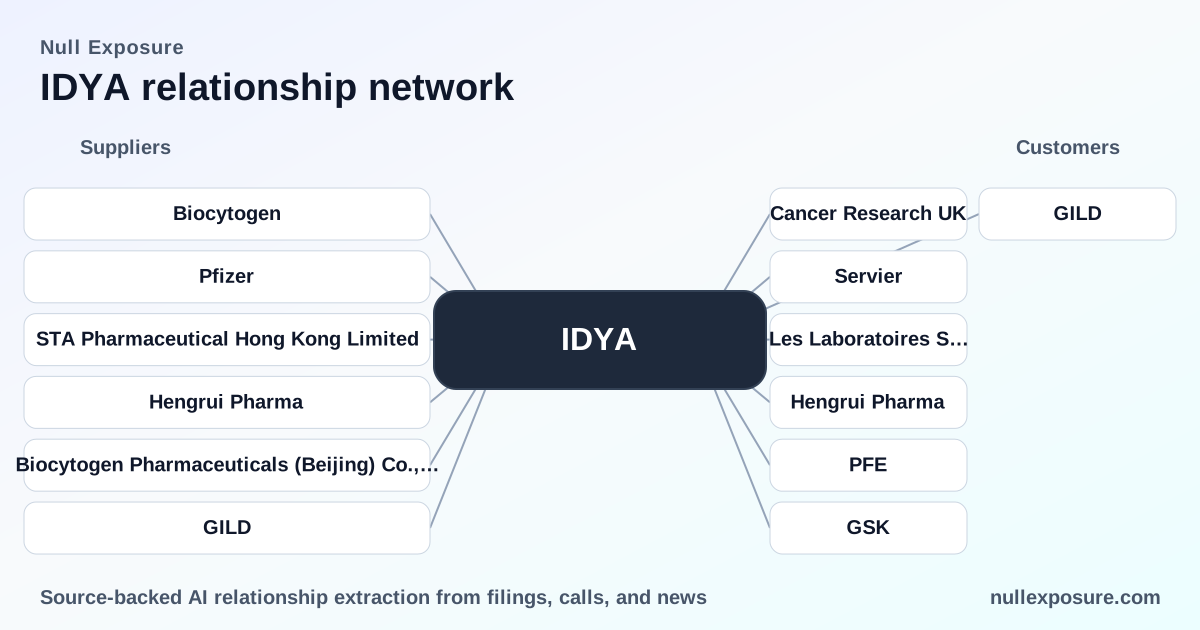
Ideaya is a precision oncology company that builds value by discovering targeted therapeutics and monetizing them through exclusive licenses and development collaborations with established pharmaceutical companies. The firm advances clinical-stage assets in-house while extracting non-dilutive capital and commercialization leverage from upfront license fees and milestone/collaboration revenue, creating a hybrid biotech model that mixes science-led value creation with partner-funded development. For a concise partner map and source-level readouts, see NullExposure’s coverage here: https://nullexposure.com/.
The investor thesis in one paragraph
Ideaya converts early-stage oncology programs into de-risking commercial value by signing exclusive licenses and development collaborations with large pharma — upfront payments and collaboration revenue are material to cash flow, while clinical readouts and registrational trials determine long-term upside. Recent large upfronts (notably for darovasertib and IDE849) have funded operations and shifted the company toward a partner-enabled commercialization model, where regulatory and market success of partnered assets will disproportionately drive Ideaya’s valuation.
How the partner map actually drives the P&L
Ideaya’s public disclosures show two cash-generative ingredients in the near term: upfront license fees and R&D services recognized over time under collaboration agreements. Financial results for FY2025–FY2026 reflect these mechanics—collaboration revenue recognition offsets operating cash burn, while upfront payments materially bolster the balance sheet. At the same time, Ideaya’s operating metrics (TTM revenue ~$218.7M, negative gross profit and operating margin) indicate a reliance on partner cash inflows to support ongoing clinical and CMC spend.
Partner-by-partner: what each relationship means for investors
-
Cancer Research UK
Ideaya holds an exclusive in‑license agreement with Cancer Research UK and the University of Manchester, and the company entered the Merck clinical trial collaboration and supply agreement to evaluate IDE161 with KEYTRUDA in endometrial cancer, positioning the program for clinical advancement supported by institutional licensing. This is documented in Ideaya’s 2024 Form 10‑K (FY2024). -
Servier / Les Laboratoires Servier
Servier signed an exclusive license for darovasertib outside the United States, and Ideaya recorded a $210 million upfront payment tied to that agreement, which significantly improved cash resources during the year ended December 31, 2025; Servier is the commercialization partner for darovasertib and will jointly announce key registrational toplines with Ideaya. These points are disclosed in the company’s FY2025 financial release and associated PR Newswire coverage (FY2026) and in subsequent trading and market reports referencing the Optimum‑02 trial (May 2026). -
Hengrui Pharma
Ideaya received a $75 million upfront payment under the license agreement for IDE849 with Hengrui Pharma (payment recorded in late‑2024), and subsequent periods reflect higher internal clinical and CMC spend to support the program as partner activity progresses, per Ideaya’s FY2025 financial report and PR Newswire commentary (reported in FY2026). -
Pfizer (PFE)
Ideaya lists Pfizer among established collaborators used to support clinical development and commercialization efforts, indicating ongoing strategic alliances that extend research and development bandwidth and commercial optionality; this is referenced in summaries of the company’s SEC filing and subsequent market reports (FY2026) that cite established collaboration lines. -
Gilead (GILD)
Gilead is noted alongside other large pharma partners in the company’s collaboration roster, supplying development support and external expertise that feed into Ideaya’s clinical programs and potential co-development pathways, as referenced in the company’s recent SEC filing summaries and market writeups (FY2026). -
GlaxoSmithKline (GSK)
GlaxoSmithKline notified Ideaya in December 2025 that it will terminate the 2020 collaboration and license agreement, returning the Werner Helicase (IDE275) and Pol Theta (IDE705) programs to Ideaya within approximately 90 days, restoring full program ownership and responsibility to Ideaya; this was reported in investor coverage and SimplyWall summaries (FY2025/FY2026).
(Each relationship summary above relies on Ideaya’s SEC disclosures and contemporaneous press and market reports: the company’s 2024 Form 10‑K, PR Newswire financial releases for the FY2025/FY2026 reporting cycle, and subsequent market coverage in March–May 2026.)
Commercial and financial implications investors should track
- Upfront cash is material and fungible: the $210M Servier and $75M Hengrui payments materially reduced financing pressure in FY2025–FY2026 and support near‑term program spend (PR Newswire, FY2026).
- Revenue recognition is timing‑sensitive: collaboration revenue reflects performance obligations satisfied over time under license agreements, so P&L and cash flow diverge depending on R&D delivery milestones and partner activity (quarterly and annual reports, FY2025–FY2026).
- Clinical readouts remain the value inflection points: registrational trials (e.g., darovasertib Optimum‑02) are primary drivers of upside or downside; market reports indicate joint announcements with Servier will move the needle (market coverage in May 2026).
For a concise partner risk map and transaction-level detail, visit NullExposure’s analysis hub: https://nullexposure.com/.
Contracts and operating model signals investors should monitor
Presenting these as company-level signals (not tied to any single disclosed constraint), Ideaya’s operating model demonstrates several clear characteristics:
- Contracting posture: ideation → in‑license or co‑develop → out‑license for commercialization; contracts include exclusive licenses and long-form collaboration agreements that deliver upfronts and shared R&D obligations.
- Concentration: a small number of large partner transactions (multi‑hundred million and tens of millions) provide outsized balance sheet impact, producing reliance on a handful of deals for near‑term liquidity.
- Criticality: partners assume significant commercialization responsibility outside Ideaya’s home market, making partner execution critical to value realization.
- Maturity profile: the portfolio mixes registrational‑stage assets and earlier programs; program returns or terminations (as with the GSK return) materially change Ideaya’s resource and time-to-market profile.
Key risks and what to watch next
- Clinical binary risk: registrational readouts control valuation volatility — positive toplines accelerate partner milestones and commercial value; negative results reverse momentum.
- Partner execution risk: market access and commercialization outside the U.S. depend on partner capabilities and timing; delays or strategic shifts at a partner will directly affect revenue timing.
- Concentration of upfronts: recent cash infusions are sizeable but episodic; continued runway depends on milestone realization, additional licensing events, or capital markets.
- Contract volatility: returning programs (GSK) illustrate that collaborations can be unwound, returning both opportunities and cost burdens to Ideaya.
Bottom line for investors and operators
Ideaya’s financial runway and near‑term valuation are materially shaped by the structure and timing of its collaboration agreements. The company’s strategy of converting clinical programs into licensed, partner‑led assets has produced significant upfront funding and reduced pure‑play commercialization exposure, but it also concentrates outcome risk on a few pivotal trials and partner actions. Operators should monitor milestone schedules, collaboration revenue recognition, and registrational trial readouts; investors should track partner announcements and quarterly disclosures for the timing of milestone recognition.
For the full partner map and transaction-level summaries that drive these conclusions, see NullExposure’s coverage at https://nullexposure.com/.