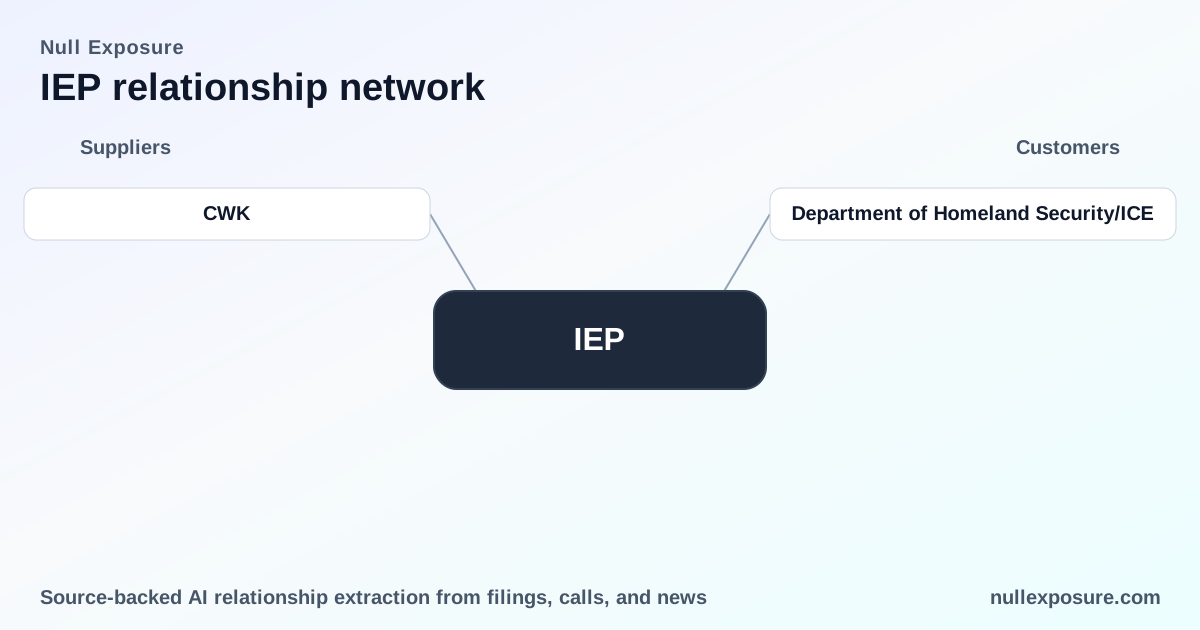
Icahn Enterprises (IEP) — Customer Relationships: an investor-oriented read
Icahn Enterprises is a diversified holding company that monetizes through operating subsidiaries across energy, manufacturing, automotive services, pharma and real estate. Revenue is generated by direct product sales (refined fuels, fertilizer, pharmaceutical products), services (automotive repair and aftermarket sales), and net-lease real estate income from owned commercial properties; the firm’s customer exposure therefore combines transactional, recurring service flows and long-duration lease cashflows. For quick access to relationship intelligence and comparable profiles, visit https://nullexposure.com/.
High-level thesis for investors
Icahn Enterprises’ customer base is structurally heterogeneous: it blends commodity-facing, volume-driven buyers in refining and fertilizer with higher-margin, service-oriented automotive customers and predictable cash from real-estate leases. That mix produces a portfolio of revenue profiles—commodity cyclicality offset by stable lease receipts and service-retention economics—while exposing the group to material concentration in key refining and partner segments and to geographic diversification dynamics driven by international manufacturing operations.
How IEP contracts with customers — a dual posture
Company disclosures present a dual contract posture that informs cash-flow predictability and counterparty risk:
- Long-term: Real estate holdings operate under long-term operating leases accounted for under ASC 842, producing stable, multi-year cashflows and tenant relationships. (Company filings, Real Estate & Automotive segment disclosures.)
- Short-term: Product sales that require prepayment are typically short-duration contracts where revenue is recognized at point of sale, producing higher turnover but lower contract visibility beyond immediate cycles. (Company filings on revenue recognition practices.)
These two contracting modes mean IEP’s cash flows combine lease-backed predictability with sales volatility inherent to commodity and retail/end-market exposure.
Geographic reach and operational footprint
Icahn Enterprises demonstrates both North American concentration and meaningful global manufacturing exposure:
- The majority of consolidated revenues are derived from customers in the United States, and multiple segments have large U.S.-centric footprints (including real estate, refineries and automotive retail/service locations). (Company filings.)
- At the same time, subsidiaries such as Viskase generate a majority of sales outside the U.S. and operate manufacturing facilities across North America, Europe, South America and Asia—a signal that IEP’s manufacturing cashflows are globally diversified. (Viskase sales and facility disclosures, FY2024.)
Investors should treat IEP as a primarily U.S.-revenue company with material global manufacturing operations that import foreign demand dynamics into consolidated results.
Concentration is real and measurable
Disclosed customer concentrations are material to segment profitability:
- The refining business reported a single top customer representing 13% of net sales for 2024, and the top two customers accounted for mid‑20s percentages in prior periods—evidence of commercial dependency in refining markets. (Company filings, Refining segment disclosures.)
- CVR Partners’ top customer represented 14% of net sales for 2024, with the top two customers accounting for roughly a quarter to a third of sales historically—again highlighting counterparty concentration in certain industrial lines. (CVR Partners, FY2024 disclosures.)
Key takeaway: concentration in refining and related industrial customers elevates counterparty and pricing risk; investors must monitor customer portfolio shifts and contract renewals closely.
Roles across the value chain — manufacturer, service provider and reseller
Icahn Enterprises operates in multiple commercial roles, reflected in its disclosures:
- Manufacturer: Energy and fertilizer operations are described as manufacturing businesses; pharma sells products directly to customers and wholesalers. (Energy and Pharma segment disclosures.)
- Service provider: Automotive operations deliver repair and maintenance services with revenue recognized on completion, creating recurring transactional relationships. (Automotive segment disclosures.)
- Reseller / seller / buyer: The refining business sells into channels that include retailers, railroads and farm cooperatives; pharma recognizes supply revenue on a gross basis as the principal in arrangements. (Refining and Pharma disclosures.)
This multi-role posture increases operational complexity but also creates multiple revenue levers—manufacturing margins, service retention and lease income—that together determine consolidated earnings variability.
Relationship inventory — Department of Homeland Security / ICE
A local news report dated March 10, 2026, documents that the Department of Homeland Security / ICE is proposing to purchase, occupy and rehabilitate a warehouse property at 29 Elizabeth Drive, Chester, NY in support of ICE operations; the article connects the transaction to property holdings tied to investor interests. (The Chronicle, March 10, 2026: “warehouse tied to investor Carl Icahn”.)
This item signals a potential direct institutional counterparty to IEP-affiliated real estate assets and is relevant for lease/sale pipeline assessment and tenant mix analysis.
Operational constraints and what they imply for investors
Several company-level signals in filings shape how investors should underwrite customer risk:
- Contract duration mix: The coexistence of long-term net leases and short-term prepayment sales balances cash-flow stability with cyclical sales sensitivity—portfolio-level underwriting must weight both.
- Segment maturity and criticality: Manufacturing (energy, fertilizer, pharma) and services (automotive) have different capital cycles and customer stickiness; real estate is a lower-frequency, longer-duration cash contributor.
- Concentration risk: Segment-level customer concentration metrics indicate that a small number of counterparties can materially move segment revenue; stress-testing should incorporate loss of a top customer or margin compression in refining.
- Geographic split: Global manufacturing revenue (notably Viskase) offsets U.S. revenue concentration but introduces FX, trade and regional demand risks.
These constraints are company-level signals that shape credit exposure, covenant sizing and valuation multiples for operating subsidiaries and the G.P./limited-partner structure.
Investment implications and monitoring checklist
For investors and operators evaluating IEP customer relationships, prioritize these monitoring items:
- Track renewal and negotiation timelines for top refining and fertilizer customers; top-customer churn is an outsized earnings risk.
- Monitor vacancy and leasing activity across the eight U.S. commercial properties and any large-sale pipeline that could impact recurring lease income.
- Watch activity at manufacturing subsidiaries with significant non-U.S. sales (e.g., Viskase) for demand shifts and supply-chain stresses.
- Evaluate automotive services’ same-store/service revenue trends and parts margin trajectory for stability of service cashflows.
For a full comparative view across portfolios and more structured relationship mapping, see additional analysis at https://nullexposure.com/.
Bottom line
Icahn Enterprises combines stable, long-term lease cashflows with cyclical, volume-exposed manufacturing and service revenues. Concentration in a handful of industrial customers and the mixed contract posture are the two principal risk levers investors must underwrite. Active monitoring of top-customer contracts, real estate tenant activity and international manufacturing demand will drive near-term valuation sensitivity and credit assessments.