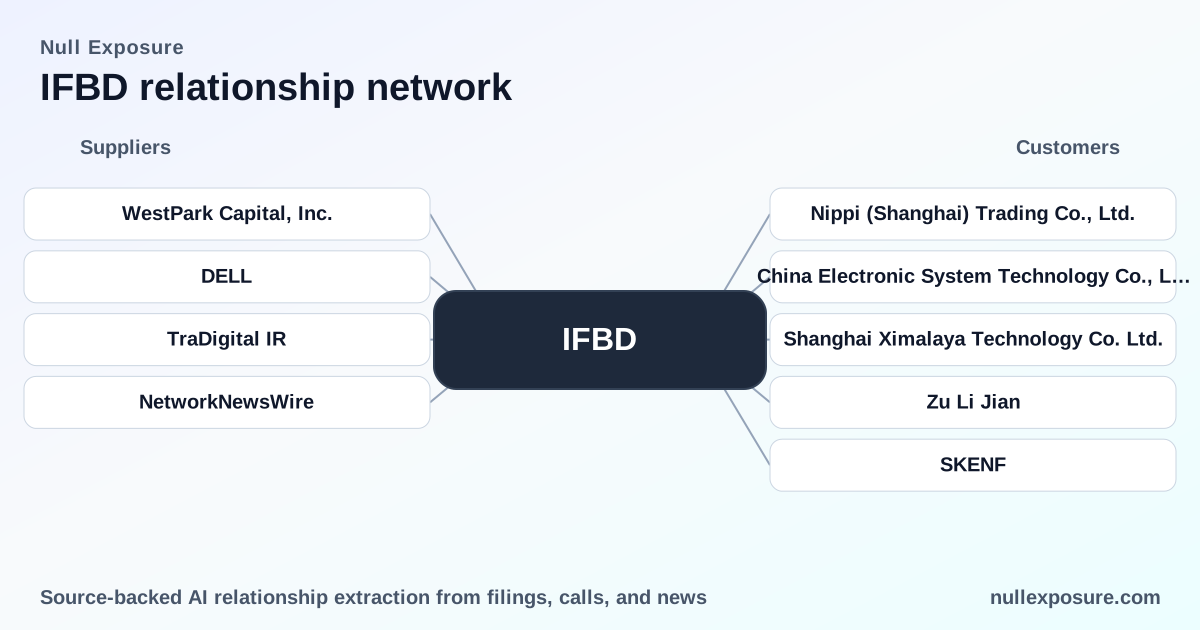
Infobird (IFBD): Customer relationships that drive an AI SaaS customer-engagement platform
Infobird is a Beijing-headquartered AI-enabled SaaS provider of customer interaction and digital marketing solutions that monetizes through recurring software subscriptions, deployment and integration services, and project-based digital marketing work with retail and enterprise clients. Its revenue base leans on commercial contracts with consumer brands and technology partners that embed Infobird’s conversational AI, cloud communications and analytics into front-office workflows. For a concise research gateway, visit https://nullexposure.com/.
How Infobird sells value and where the money comes from
Infobird packages cloud-native customer engagement products—IVR, chatbots, voice AI, analytics and campaign optimization—into subscription and services contracts sold to retailers, consumer brands and institutional partners. The company reported RevenueTTM of 8.7067 million and GrossProfitTTM of 2.5685 million, while operating margins are negative, reflecting ongoing investment in product and go-to-market. These financials underline a recurring-revenue model under pressure from profitability headwinds: the business scales through customer wins but requires careful customer concentration and contract-management oversight to convert growth into durable margins.
Customer relationships that create the revenue map
Below I summarize every relationship flagged in the available results, with the source context and fiscal period noted so an investor can follow primary references.
Nippi (Shanghai) Trading Co., Ltd. — FY2022
Infobird provided digital marketing services to Nippi (Shanghai), a subsidiary of Japan’s Nippi, indicating direct marketing and campaign services sold to multinational trading affiliates. The engagement was reported in an askTraders note on March 10, 2026 (https://www.asktraders.com/analysis/heres-why-infobird-ifbd-stock-rallied-24-today-despite-a-lack-of-news/), citing FY2022 activity.
China Electronic System Technology Co., Ltd. (CESTC) — FY2021
Infobird signed an ecological partnership to deliver technology, products and solution support for CESTC’s broader digital-economy initiatives, a clear signal of strategic cooperation with a large state-affiliated systems integrator. This partnership was publicized in a GlobeNewswire release dated May 20, 2021 (https://www.globenewswire.com/news-release/2021/05/20/2233659/0/en/Infobird-and-CESTC-Reach-Ecological-Partnership-Agreement-To-Jointly-Promote-Digital-Economy-Development.html).
Zu Li Jian — FY2021
Infobird’s retail/consumer product solutions were applied at Zu Li Jian, a domestic footwear brand serving older consumers, showing vertical penetration into specialty retail segments where service and loyalty programs matter. The client mention appears in an Accesswire release summarizing a client launch in August 2021 (https://markets.financialcontent.com/stocks/article/accesswire-2021-8-3-infobird-announces-successful-client-launch-with-a-global-leading-retail-brand?Language=english).
Shanghai Ximalaya Technology Co. Ltd. — FY2021
Infobird deployed an “Intelligent Interactive Training Solution” for Shanghai Ximalaya to upgrade the customer experience in the online audio economy, demonstrating product application in digital media and content platforms. The engagement was disclosed in a PR News Asia release reporting an equity-transfer agreement and deployment details (https://enmobile.prnasia.com/releases/global/infobird-enters-into-equity-transfer-agreement-with-shanghai-qishuo-to-further-expand-its-standardized-saas-in-the-consumer-products-and-retail-industry-346819.shtml).
SaSa — FY2021
Infobird lists SaSa, a Hong Kong beauty retailer, among clients using its retail and consumer-product solutions, reflecting adoption by regional omnichannel retailers that require customer engagement and campaign automation. The relationship is cited in the same August 2021 client-launch communications on Accesswire and related outlets (https://markets.financialcontent.com/worldnow.katv/article/accesswire-2021-8-3-infobird-announces-successful-client-launch-with-a-global-leading-retail-brand and https://markets.financialcontent.com/stocks/article/accesswire-2021-8-3-infobird-announces-successful-client-launch-with-a-global-leading-retail-brand?Language=english).
SKENF — FY2021
SKENF appears in distribution of the same client-launch commentary where SaSa and Zu Li Jian are named, implying either a reporting alias or a linked regional ticker for retail clients mentioned in public releases; the underlying point is Infobird’s foothold in retail customer engagement projects reported in August 2021 (https://markets.financialcontent.com/worldnow.katv/article/accesswire-2021-8-3-infobird-announces-successful-client-launch-with-a-global-leading-retail-brand).
What these relationships say about Infobird’s operating model
These customer ties form a coherent commercial pattern: enterprise and brand engagements across retail, consumer goods and digital media, with at least one strategic technology partnership with a large systems integrator (CESTC). That mix implies specific operating characteristics investors should evaluate:
- Contracting posture: Infobird combines recurring SaaS contracts with project-based professional services and marketing engagements, producing a hybrid revenue mix that requires sales and delivery capacity at scale.
- Customer concentration and vertical focus: Multiple references to retail and consumer brands point to vertical concentration; this is beneficial for product specialization but increases exposure to retail cyclicality and client retention risk.
- Criticality: Solutions address front-line customer interactions and campaign performance—functions that are operationally critical to clients and therefore support retention if performance and integration deliver.
- Maturity of relationships: Public partnerships and client launches date back to 2021, indicating multi-year commercial traction rather than one-off pilots.
For deeper platform-level signals and competitive mapping, review additional research at https://nullexposure.com/ (research hub).
Constraints and company-level signals
There are no explicit constraints listed in the supplied relationship data. As a company-level signal, that absence requires discipline in due diligence: no disclosed contractual constraints does not equate to no risk. Investors should assess standard commercial diligence points—contract lengths, renewal rates, concentration by revenue, and dependency on a small number of integration partners or channels. Financials point to growth in revenue but negative operating margins, so the governance around customer acquisition cost and retention mechanics is essential.
Bottom line for investors
Infobird’s public customer relationships show a repeatable go-to-market in retail and consumer brands plus partnerships with larger institutional integrators, which supports the core SaaS recurring-revenue thesis. Primary risks center on retail concentration, margin conversion and the company’s ability to convert client deployments into steady subscription revenue. Monitor renewals, contract terms and any new anchor accounts or state-level partnerships that materially change concentration or competitive positioning.
For a quick gateway to expanded coverage and to track updates on IFBD relationships, visit https://nullexposure.com/.