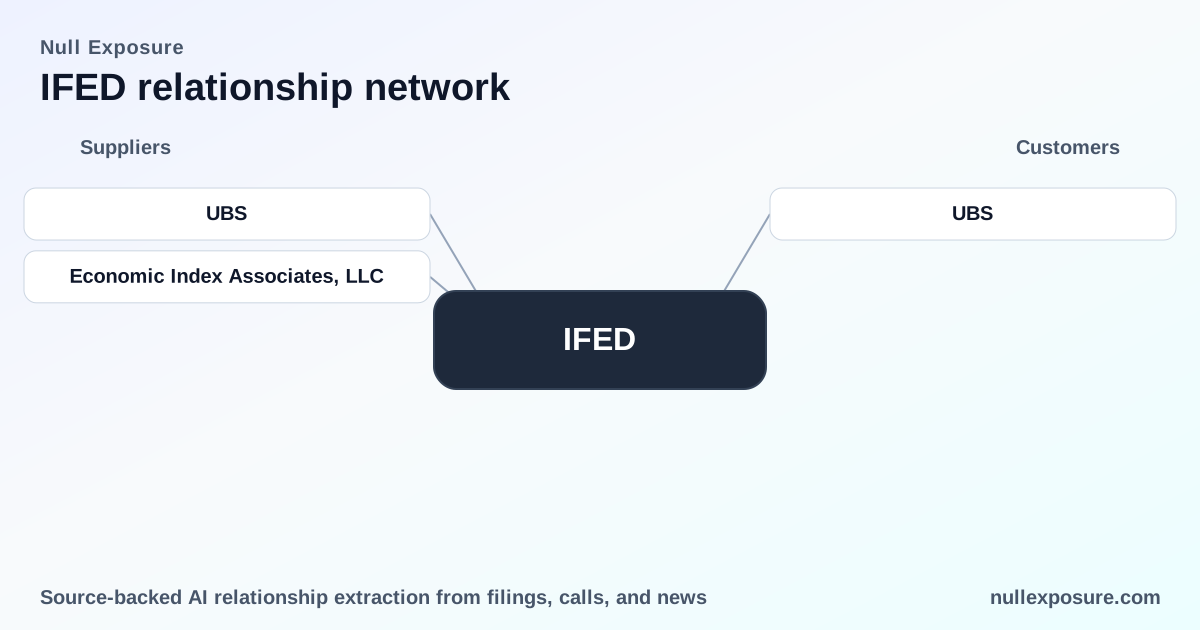
IFED: Index licensing revenue anchored by ETN partnerships with UBS
IFED operates as an index owner and licensing counterparty: it creates the IFED Large‑Cap US Equity Index TR and monetizes that intellectual property by licensing the index to structured‑product issuers and exchanges that build ETNs and similar instruments. Revenue is driven by licensing and data‑use fees contracted with financial institutions; product partnership concentration is a material commercial characteristic. Learn more about how we track these relationships at https://nullexposure.com/.
Market signal set for IFED is narrow and issuer‑focused: the documents in scope show repeated partnerships with UBS (and its Investment Bank arm) dating to 2021 and activity through a 2024 ETN redemption notice. For investors evaluating IFED as a licensing business, the UBS relationship is the primary observable commercial channel and therefore the key revenue and concentration risk to model.
What the relationship map tells investors about IFED’s operating model
IFED’s commercial posture is that of a licensor to institutional issuers rather than a retail product distributor. That contracting posture implies:
- Concentration risk: Public records in this sample show UBS and its Investment Bank as the only named licensee/issuer, creating a single‑partner revenue exposure in observed disclosures.
- Criticality: The index function is critical to the economics of linked ETNs; termination or redemption of products can materially change recurring licensing and usage fees.
- Maturity: The relationship has multi‑year history—initial ETN listings in 2021 and redemption actions recorded in 2024—indicating the commercial link evolved from product launches to lifecycle events. These are company‑level signals derived from the relationship set; no contract excerpts in the results explicitly name additional counterparties.
Key takeaway
IFED’s commercial viability depends on a small number of institutional distribution partners; UBS is the observable anchor. That concentration creates both upside—stable, deep distribution when relationships hold—and downside—material revenue volatility if primary issuers exit or redeem linked products.
Document‑level relationship log (each result in the record)
-
UBS AG — redemption notice (FY2024). A UBS press release distributed via FinancialContent on November 20, 2024 announced the redemption of seven UBS‑issued ETNs, including the FEDL ETRACS 2x Leveraged IFED Invest with the FED TR Index ETN due 2061, signaling lifecycle management of IFED‑linked products. Source: FinancialContent / BizWire press release, 20 Nov 2024 (FY2024).
-
UBS — ETN launches (FY2021). UBS Investment Bank announced on September 20, 2021 the listing of two new ETNs linked to the IFED Large‑Cap US Equity Index TR, demonstrating initial product adoption of IFED’s index by a major issuer. Source: FinancialContent / BizWire press release, 20 Sep 2021 (FY2021).
-
UBS Investment Bank — ETN launches (FY2021). The UBS Investment Bank unit publicly listed two ETNs that reference the IFED index on September 20, 2021, confirming the bank’s role as the structured‑product sponsor using IFED’s index. Source: FinancialContent / BizWire press release, 20 Sep 2021 (FY2021).
-
UBS — ETN listing detail (FY2021). A WorkBoat‑hosted copy of the same September 20, 2021 BizWire announcements reiterates that UBS listed two ETNs tied to the IFED Large‑Cap US Equity Index TR, reinforcing the 2021 product launch as a documented commercial event. Source: WorkBoat reprint of BizWire, 20 Sep 2021 (FY2021).
-
UBS Investment Bank — ETN listing detail (FY2021). WorkBoat also carried the UBS Investment Bank announcement of the two IFED‑linked ETNs on September 20, 2021, underlining the Investment Bank’s sponsorship role in issuing index‑linked securities. Source: WorkBoat reprint of BizWire, 20 Sep 2021 (FY2021).
-
UBS — ETN redemption notice (FY2024). A WorkBoat reprint of the November 20, 2024 redemption announcement lists specific ETNs being redeemed, including an IFED‑linked leveraged ETN, which indicates post‑launch lifecycle activity for IFED‑linked products. Source: WorkBoat reprint of BizWire, 20 Nov 2024 (FY2024).
-
UBS AG — redemption notice (FY2024). A WSS/FinancialContent posting of the November 2024 notice repeats UBS AG’s decision to redeem the named ETNs, making the redemption a broadly distributed public filing and a material event for product economics tied to IFED. Source: FinancialContent / BizWire reprint, 20 Nov 2024 (FY2024).
-
UBS — ETN launches (FY2021). WSS carried the September 20, 2021 BizWire announcement that UBS listed two ETNs tracking the IFED Large‑Cap US Equity Index TR, providing another publication channel for the original launch disclosure. Source: WSS reprint of BizWire, 20 Sep 2021 (FY2021).
-
UBS Investment Bank — ETN launches (FY2021). WSS also reproduced the UBS Investment Bank notice about the IFED‑linked ETNs on September 20, 2021, corroborating UBS Investment Bank’s role across multiple press channels. Source: WSS reprint of BizWire, 20 Sep 2021 (FY2021).
-
UBS AG — redemption notice (FY2024). Markets.FinancialContent and MinsterCommunityPost distributed the November 20, 2024 UBS redemption release, again listing the FEDL ETRACS leveraged IFED ETN among the securities to be redeemed and confirming the product lifecycle action. Source: Markets.FinancialContent / BizWire, 20 Nov 2024 (FY2024).
Commercial implications for investors and operators
- Revenue concentration is the primary risk vector. Publicly visible commercial activity centers on UBS as the issuer of IFED‑linked ETNs; model IFED revenues accordingly with a high single‑counterparty weight and stress test for product redemptions.
- Product lifecycle management matters. Launches in 2021 and redemptions in 2024 show that licensing income is episodic and tied to issuer product decisions rather than purely recurring subscription economics.
- Contracting posture favors licensing + distribution agreements. IFED’s monetization profile is consistent with index owners that license benchmarks to banks and sponsors; legal and commercial terms with those sponsors determine renewal cadence and fees.
Risk checklist investors should factor into valuation
- Counterparty concentration (UBS is the only visible issuer in these records).
- Exposure to issuer product lifecycle decisions (redemptions directly reduce fee-bearing products).
- Visibility limits: public press distribution gives event dates but not fee schedules or contract terms.
For ongoing monitoring of IFED’s counterparty footprint and to see how this relationship set evolves, visit our platform at https://nullexposure.com/.
Bold final point: IFED’s near‑term cashflow profile is highly correlated with the behavior of a small set of structured‑product issuers; UBS is the observable anchor and the central commercial risk or opportunity for investors.