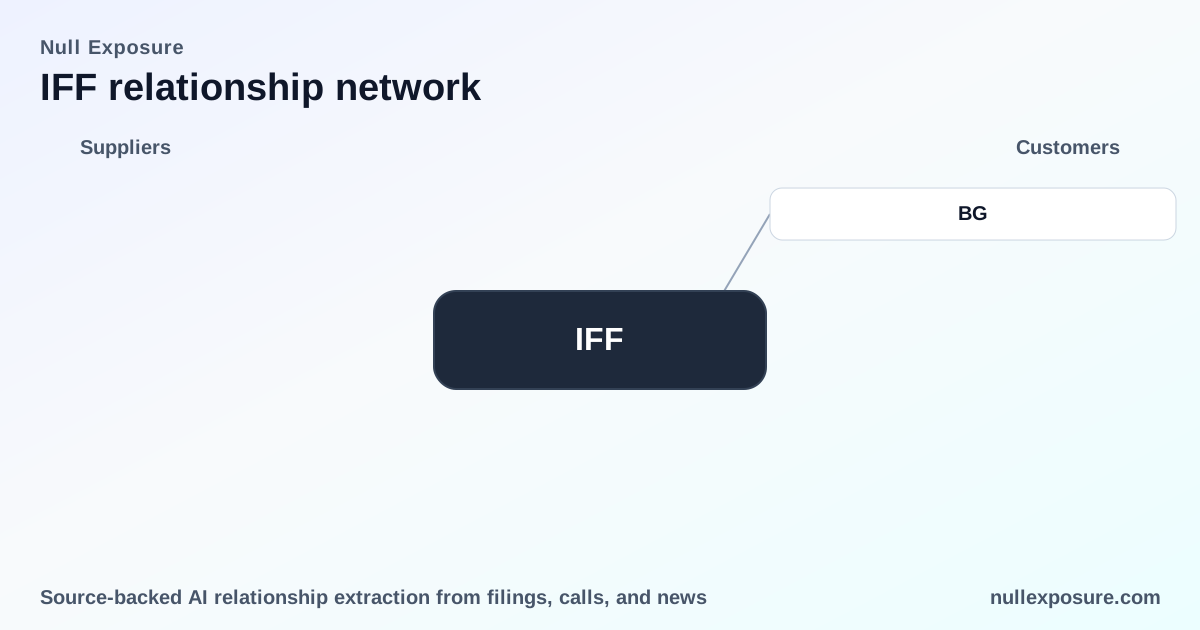
IFF customer map: what recent divestitures mean for revenue quality and counterparty risk
International Flavors & Fragrances (IFF) manufactures flavors, fragrances and cosmetic actives and monetizes primarily by selling formulated ingredients and development services to consumer packaged goods and personal care manufacturers worldwide. Revenue derives from a mix of bulk commodity-derived ingredients and higher-margin formulation and creative services, sold to a broad customer base that includes large multinationals and many small and mid-sized companies. Learn more about coverage and signals at https://nullexposure.com/.
Strategic divestitures are reshaping the customer footprint
IFF has been actively simplifying its portfolio, selling lower-margin commodity businesses and retaining its higher-value flavor and fragrance capabilities. The sale of soy protein concentrate, lecithin and soy-crush assets transfers a set of commodity relationships away from IFF, reducing exposure to large-volume industrial customers while concentrating the company on core CPG and beauty accounts. This is a deliberate repositioning toward higher-margin, relationship-driven work that depends on being on strategic suppliers lists of global customers.
Bunge (BG): buyer of soy protein, lecithin and crush assets
Bunge completed acquisition of IFF’s soy protein concentrate, lecithin and soy crush businesses in early March 2026, taking ownership of those manufacturing operations and the related commercial relationships. According to a March 2, 2026 press release and trade coverage, the transaction closed and Bunge has taken over those product lines and customers formerly supplied by IFF. (BizWire / World-Grain, March 2, 2026)
- Implication: The divestiture reduces IFF’s commodity-processing exposure and shrinks the pool of bulk-protein customers on IFF’s books, while concentrating remaining revenue on flavors, fragrances and active ingredients that rely on strategic supplier status. (Marketscreener / InsiderMonkey reporting March 2026)
COTY: creative/perfumery client relationships in beauty
IFF continues to supply and collaborate with fragrance houses and brand owners in the beauty sector; trade reporting noted that fashion and beauty clients such as Coty engage perfumers and fragrance suppliers including IFF for high-concentration, creative formulations. A WWD profile from 2026 described Coty working with perfumers at suppliers such as IFF to develop bespoke fragrance compositions. (WWD, 2026)
- Implication: Beauty accounts remain a strategic revenue stream and a source of higher-margin, formulation-led work that depends on creative talent and proprietary formulations rather than commodity scale.
What the customer constraints tell investors about operating posture
The company disclosures and evidence point to several characteristics of IFF’s customer base and contracting posture that are material to credit and equity investors:
-
High breadth with small-account skew. After the N&B transaction, IFF reported roughly 18,300 customers based on 2024 sales, with approximately 67% small and mid-sized companies, indicating a retail/SMB-heavy tail that supports diversified revenue but increases account management and working-capital complexity. (Company filing, 2024 sales disclosure)
-
Significant concentration among large customers. The top 25 customers — primarily multinational consumer products companies — accounted for about 33% of sales in 2024, a meaningful concentration that creates negotiation leverage for a small number of global buyers and makes revenue sensitive to retention at that tier. (Company filing disclosures)
-
Global footprint with regional balance. Net sales are spread across North America, EMEA, Greater Asia and Latin America, with 2024 reported areas showing North America $3,440m, EMEA $3,840m, Greater Asia $2,731m, Latin America $1,473m, and U.S. sales roughly 28% of the total; no single country exceeds 10% of sales. This supports geographic diversification while leaving some exposure to regional economic cycles. (Net sales by geographic area, 2024)
-
Mixed counterparty mix by size and role. Evidence supports a customer base spanning small business, mid-market and large enterprise buyers, and IFF operates both as a manufacturer/seller of ingredients and as a strategic supplier on many core customer lists — a dual role that combines transactional sales with relationship-driven opportunities.
-
Service transition commitments after disposals. For divestitures the company has entered transition services agreements to provide accounting, IT and other services for limited periods (up to 19 months), which has generated modest transition income historically; these arrangements indicate a controlled unwind of operational ties rather than sudden contract termination. (Transition services disclosures, fiscal years 2023–2022)
How these signals affect credit and operational risk
The combination of a high-volume base of small customers and a concentrated set of large customers produces a two-tier risk profile: resilience from diversification across thousands of small buyers, paired with headline sensitivity to the loss or contract renegotiation with top multinationals. The pivot away from commodity soy processing reduces exposure to low-margin, cyclical commodity markets but also transfers the working-capital footprint and contract risk to buyers such as Bunge.
- Credit angle: Reduced commodity exposure should improve margin stability and EBITDA quality over time; however, the top-25 concentration keeps covenant and revenue risk focused on a small set of counterparties.
- Operational angle: Transition service agreements and divestiture proceeds are evidence of orderly separation, lowering integration risk for the retained business but requiring active supplier-list management to protect access to strategic customers.
Bottom line for investors and operators
IFF is repositioning into higher-value, relationship-driven flavor and fragrance work while shedding commodity processing lines to buyers like Bunge. Investors should view the portfolio simplification as a constructive margin-preservation step, balanced against concentration among large clients and a very large number of small and mid-sized accounts that complicate working capital. Operators should prioritize retaining core supplier status with multinational CPG and beauty clients and ensure that post-divestiture service agreements are executed without friction.
If you want a concise, sourced map of IFF’s customer relationships and divestiture impacts, visit https://nullexposure.com/ for the full signal set and company-level constraints analysis.
Acknowledgements: press releases and trade coverage (BizWire, World-Grain, Marketscreener), earnings-call recaps and reporting (InsiderMonkey, Finviz), and industry trade press (WWD, 2026).