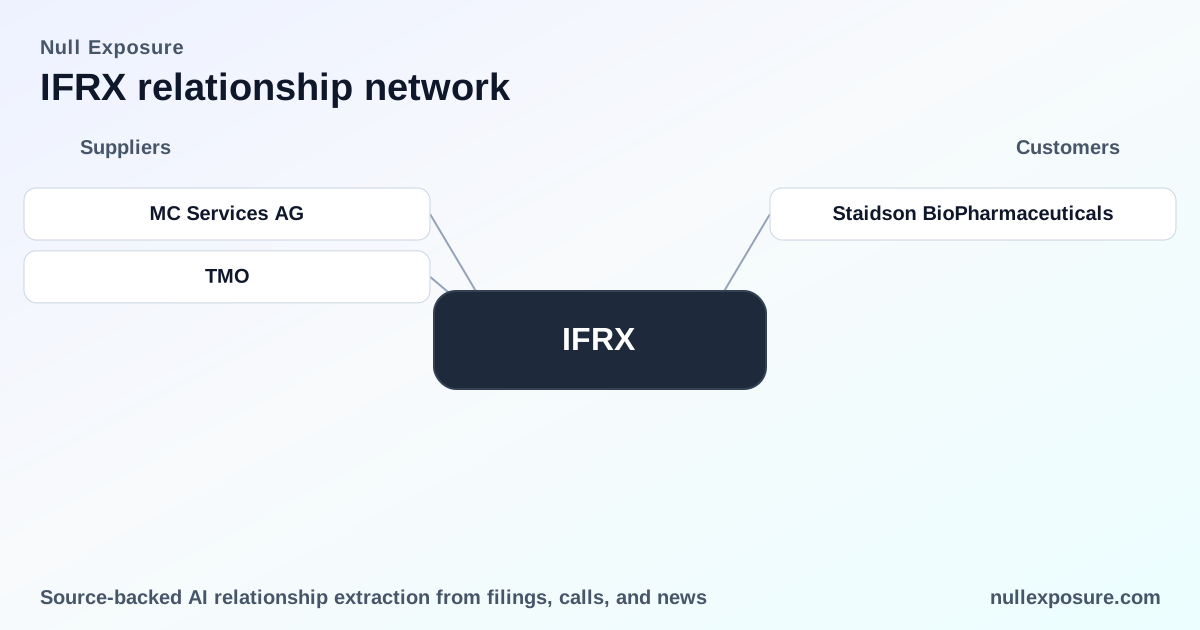
InflaRx (IFRX): Royalty-Driven Clinical Biotech with Concentrated Partner Exposure
InflaRx develops inhibitors targeting the complement C5a pathway and monetizes primarily through co-development partnerships and royalty streams tied to partnered products, while pursuing internal clinical programs that can convert into future product revenue. The company is clinical-stage, generates negligible commercial revenue today, and relies on partner-led manufacturing and regional licensing to extract value from its vilobelimab technology. For contract- and relationship-level intelligence on InflaRx, see the NullExposure homepage: https://nullexposure.com/
Thesis — why relationships matter more than headline financials
InflaRx’s enterprise value is driven by the optionality embedded in a small number of clinical assets and partner licenses, not by current sales. With Revenue TTM of roughly $29k against persistent operating losses (EBITDA -$48.2M) and a market capitalization near $154M, investor returns will come from successful clinical readouts or from royalty-bearing partner commercialization rather than steady organic revenue. Partnerships that place manufacturing or regional rights in third parties convert science into scalable economics while shifting capital and execution risk off InflaRx’s balance sheet.
All reported customer relationships and what they mean
Below I cover every customer/partner relationship returned in the review dataset.
Staidson BioPharmaceuticals — China co-development and royalty rights
Under a China co-development agreement, InflaRx granted Staidson the right to use the vilobelimab cell line to develop and manufacture the anti-C5a antibody BDB-001, and InflaRx is contractually entitled to royalties on net sales of Staidson products containing BDB-001, including mid-single-digit percentage royalties on future sales in AAV. A QuiverQuant news release reported these terms in March 2026. (QuiverQuant, March 10, 2026)
What the Staidson deal concretely changes for InflaRx
The Staidson arrangement converts intellectual property into a predictable, royalty-based upside in China while outsourcing biologics production and regulatory execution locally. That structure reduces InflaRx’s manufacturing and commercialization capital requirements in the Chinese market and creates a non-dilutive revenue lever tied to partner sales. The royalty percentages described are modest but meaningful for a company with essentially no current product revenue. (QuiverQuant, March 2026)
Operating model and corporate constraints — company-level signals
No external constraint records were returned in the relationship review, so contract-level constraints are not available for further parsing. Present company-level signals, however, shape how investors should view InflaRx:
- Contracting posture: InflaRx pursues co-development and licensing arrangements that transfer manufacturing and regional commercialization responsibilities to partners while retaining royalty and milestone economics.
- Revenue concentration: The business shows extreme concentration — current cash flows depend on a handful of partner agreements and outcome-driven milestones rather than diversified product sales.
- Criticality and maturity: InflaRx is clinical-stage and early in commercial maturity; its revenue profile is nascent and dependent on partner execution and clinical development outcomes.
- Counterparty reliance: Given the company’s outsourcing of manufacturing and market entry, partner stability and regulatory success in local jurisdictions are critical to any realized royalty stream.
These signals position InflaRx as a low-revenue, high-binary-return biotech whose valuation is determined by partner-triggered commercialization events and clinical data.
Financial posture and market bearings
Key financial signals that inform a risk/return assessment:
- Market capitalization: ~$154M.
- Revenue: $29k (TTM) — effectively de minimis commercial revenue.
- Profitability: EBITDA: -$48.2M, reflecting ongoing R&D and operating burn.
- Valuation multiples: Extremely stretched relative to revenue — P/S ~5,249x — reflecting a pure optionality play rather than operating earnings.
- Ownership: Insiders hold ~6% and institutions ~27%, indicating some professional investor interest but limited institutional footprint.
Analyst coverage tilts positive (consensus target ~$8.57 with more Buys than Holds); that view presumes successful clinical progression or constructive partner commercialization. InflaRx’s balance sheet and cash run-rate must be monitored for dilution risk ahead of late-stage readouts or partner milestone payments.
Catalysts, risks, and what to watch next
Key near- and medium-term items that will reprice InflaRx’s equity:
- Upcoming clinical data readouts for internal programs and partnered assets that will determine valuation jumps or re-ratings.
- Royalty receipts from partners like Staidson that convert pre-commercial arrangements into revenue; timing of first sales will materially affect liquidity and valuation.
- Partner execution risk in regulatory approvals and manufacturing scale-up in regions where rights were licensed.
- Financing/dilution risk if the company requires capital to advance internal programs before realizing partner revenues.
Investor checklist:
- Confirm milestone and royalty payment timing in partner agreements.
- Monitor cash runway and financing announcements.
- Track partner regulatory filings and manufacturing scale milestones in China and other licensed territories.
For focused contract-level signals and to map counterparties to revenue timing, NullExposure provides structured relationship intelligence: https://nullexposure.com/
Bottom line
InflaRx is a classic clinical-stage biopharma investment: value is concentrated in a few assets and in the company’s ability to convert partnerships into royalties and milestones. The Staidson agreement is an example of InflaRx’s commercial playbook — transfer execution risk to partners, retain royalty economics, and de-risk capital intensity. Investors should treat IF R X as a binary, partner-dependent exposure where upside is significant if clinical and regulatory pathways succeed, and downside is defined by continued operating losses and the timing of partner commercialization.