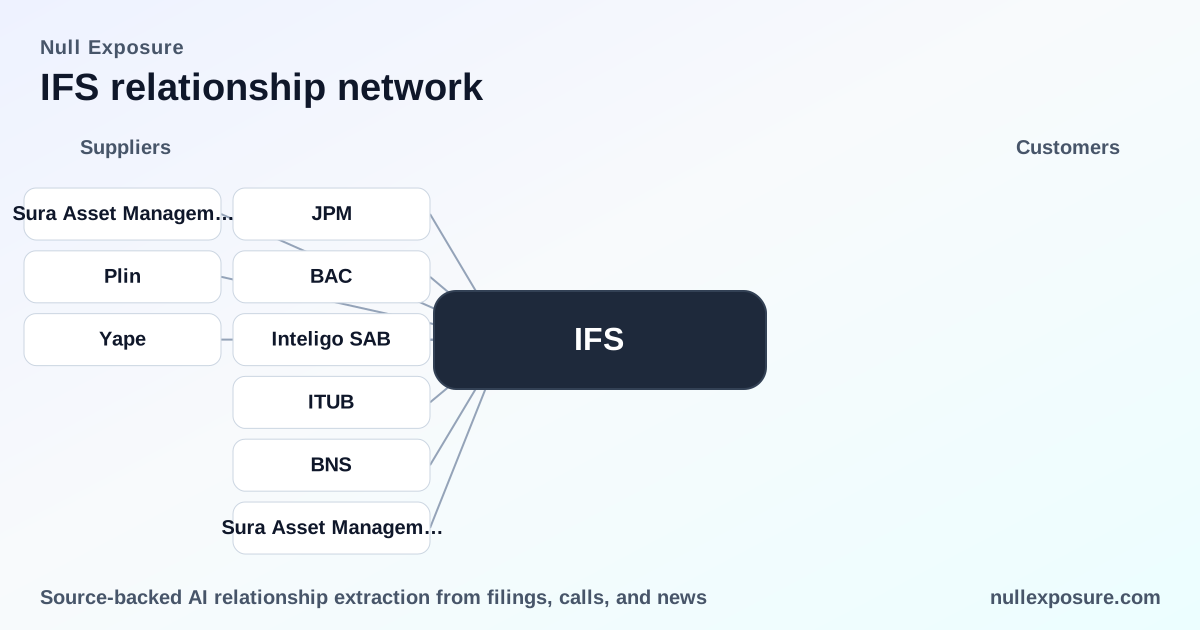
Intercorp Financial Services (IFS): Customer Relationships, Commercial Footprint, and the Chelsea Deal
Intercorp Financial Services monetizes a Peruvian retail and commercial banking franchise through interest income, insurance premiums, and wealth-management fees, augmented by cross-sell of financial products across a large retail client base. The company generates scale from deposit funding and loan origination while capturing fee revenue from insurance and asset-management services; its public-market valuation reflects an efficient regional bank with FY2026 revenues near $5.50 billion and a trailing P/E of 9.3. For investors and operators, the critical lens is how customer relationships—both traditional banking clients and marketing/partnership arrangements—translate into durable revenue and brand lift. For deeper customer intelligence visit https://nullexposure.com/.
Business model and monetization: Intercorp runs an integrated financial-services platform in Peru that collects deposits, extends credit, underwrites insurance, and manages client assets; revenue per share is $49.21 and profit margins are strong at 35.1%, signaling profitable core operations. The company trades with a price-to-book of 1.41 and delivers return on equity of 16.6%, consistent with a mature regional bank capturing pricing power in its home market. Ownership is concentrated—insiders hold roughly 73%—which produces a stable strategic posture but reduces float and can amplify governance and liquidity dynamics.
How customer relationships feed the model
Intercorp’s economics depend on two relationship vectors: transactional financial customers (depositors, borrowers, insurance policyholders) that generate recurring interest and fee income, and strategic brand relationships that extend customer acquisition and retention. Traditional customers deliver predictable net interest margin and fee flows; marketing partnerships serve as distribution and brand-amplification tools that can accelerate retail customer acquisition at scale, especially in consumer banking segments where trust and recognition matter.
Chelsea Football Club — headline relationship
Chelsea Football Club selected IFS as a principal partner for brand and commercial activities, a move announced in market news on May 3, 2026 and reported by MarketScreener. This partnership places IFS alongside a high-profile global sports brand, increasing the bank’s international visibility and providing a platform for consumer customer acquisition beyond traditional Peruvian channels (MarketScreener, 2026-05-03).
Operational characteristics and corporate constraints
Assessing how IFS operates and the constraints that shape future customer relationships requires viewing several corporate-level signals:
-
Contracting posture: IFS’s core customer contracts—deposits, loans, insurance policies, and managed-account agreements—are relationship-driven and duration-oriented, producing predictable cash flows and high customer switching costs for core retail segments. The business model leans on durable, account-level relationships rather than one-off transactions.
-
Concentration and governance: Insider ownership at ~73% creates a concentrated control structure that stabilizes strategic direction but reduces public float and can limit the influence of institutional shareholders (institutions own ~24%). That control profile materially impacts corporate strategic decisions on partnerships, capital allocation, and M&A.
-
Criticality of services: Banking, insurance, and wealth management are mission-critical for customers; disruptions or reputational damage to IFS would have immediate commercial consequences. As such, regulatory compliance and operational resiliency are central constraints on how aggressively the company can scale certain customer-facing programs.
-
Maturity and margin profile: With profit margins at 35.1%, ROE of 16.6%, and stable revenue growth, IFS operates at a mature margin profile for a regional bank, allowing it to fund brand initiatives like the Chelsea partnership while maintaining retail pricing discipline.
-
Market and geographic concentration: The company’s operations are concentrated in Peru and its public listing is on the NYSE; this geographic concentration increases exposure to Peruvian macro cycles, regulatory changes, and FX dynamics that influence customer credit behavior and deposit flows.
What the Chelsea relationship implies for investors and operators
-
Brand-customer acquisition trade-off: Partnering with Chelsea is a deliberate move to accelerate consumer brand recognition and potentially reduce customer acquisition costs over time. Expect marketing and sponsorship expense in the near term with the objective of translating visibility into deposit and card-holder growth.
-
Non-traditional customer channel: The partnership creates a marketing channel rather than a financial counterparty relationship—its ROI must be evaluated against customer lifetime value and incremental cross-sell metrics rather than short-term revenue bumps.
-
Reputational upside and operational obligations: High-profile partnerships increase reputational reach but also require strict compliance and service-delivery standards; operational teams must ensure that onboarding and digital service levels can convert visibility into account openings and product adoption.
Relationship-by-relationship coverage
- Chelsea Football Club: MarketScreener reported on May 3, 2026 that Chelsea selected IFS as a Principal Partner, positioning IFS for enhanced international brand exposure and potential retail customer acquisition sourced from global football audiences (MarketScreener, 2026-05-03).
Investment takeaways and operator action points
-
Valuation and performance: IFS trades at a modest multiple (trailing P/E ~9.3) with healthy profitability metrics, making it an attractive candidate for investors seeking regional banking exposure with strong margins. Monitor how marketing investments—like the Chelsea partnership—translate into tangible deposit and fee growth.
-
Ownership structure risk-reward: High insider ownership stabilizes long-term strategy but compresses public liquidity, which can both protect strategic initiatives and limit investor activism. Institutional investors should price a governance premium.
-
Execution focus for operators: Convert sponsorship visibility into measurable customer flows—digital onboarding funnels, co-branded products, and data-driven cross-sell campaigns will determine whether the Chelsea relationship becomes a durable growth lever.
-
Monitor macro sensitivity: Given Peru concentration, track local credit trends, regulatory shifts, and currency movement as primary drivers of customer credit performance and deposit behavior.
Conclusion
Intercorp Financial Services combines a profitable regional banking platform with a strategic push into brand-led customer acquisition. The Chelsea Football Club partnership is a high-visibility, non-traditional channel designed to accelerate retail growth; its success will hinge on disciplined execution and the firm’s ability to convert global exposure into Peruvian customer relationships and fee income. For investors and operators focused on customer-driven growth, the key metric to watch is the conversion of sponsorship-driven traffic into funded accounts and product penetration, alongside governance and geographic concentration signals. Learn more about customer-level implications and relationship analytics at https://nullexposure.com/.