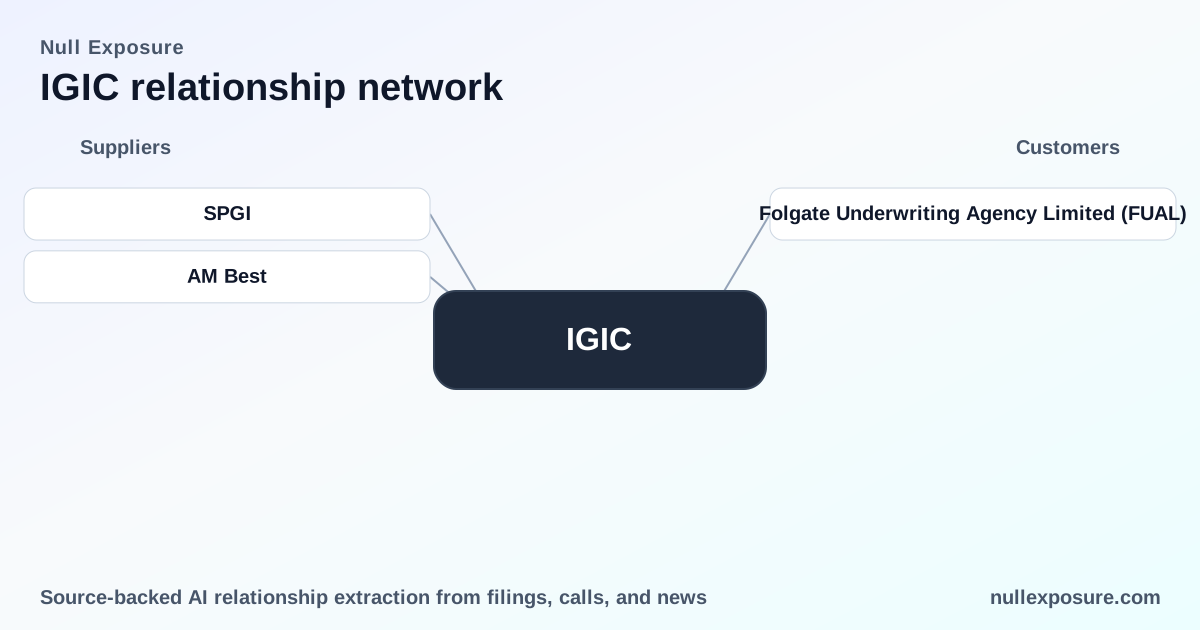
IGIC: Capacity provider and capital allocator — what the Folgate deal reveals
International General Insurance Holdings Ltd (IGIC) underwrites specialized commercial insurance and reinsurance risks globally and monetizes through insurance premium margin, reinsurance capacity sales, and investment income on reserves. The company uses group capital and underwriting platforms (including International General Insurance Company (UK) Ltd, “IGI”) to supply capacity to specialty brokers and underwriting agencies, earning underwriting profit and retaining float for investment. Investors should view IGIC as a capital-lite specialty insurer that leverages distribution partnerships to scale premium income while keeping a concentrated, underwriting-focused balance sheet. For more context on IGIC’s positioning and coverage of customer relationships, visit https://nullexposure.com/.
Why this matters: IGIC’s profitability is driven by underwriting margins (Operating Margin ~26.7% and Profit Margin ~24.6% on trailing twelve-months) and selective distribution partnerships that connect IGI capacity with niche brokers and managing agencies. That operating model amplifies returns when underwriting discipline holds and exposes the company to concentration and counterparty performance in its distribution network.
What the recent Folgate arrangement says about IGI’s commercial posture
IGI executed a dedicated capacity agreement for Folgate Underwriting Agency Limited’s professional indemnity (PI) book, supplying both primary and excess limits. This is an archetypal transaction for IGIC: capital provision to a specialist underwriting agency in exchange for premium flow and underwriting control. The deal underscores IGI’s strategy to grow through targeted capacity placements into specialty lines rather than broad retail expansion.
According to Insurance Business UK (March 2026), Folgate completed a new capacity agreement led by International General Insurance Company (UK) Ltd, securing dedicated primary and excess capacity for its PI portfolio: https://www.insurancebusinessmag.com/uk/news/breaking-news/folgate-underwriting-secures-new-capacity-with-igi-561051.aspx.
Single relationship in the public feed — what investors need to know
The relationship feed available for IGIC includes one discrete customer arrangement:
- Folgate Underwriting Agency Limited (FUAL): IGI has led a capacity agreement providing dedicated primary and excess capacity for Folgate’s professional indemnity portfolio. This is a focused capacity placement that channels IGI underwriting into a specialist PI program run by Folgate. Source: Insurance Business UK, March 2026 (link above).
This transaction is a clear example of IGIC supplying financial capacity to underwriting agencies rather than acting as a retail distributor itself. Key takeaway: IGIC uses platform companies like IGI to deploy capital into specialist lines through agency partnerships, creating predictable premium streams when partnerships are underwritten tightly.
(If you want a broader view of IGI’s customer placements and counterparties, the IGIC coverage on the firm’s platform provides deeper relationship mapping — see https://nullexposure.com/.)
Operating model and business-model constraints — company-level signals
The record contains no explicit contractual constraints tied to individual customer relationships. That absence itself is informative: the data feed lists no constraint entries, which should be treated as a company-level signal rather than a relationship-level attribute.
From an investor perspective this implies several operational characteristics:
- Contracting posture: IGIC operates as a capacity provider with standard market documentation that is not unusually disclosed in public summaries; the firm relies on binding authority and placement agreements through its UK entity to formalize underwriting relationships.
- Concentration: IGIC’s model concentrates risk across specialty partnerships; a small set of agency relationships can drive meaningful premium flows, which increases earnings leverage to underwriting outcomes.
- Criticality: Counterparty performance (agency underwriting standards, claims handling) is critical to realized loss ratios because capacity providers underwrite paper placed by partners.
- Maturity: The structure — using group-led carriers to lead capacity for managing agencies — reflects an established specialty-insurer playbook rather than an experimental distribution model.
These are company-level signals drawn from the relationship type and the available metadata; they should inform due diligence on counterparty credit, collateralization, and performance covenants in underlying capacity agreements.
Financial context that matters to capacity-risk assessment
IGIC’s public financials show material underwriting profitability and scale: trailing revenue of about $516.9 million, strong operating margins (~26.7%), and a profit margin (24.6%) that supports reinvestment into underwriting capacity. The company’s market capitalization ($1.07 billion) and conservative beta (~0.18) position it as a specialty insurer whose market risk is lower than broad financials peers, but exposure to loss volatility remains a primary risk vector.
Implication for capacity placements: strong underwriting returns give IGIC flexibility to provide program capacity, but investors should monitor loss ratio cycles in lines like professional indemnity where liability trends and social inflation can compress margins.
Risk and concentration checklist for underwriters and investors
A focused list of what to watch, distilled from the relationship type and company profile:
- Counterparty underwriting quality and claims governance at agency partners.
- Contractual collateral or profit-share mechanics that protect IGIC against adverse claims development.
- Line-of-business concentration — repeated capacity placements into PI or other liability classes raise volatility risk.
- Public transparency on relationship terms; absence of disclosed constraints increases reliance on private contract diligence.
Bottom line and investor action
IGIC executes its strategy by placing balance-sheet capacity through group carriers such as IGI into specialist underwriting agencies like Folgate. This model scales premium income efficiently but concentrates underwriting and counterparty risk; underwriting discipline and partner selection are the primary value drivers. For investors evaluating IGIC’s customer relationships, the Folgate agreement is a representative example of the company’s market approach and should prompt focused diligence on agency underwriting standards and contract protections.
To explore IGIC’s coverage and relationship tracking further, see https://nullexposure.com/.