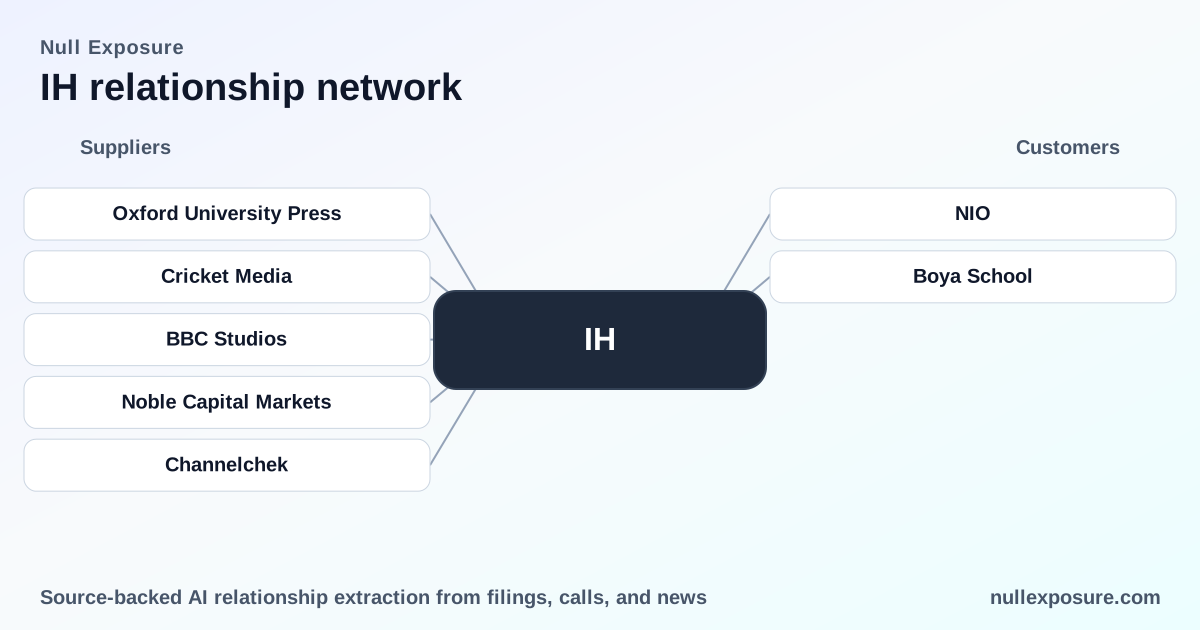
iHuman Inc (IH): Customer Relationships That Extend Reach — and Concentration
iHuman monetizes a hybrid B2C and B2B education-and-entertainment model: it sells subscriptions and content to individual users while licensing and embedding its learning apps and customized curricula into third-party platforms and institutions. Revenue comes from direct consumer subscriptions, content licensing, and strategic distribution partnerships that broaden reach without heavy capital outlay. For a concise investor briefing and additional relationship intelligence, see https://nullexposure.com/.
High-level investor thesis: platform distribution amplifies growth but concentrates execution risk
iHuman’s strategy leverages productized children’s learning apps (iHuman Chinese, iHuman Pinyin, iHuman English) and bespoke educational services to monetize both scale and contract revenue. The company drives margin through digital content and platform placements rather than physical infrastructure, reflected in a healthy gross margin and an extended profit streak despite revenue headwinds. However, distribution partnerships—especially embedded placements inside third-party hardware and school contracts—create concentration and execution dependencies that investors must monitor.
What the customer relationships reveal about the operating model
- Contracting posture: iHuman operates with a mix of recurring consumer subscriptions and one-off or recurring B2B contracts (school programs, distribution agreements). This gives predictable subscription cash flows while enabling spike revenue from institutional deals.
- Concentration: Partnerships with channel partners and select institutions amplify reach but create nodes of dependency; a handful of distribution partners can materially affect user acquisition efficiency.
- Criticality: Embedded placements (e.g., in-car integrations) function as distribution multipliers rather than core revenue centers today, but they are strategically critical to broaden addressable markets beyond traditional home and classroom environments.
- Maturity: Product and content maturity is evident—iHuman sustains profitability (profit margin ~11.8%) and repeated positive EBITDA—indicating the core business can scale digital distribution with limited incremental cost.
NIO: in‑car integrations to access a new attention environment
iHuman has placed core apps such as iHuman Chinese and iHuman Pinyin inside NIO’s in-car systems, expanding distribution into vehicle-based user time and mobility experiences. This is a distribution play that converts a new hardware environment into an engagement channel without direct capital investment in hardware. According to iHuman’s Q3 2025 financial release (distributed via PR Newswire) and subsequent press coverage in The Globe and Mail, management emphasized in-car integrations with NIO as part of a broader push to deepen engagement and broaden the addressable market (Q3 2025 corporate release; Globe and Mail coverage, March 2026). Laotian Times also recorded the in-car initiative when summarizing the Q3 results in late 2025 (Laotian Times, Dec 29, 2025).
Boya School: customized curriculum sales to an institutional customer
iHuman developed a tailored coding program for Boya School, a private Beijing institution educating students from elementary through high school, reflecting the company’s capacity to deliver bespoke curricula for institutional clients. This type of engagement illustrates iHuman’s B2B revenue channel: bespoke content sold to education providers that can be higher-margin and multi-term. The Boya School relationship was described in iHuman’s Q1 2025 results summary published by Plataforma Media (June 26, 2025).
How each relationship affects the investment case
- Distribution leverage (NIO): Embedded app placements are strategically valuable because they convert a captive attention environment into potential subscribers and brand exposure; however, the business is reliant on third-party platform roadmaps and integration terms. Press materials tied the NIO integration to product innovation and distribution expansion in Q3 2025 (PR Newswire; Globe and Mail).
- Contract revenue diversification (Boya School): Institutional contracts reduce reliance on individual subscription churn and create upsell pathways for curriculum packages; the Boya School engagement demonstrates the company’s ability to tailor offerings to school buyers (Plataforma Media, Q1 2025 release).
Where to watch next — operational checklist for investors
- Active monitoring of distribution KPIs: user activation and conversion rates from NIO in-car placements and leading smart speaker platforms cited in corporate releases. A material uptick in conversions would validate the channel; stalling conversions would point to execution risk.
- Renewal and expansion cadence for institutional contracts like Boya School; frequency and scale of bespoke program rollouts will indicate whether institutional sales can become a stable revenue stream.
- Macro and demographic indicators that directly affect user acquisition and lifetime value in China’s children’s learning sector; management has publicly framed partnerships as mitigants to demographic and macro top-line pressure (Globe and Mail, March 2026).
- Regulatory developments around educational content and edtech operations in China, which remain a sector-wide variable.
Financial context and strategic implications
iHuman’s P&L and multiples reflect a business with solid profitability but constrained top-line momentum: Revenue TTM ~¥807M, Profit Margin ~11.8%, and a trailing P/E of 6.65, pointing to a company that converts sales to profit efficiently but is facing year-over-year revenue pressure. The strategic use of third-party distribution (NIO, smart speakers) and branded institutional contracts (Boya School) is consistent with a capital-light scaling model—highly scalable distribution, but concentration risk across a limited set of partners.
For a deeper set of relationship profiles and to track updates to these partnerships, visit https://nullexposure.com/.
Bottom line: distribution-first growth with partner concentration that deserves active monitoring
iHuman’s customer relationships show a clear strategic choice: extend reach through platform partnerships and selective institutional contracts rather than heavy asset builds. This underwrites a profitable, capital-efficient model while concentrating execution risk on partner integrations and institutional sales conversion. Investors should value the company’s profitability and content strength while tracking conversion performance from NIO and renewal cadence on institutional programs as primary signals of sustainable growth.