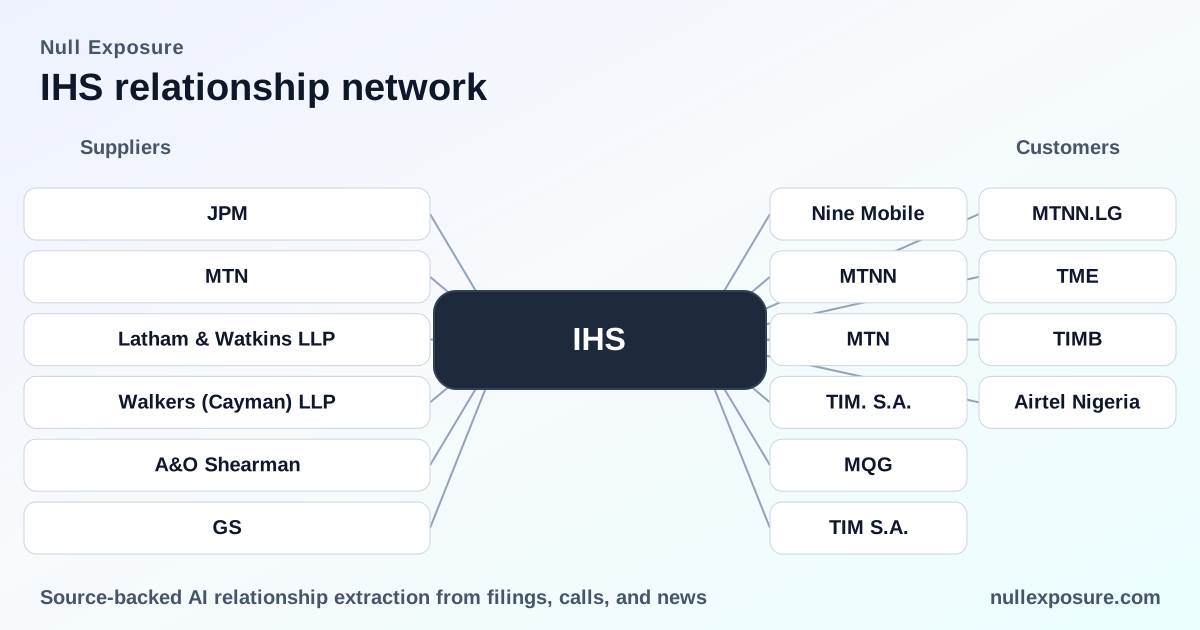
IHS Holding: customer relationships that shape valuation and strategic options
IHS Holding owns, operates and monetizes shared telecommunications infrastructure across emerging markets by leasing passive sites and fiber to mobile network operators, executing sale‑and‑leaseback transactions, and selectively selling regional assets to recycle capital. Revenue is driven by tenancy rents and long-term master leases with a small number of dominant carriers; strategic disposals and the proposed MTN transaction are the levered exit and balance‑sheet vectors that crystallize value. For a quick portal to our research tools, visit https://nullexposure.com/.
How customers make — and remake — the business
IHS’s operating model is built around long-term, counterparty‑anchored leases rather than transactional equipment sales. That contracting posture produces predictable cashflows when tenants are stable, but it also concentrates counterparty risk: multiple sources in March–May 2026 identify MTN as the single largest customer and a material shareholder, while other national carriers supply regional tenancy and near-term churn dynamics. Management has executed asset sales in Latin America and targeted reorganizations in Africa to sharpen returns, indicating a maturing portfolio that is being rebalanced from growth by tower count to cash realization and strategic consolidation.
- Contracting posture: master leases and sale‑and‑leaseback structures that secure long-duration income streams.
- Concentration: high, with MTN repeatedly described as the largest tenant and strategic partner.
- Criticality: infrastructure is a backbone asset for operators in key African markets, giving tenants operational dependence.
- Maturity: active disposals (LatAm towers, Brazilian fiber) and a negotiated merger/acquisition path suggest a transition from scale‑build to value crystallization.
These are company‑level operating signals drawn from recent earnings calls and press reporting; they describe the commercial dynamics that investors should price into cashflow durability, equity optionality, and takeover risk.
Relationship map — every reported customer and counterparty
Nine Mobile
IHS reported tenancy churn of 2,576 sites linked to an updated agreement with its smallest key Nigeria customer, Nine Mobile, indicating contract renegotiation effects on site count and near‑term revenue. This was discussed on the IHS 2025 Q3 earnings call (transcript referenced March 2026).
T2 (formerly 9mobile)
Press coverage identifies T2 as IHS’s smallest major customer in Nigeria and a focus of portfolio cleanup ahead of the MTN transaction, underscoring that even smaller tenants can drive localized churn. See TechAfricaNews reporting in March 2026.
MTN / MTN Group / MTN Group Limited
Multiple disclosures and press stories in March–May 2026 state that MTN is IHS’s largest customer, a 25% shareholder, and the proposed acquirer in a ~$6.2 billion transaction, a development that converts customer concentration into an ownership outcome and materially changes strategic optionality. See the Finviz and BusinessDay coverage of the MTN merger/offer announced February–March 2026.
MTN Nigeria / MTNN / MTNN.LG
Management cited near‑term site churn tied to renewed and extended contracts with MTN Nigeria, an operational effect visible in the 2025 Q3 earnings call that impacts tenancy metrics and short‑term revenue visibility. The earnings call transcript and subsequent news aggregation in March 2026 document this dynamic.
Macquarie Asset Management / MQG
IHS agreed to sell its South American tower operations to Macquarie Asset Management, a strategic divestment to exit Latin America and realize cash, reported by FinViz and press in March 2026. That buyer relationship signals IHS’s willingness to monetize geography‑specific assets rather than hold globally.
TIM S.A. / TIM / TME / TIMB
IHS sold a 51% stake in Brazilian fiber provider I‑Systems to TIM S.A., and separately described an expanded site agreement to build up to 3,000 sites in Brazil with TIM, reflecting both divestiture and commercial partnership behavior in LatAm; these items were disclosed in press reports and the company earnings commentary in March 2026.
Paradigm Tower Ventures
IHS recorded a net gain from the sale of IHS Rwanda to Paradigm Tower Ventures (October 2025), which management and press cited as an example of asset optimization in Africa and a contributor to 4QFY25 results, per TechAfricaNews reporting in March–May 2026.
Airtel Nigeria
IHS management highlighted strong financial results at tenants such as Airtel Nigeria, linking carrier pricing and capacity decisions to improved pass-through economics at tower sites; this was noted on the 2025 Q3 earnings call (March 2026 transcript).
What the relationship set implies for investors
- Customer concentration is a clear valuation driver. MTN’s dual role as largest tenant and strategic buyer materially reduces a standalone equity upside case and converts counterparty risk into an acquisition pathway; multiple March 2026 reports emphasize this repositioning.
- Contract churn is operationally visible. Renewals and updated agreements in Nigeria (MTN Nigeria and Nine Mobile/T2) drove site churn metrics in 2025Q3, and those effects depress near‑term tenancy counts even as longer‑term cashflows stabilize.
- Portfolio refocus is active. Sales to Macquarie (LatAm towers) and TIM (Brazilian fiber stake) are deliberate capital recycling moves that increase cash realization at the expense of geographic diversification; analysts and law firm advisories reported these deals in March 2026.
- Deal execution risk materializes as corporate risk. The MTN merger/acquisition pathway is central to valuation timing and exit certainty; continued regulatory, currency, or contract volatility in core markets will affect deal economics and recurring revenues (widely flagged by market commentary in March–May 2026).
Bottom line: where to position
IHS is transitioning from a growth‑by‑count platform to a cash‑realization and consolidation play anchored by a dominant customer‑buyer. Investors should price the company with an explicit assumption that MTN’s actions (as tenant and owner) will be determinative for future earnings realization and equity optionality; meanwhile, divestments to Macquarie and TIM show disciplined portfolio pruning that supports near‑term liquidity.
For comparative diligence and access to structured relationship intelligence, visit https://nullexposure.com/ for more on how these counterparty links change risk and value.