InnSuites Hospitality Trust (IHT): management-led hotel operations with fee-based revenue and concentrated control
InnSuites Hospitality Trust operates as a small hotel REIT/management platform that monetizes through hotel ownership, management fees and trademark licensing. The Trust drives revenue primarily from room receipts (management fees of 5% of room revenue plus a $2,000 monthly accounting fee per hotel) and from providing the InnSuites trademark and associated services via its majority-owned management subsidiary, RRF LLLP. For investors this is an asset-light, revenue-sensitive model tied to occupancy and pricing at two owned properties; financial scale is small (market cap roughly $10.7 million; Revenue TTM ~$7.4 million) and profitability is negative on the latest trailing measures. For further background or model testing, see more at Null Exposure.
How InnSuites makes money — the operating and contracting posture that matters
InnSuites combines hotel ownership with a management services business. The Trust collects fees that are directly usage-linked: management fees equal 5% of room revenue plus a fixed $2,000 monthly accounting fee per hotel, and it includes trademark services under those fees. These terms produce revenue that is procyclical with occupancy and average daily rate (ADR) rather than fixed, so investor returns hinge on operational recovery and local demand.
Contractually, agreements are short-duration and cancellable on 30-days' notice, which increases counterparty flexibility but raises revenue volatility and the possibility of rapid contract turnover. The company operates exclusively in the United States, which simplifies regulatory exposure but concentrates geographic risk in North American lodging markets. No single customer represents more than 10% of revenues historically, which signals limited customer concentration, but the business remains small in scale and sensitive to idiosyncratic property performance.
RRF LLLP, the Trust’s majority-owned management entity, functions as the operating nerve center, providing day-to-day hotel management and trademark services and therefore representing the critical operational link between InnSuites and the hotels it manages. These characteristics produce a services-dominant segment that is inherently variable, relationship-driven and dependent on on-the-ground hotel performance.
Customer relationships and counterparties you need to track
Below are the individual counterparties surfaced in the available reporting and how each relates to IHT’s business, with sources.
TIMB — (appears in newsfeeds but not a direct IHT counterparty)
The report mentioning TIMB refers to a telecom stake transaction in Brazil and is not tied to InnSuites’ hotel operations; it is a contextual news item picked up by the feed. According to DevelopingTelecoms (March 10, 2026), the piece covered IHS Towers selling a fibre stake back to TIM SA. This item is unrelated to IHT’s hotel-management contracts but shows the news universe that referenced the IHT feed.
Source: DevelopingTelecoms, March 10, 2026.
IBC Hotels, LLC / InnDependent Boutique Collection (IBC)
IBC is central to recent activity: REF (an investor vehicle controlled by IHT’s chairman and family) purchased IBC Hotels in March 2025 and engaged RRF LLLP, InnSuites’ management subsidiary, to run IBC’s rebirth, signaling a service arrangement where InnSuites’ operating arm manages an independent boutique platform. GlobeNewswire’s December 15, 2025 release and related filings (reported in early May 2026 feeds) describe the transaction and the management appointment; multiple notices in 2025 confirm RRF’s management role.
Sources: GlobeNewswire (Dec 15, 2025); TradingView summary (May 3, 2026).
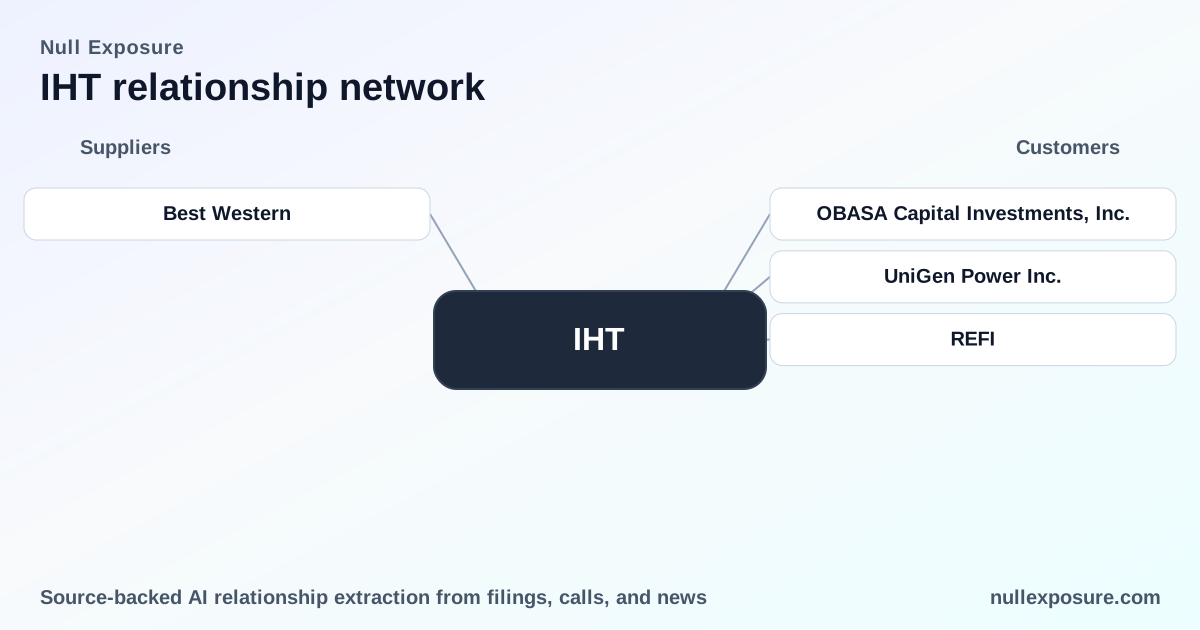
OBASA Capital Investments, Inc.
In 2018 InnSuites previously contracted to sell IBC to a wholly owned subsidiary of OBASA Capital Investments, Inc., reflecting historical divestment activity. That sale was disclosed in the company announcement and underscores the Trust’s pattern of asset disposals and third‑party transfers when strategic. Hotel-Online carried the 2018 notice of the sale.
Source: Hotel-Online (FY2018 filing/report).
REFI / REF (investment entity affiliated with IHT chairman)
REF/REFI is an investment vehicle owned by the chairman and family that purchased IBC and then retained RRF LLLP to manage it; this is an explicit related-party economic arrangement tying InnSuites’ management subsidiary to a company controlled by insiders. GlobeNewswire’s December 2025 release describes REF’s purchase of IBC on March 5, 2025 and the hiring of RRF LLLP on March 7, 2025 to manage the revived IBC platform.
Source: GlobeNewswire (Dec 15, 2025).
UniGen Power Inc.
A separate press item indicates UniGen Power Inc. expected to receive $1.1 million in funding from InnSuites and other investors, which shows InnSuites participating in outside financings or investments beyond its core hotel-management revenue streams. MarketScreener reported this arrangement in March 2026 coverage of insider and related investor activity.
Source: MarketScreener (reported March 2026).
Key investment implications and risk checklist
- Revenue is usage-driven and seasonal. With management fees set at 5% of room revenue plus fixed monthly accounting fees, top-line is tightly linked to occupancy/ADR cycles and local demand shifts. (Contract excerpts: fee formula.)
- Contracts are short and cancellable, creating flexibility for hotel owners but also potential churn for InnSuites’ management income. (Contract excerpt: 30-day cancellation.)
- Service-provider centrality through RRF LLLP means operational execution and talent on the ground are critical; RRF’s performance directly affects fees and brand licensing value.
- Geographic concentration to the U.S. reduces international risk complexity but increases exposure to U.S. leisure and business travel cycles. (Company disclosure.)
- Limited customer concentration vs. concentrated ownership. No customer exceeds 10% of revenues historically, which lowers counterparty concentration risk; however, insiders control a large share of equity (about 71% insider ownership) which elevates related-party and governance scrutiny.
- Small scale and negative profitability. Market cap and trailing metrics show a small-cap, thinly traded vehicle with negative EPS and slim institutional ownership—factors that increase liquidity, execution and governance risks.
Bottom line for investors
InnSuites combines fee-for-service hotel management and trademark licensing with a small asset base and high insider ownership. The firm’s usage-based fee model produces volatility linked to occupancy, while short-term cancellable agreements and related-party transactions (REF/REFI hiring RRF to manage IBC) are material governance watch points. For analysts assessing IHT, track actual room revenue trends at the two owned properties, RRF’s execution on the IBC mandate, and any further investments or cash flows into third parties like UniGen.
For a full view of relationships and contract-level signals captured on IHT, visit Null Exposure for the curated intelligence platform and relationship summaries.