i3 Verticals (IIIV): Customer Relationships That Define a Public‑Sector SaaS Play
i3 Verticals monetizes by selling software and related services—primarily cloud‑native SaaS, support, licensing and implementation—to small and medium organizations and public‑sector entities, while historically operating payment services that were divested in 2024. The company earns recurring revenue from subscription and services contracts (many with one‑year terms) and complements software with payment and settlement services where retained; that mix drives predictable near‑term cash flow but keeps renewal risk concentrated around annual contracting cycles. For a quick company overview, visit https://nullexposure.com/.
How i3 Verticals actually operates — the commercial contours investors should track
i3 Verticals is a software-first vendor positioned in public‑sector verticals (courts, schools, utilities) and adjacent markets such as property management and healthcare prior to divestiture. The filings and company commentary convey a clear operating posture:
- Contracting posture: most deferred‑revenue contracts are one year, supporting a cadence of regular renewals rather than multi‑year lock‑ins. Evidence in the company filings states one‑year terms for contracts with deferred revenue.
- Revenue model: sales originate from subscriptions, recurring services, licenses, support, and implementation; the company explicitly recognizes SaaS revenue over the term of the agreement.
- Customer mix: a heavy tilt to government and public‑sector customers across states and municipalities; the company reports thousands of software installations across all 50 U.S. states and some Canada.
- Geography: revenue is primarily U.S. with Canada immaterial for separate disclosure.
- Criticality and materiality: i3 frames its solutions as mission‑critical for many public customers, but no single continuing customer represented more than 10% of revenue for fiscal years through 2025, indicating diversified counterparty concentration.
- Role and offering: i3 is both seller (software and equipment) and service provider (operations, payment authorization/settlement historically), with continuing operations focused on enterprise software after the Healthcare RCM sale.
- Contract maturity and stage: thousands of active installations and public‑sector breadth support a mature, deployed base of customers.
These characteristics create a business model with recurring annual cash flows, government counterparty stability, and renewal risk at annual anniversaries—critical inputs for modeling churn, CAC payback and revenue visibility.
Customer and partner mentions in the record — what each relationship says
Below are the specific relationships flagged in the coverage set, each with a concise plain‑English summary and the source context.
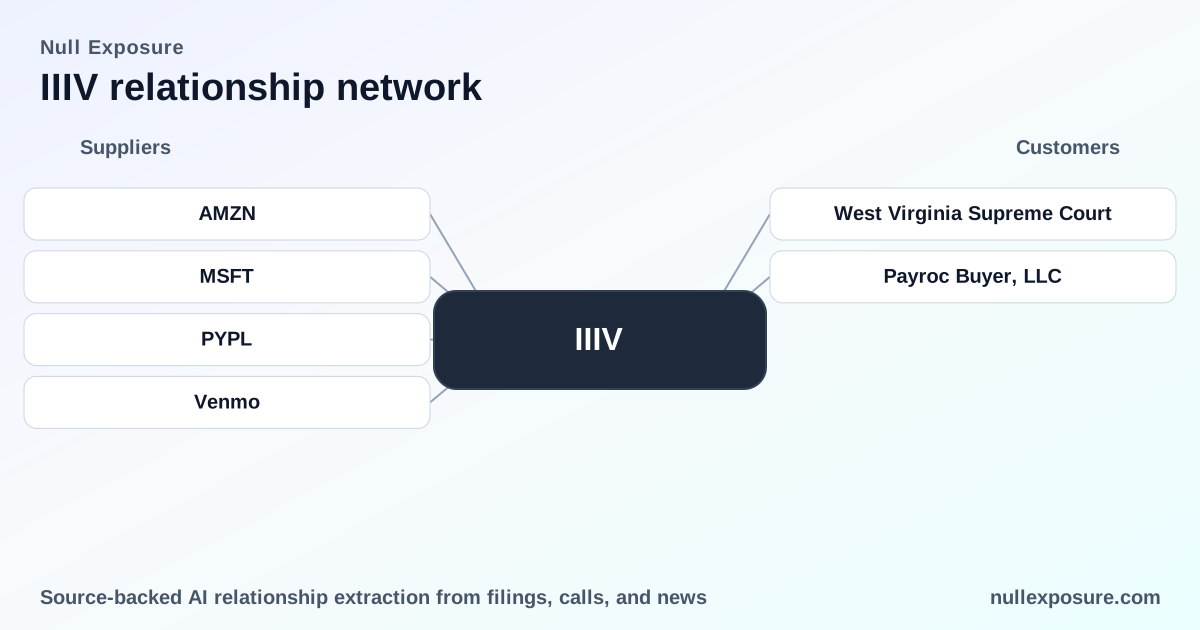
West Virginia Supreme Court
i3 announced an expanded partnership to deliver the i3 Court One case management solution to circuit, family and magistrate courts in West Virginia, signaling continued public‑sector penetration and upsell into state court systems. This was disclosed on the company’s 2025 Q4 earnings call. (iiiv 2025 Q4 earnings call, March 2026.)
Payroc
i3 completed the $438 million sale of its Merchant Services business to Payroc, representing a strategic exit from the merchant acquiring/payments merchant services business and a crystallization of value from that asset. This transaction was reported in news coverage summarizing the FY2024 disposition. (Investing.com report on the transaction; FY2024 disclosures.)
Payroc Buyer, LLC
i3’s merchant services business was sold to Payroc Buyer, LLC for approximately $438 million on September 20, 2024, as noted in public filings and subsequent market reporting—an explicit transaction date and buyer entity that clarifies the counterparty for the divestiture. (TradingView summary referencing the Company’s SEC disclosures, September 20, 2024.)
Athenex (ATNX)
A remark in a Q2 2025 earnings call transcript referenced Athenex in a collaborative or team context, suggesting engagement or personnel interaction between i3 and Athenex; the mention is brief but indicates a customer or partner touchpoint in 2025. (Earnings‑call transcript coverage, Q2 2025.)
What the relationships collectively reveal about strategy and risk
The customer list and corporate disclosures sketch a coherent strategic pivot and operational reality:
- The sale to Payroc/Payroc Buyer, LLC confirms a deliberate move away from merchant services and concentrates i3 on public‑sector software and services; that cash realization strengthens the balance sheet but removes a payments revenue stream.
- Public sector deals like the West Virginia Supreme Court expansion underscore the company’s depth in mission‑critical government software and the opportunity for product expansion within state court systems.
- Small, one‑off mentions like Athenex indicate the company’s continued engagements across diverse end markets beyond core public clients; however, company filings emphasize that no single customer exceeds 10% of revenue, supporting investor confidence in diversification.
Financial and operational implications for investors
- Revenue predictability: the SaaS/subscription orientation with annual contracts offers near‑term predictability, but the prevalence of one‑year terms means renewal cycles are a primary source of execution risk. Model recurring revenue with explicit renewal assumptions and sensitivity to 10–20% renewal variation.
- Concentration and credit risk: heavy exposure to U.S. government and public entities reduces commercial volatility but raises budget timing and procurement cycle risk; investors should model state/local budget seasonality and payment terms.
- Capital allocation: the Payroc sale represents non‑organic capital redeployment; investors should monitor how proceeds are used (deleveraging, M&A, or share repurchases) because the company has materially redefined its cash‑flow base.
- Criticality vs. customer scale: solutions are described as mission‑critical, which supports pricing power and retention, but the absence of very large single customers limits extreme client concentration risk.
Bottom line: what to watch next
- Track quarterly renewal rates and deferred revenue churn given the one‑year contract cadence; this is the single largest driver of near‑term revenue variability.
- Monitor deployment wins in other state court systems and public‑sector verticals for organic growth and cross‑sell potential.
- Follow management’s capital allocation of the Payroc transaction proceeds for signs of strategic M&A or balance sheet strengthening.
For a focused dashboard on i3 Verticals’ commercial relationships and to track subsequent filings and call transcripts, visit https://nullexposure.com/.
Investors should treat i3 as a software company with recurring revenue, public‑sector customer stability, and concentrated renewal timing risk—a profile that rewards clear visibility into renewal dynamics and disciplined capital deployment.