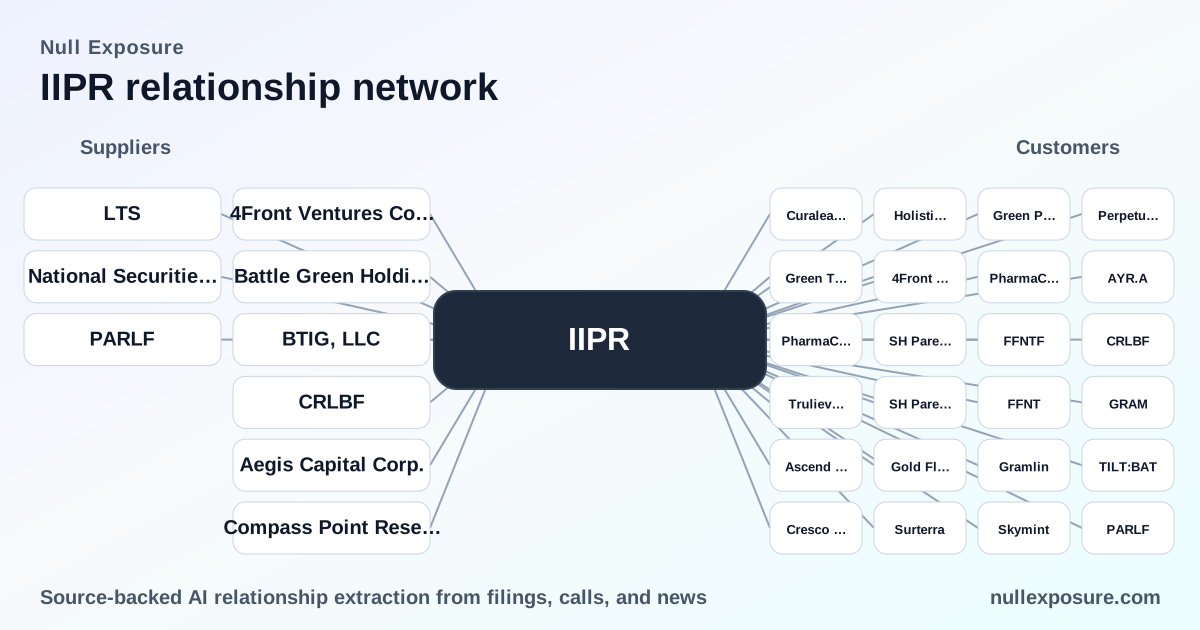
IIPR customer relationships: who pays, who defaulted, and what it means for the REIT
Innovative Industrial Properties (IIPR) acquires, owns and manages specialized industrial real estate used by licensed cannabis operators, monetizing through long‑term, triple‑net leases and sale‑leaseback transactions that generate recurring rental income, tenant reimbursements and capital deployment opportunities. For investors, the story is straightforward: property cashflow depends on a concentrated set of regulated operators, and portfolio value is driven by lease durability, re‑leasing outcomes and the company’s ability to recycle capital into new sale‑leasebacks.
If you want a quick portfolio snapshot and relationship log, visit https://nullexposure.com/ for the underlying source feed and document links.
Why IIPR’s customer map matters right now
IIPR’s business model is characterized by long-term contracting posture (the company reports a weighted-average remaining lease term of roughly 13.7 years) and U.S.-only geographic exposure, which makes the portfolio sensitive to domestic cannabis operator credit and regulatory developments. According to IIPR’s 2024 Form 10‑K, the top tenants are materially concentrated — five tenants together represented meaningful percentages of rental revenue — which creates concentration risk but also high recoverability when leases are re‑assigned or re‑leased to better‑capitalized operators. The company also operates predominantly as an infrastructure landlord: tenants are responsible for operations and property costs under triple‑net leases, so tenant solvency directly drives cashflow stability.
Quick operating constraints that matter to evaluation
- Contracting posture: IIPR operates almost entirely under long‑term, triple‑net leases with sellers becoming tenants on sale‑leaseback transactions, which limits short-term upside but provides visibility into contractual cashflows (IIPR 2024 10‑K).
- Geography: All revenues are U.S.-generated and consolidated under a single CODM, concentrating regulatory and market risk domestically (IIPR 2024 10‑K).
- Materiality / Concentration: A small number of operators are material to revenues — PharmaCann, Ascend, Green Thumb, Holistic and Curaleaf were each called out for representing a material share of rental revenues for the 12 months ended Dec 31, 2024 (IIPR 2024 10‑K).
- Maturity / Criticality: The portfolio is long‑dated on average and landlords rely on tenants to operate regulated cultivation/processing facilities, making tenant credit and regulatory compliance critical to cash collection.
If you need consolidated relationship signals and primary documents for due diligence, see https://nullexposure.com/ for direct links to filings and press coverage.
Tenant relationship log — one sentence per relationship, with sources
- Trulieve Cannabis Corp. Trulieve is listed among IIPR’s tenants in the company’s 2024 Form 10‑K disclosures, indicating a multi‑site leasing relationship disclosed for FY2024 (IIPR 2024 10‑K).
- Ascend Wellness Holdings, Inc. Ascend figures as one of the larger tenants by contracted rent and is explicitly called out in IIPR’s FY2024 tenant revenue breakdown (IIPR 2024 10‑K).
- Curaleaf Holdings, Inc. Curaleaf is reported among tenants and included in IIPR’s FY2024 tenant revenue schedule (IIPR 2024 10‑K).
- Green Thumb Industries, Inc. Green Thumb is identified as a multi‑property tenant and is included in IIPR’s tenant concentration disclosure for FY2024 (IIPR 2024 10‑K).
- PharmaCann Inc. PharmaCann was a material tenant with multiple properties and — following payment shortfalls and litigation — IIPR announced a settlement that included lease terminations and recovery actions across New York, Ohio and Pennsylvania (IIPR 2024 10‑K; InvestingNews, Mar–May 2026).
- SH Parents, Inc. / SH Parent, Inc. (Parallel) Parallel (listed under SH Parent/SH Parents) appears as a tenant in the 10‑K and was later cited by IIPR and financial press as a tenant tied to re‑leasing momentum (IIPR 2024 10‑K; FinancialContent/Markets coverage, 2026).
- Holistic Industries, Inc. Holistic is disclosed among the named tenants in IIPR’s FY2024 filing and contributes to the company’s material tenant mix (IIPR 2024 10‑K).
- Cresco Labs Inc. Cresco entered sale‑leaseback arrangements with IIPR historically and is listed in IIPR’s tenant roster and public transaction announcements (NewCannabisVentures, FY2019; IIPR 10‑K).
- Gold Flora, LLC Gold Flora’s properties were subject to receivership and collections history; IIPR disclosed receipts from a Gold Flora receivership and later executed replacement leases for those assets (earnings call transcript; InvestingNews/Yahoo Finance FY2025–FY2026).
- 4Front Ventures Corp. (FFNT / FFNTF) 4Front completed sale‑leaseback transactions with an IIPR affiliate for cultivation/production facilities, a transaction publicly disclosed in 2020 and referenced in later re‑leasing updates (InvestingNews, FY2020 and FY2026).
- Surterra IIPR purchased a Parallel site in Florida and concurrently entered a triple‑net lease with Surterra to run cultivation and processing operations at the facility (Mugglehead report, FY2020).
- Green Peak Industries, LLC IIPR completed a purchase with a long‑term triple‑net lease to Green Peak for a Michigan facility tied to medical cultivation and processing (NewCannabisVentures coverage, FY2018).
- Battle Green Holdings, Inc. Battle Green defaulted on rent for its sole Ohio property in March 2026, a localized default IIPR identified in recent portfolio updates (InvestingNews/Intellectia, Mar–May 2026).
- Forefront Ventures IIPR has been engaged with U.S. receivers and trustees over Forefront properties; receivership proceedings remain ongoing and IIPR is pursuing legal protections under the leases (earnings call transcript, FY2025).
- Skymint Management and press cited Skymint among tenants tied to re‑leasing momentum and recovery catalysts in investor commentary (FinancialContent/TradingView coverage, 2026).
- Gramlin Gramlin executed a full‑building lease for IIPR’s Desert Hot Springs, CA property (204,000 sq. ft.) in January 2026, cited in IIPR’s quarterly reporting (Yahoo Finance / IIPR quarter report, Jan 2026).
- Perpetual Brands Perpetual Brands signed a 58,000 sq. ft. full‑building lease for IIPR’s Holliston, MA property in November 2025, disclosed in the company’s portfolio update (IIPR quarter report, Nov 2025).
- AYR Wellness Inc. (AYR.A) AYR Wellness leased a 145,000 sq. ft. industrial site from IIPR for redevelopment into cultivation space, as reported in press coverage of the strategic real‑estate partnership (The Dales Report, FY2024).
- Pharmacann (variant spellings) Multiple outlets reported a settlement resolving PharmaCann’s unpaid amounts across New York, Ohio and Pennsylvania — media coverage sometimes spells the tenant name variably but refers to the same PharmaCann matter (Bitget / InvestingNews / Sahm Capital, Mar–May 2026).
- Berry Green Berry Green was mentioned by IIPR management as one of several re‑leasing tenants used to backfill vacated space since 2023 (earnings call transcript, FY2025).
- Loom Cannabis Loom was referenced as another re‑lease that management cited as part of backfill activity across the portfolio (earnings call transcript, FY2025).
- Mint Extracts Mint Extracts was also named among the re‑leasing tenants that replaced prior occupants in IIPR properties (earnings call transcript, FY2025).
- Try Mountain Pure Try Mountain Pure is part of the cohort of backfill leases IIPR disclosed during re‑leasing updates (earnings call transcript, FY2025).
- TILT TILT was called out by IIPR as a tenant tied to recent revenue decreases due to a tenant default, included in the company’s 2025–2026 portfolio commentary (IIPR quarterly report / Yahoo Finance FY2026).
- The Cannabist Company The Cannabist Company and affiliates defaulted on March 2026 rent for a Pennsylvania property, per IIPR portfolio disclosures and press reports (InvestingNews / Intellectia / TradingView, Mar–May 2026).
- Gold Flora / GRAM (ticker references) Beyond the earlier Gold Flora entry, IIPR’s public update lists executed replacement leases for Gold Flora’s former assets and shows proceeds and rent receipts tied to the receivership resolution (Yahoo Finance / InvestingNews FY2025–FY2026).
- PARLF / Parallel (ticker variants) Parallel’s defaults and subsequent placement for re‑leasing were discussed across investor commentary as part of IIPR’s re‑leasing catalyst list (Markets FinancialContent / TradingView, 2026).
- CRLBF (Cresco ticker variant) Cresco / CRLBF historic sale‑leaseback relationships with IIPR are part of the REIT’s longer track record of buying operator assets and leasing them back under triple‑net terms (NewCannabisVentures FY2019).
What the relationship map implies for investors
- Credit risk is tenant risk. Tenant defaults (notably PharmaCann, Battle Green, The Cannabist Company and TILT) produced measurable rent shortfalls that management quantified and worked to resolve through litigation and settlements; those events highlight how IIPR’s cashflow is tied to operator solvency (IIPR filings and InvestingNews, Mar–May 2026).
- Re‑leasing is the recovery engine. IIPR is actively re‑leasing vacated and defaulted assets to better‑capitalized operators (Gramlin, Perpetual Brands, various backfills like Mint Extracts/Loom), which management cites as the primary path back to rent growth (earnings call transcript; Yahoo Finance, 2026).
- Concentration can cut both ways. A concentrated top‑tenant base delivers predictable cashflows when tenants perform, but simultaneous operational stress in a few tenants materially depresses revenue; IIPR’s disclosure of top‑tenant percentages is therefore a critical monitoring metric (IIPR 2024 10‑K).
Bottom line for active investors
IIPR is a specialized REIT whose asset cashflows are directly exposed to the operational and credit cycle of licensed cannabis operators. Key drivers to watch are re‑leasing velocity, legal outcomes from tenant defaults, and the pace of new sale‑leaseback transactions. For document-level references and the source feed used to compile this relationship log, visit https://nullexposure.com/.