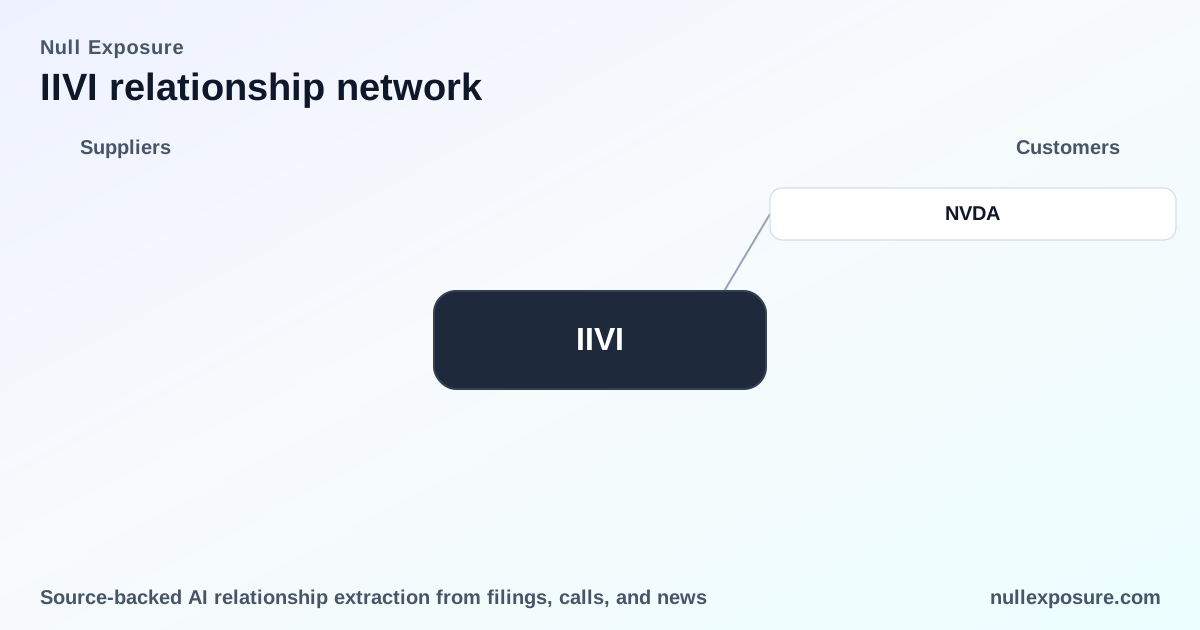
IIVI customer relationships: optics demand tied to hyperscaler and OEM commitments
Thesis: II‑VI Incorporated (IIVI) operates as a vertically integrated supplier of engineered materials, lasers and optical subsystems that it monetizes through product sales, long‑term supply agreements and capacity commitments with OEMs and large technology customers. Revenue sensitivity is driven by multiyear manufacturing and R&D commitments from advanced computing and datacom customers, which translate into predictable backlog when contracts include purchase commitments and capacity rights. Learn more at https://nullexposure.com/.
Why optics partnerships matter for investors
Optical components and lasers sit at the intersection of semiconductor manufacturing, datacenter interconnects and high‑performance computing. For a company like IIVI, customer agreements that include capacity reservations and multi‑billion dollar purchase commitments directly influence near‑term manufacturing utilization and medium‑term capital allocation. Market momentum in AI and hyperscale compute increases demand for advanced optics, and suppliers that secure long‑term capacity deals gain both revenue visibility and negotiating leverage on pricing and capital spending.
What the customer relationship data shows — every listed entry
NVDA (inferred symbol NVDA)
- IIVI’s relational data includes NVDA as a customer entry; the cited news item describes a multiyear, nonexclusive agreement between Coherent Corp. and NVIDIA that covers manufacturing capacity, R&D collaboration and a multibillion‑dollar purchase commitment for advanced laser and optical networking products. This item signals elevated demand and multi‑year purchase commitments in the optics space as of FY2026 (PennBizReport, March 10, 2026).
- Source: PennBizReport coverage of Coherent–NVIDIA agreement (Mar 10, 2026).
NVIDIA (inferred symbol NVDA)
- The same PennBizReport item is also captured under the name “NVIDIA”; it reiterates that a large technology OEM committed to multiyear access to advanced laser and optical networking capacity, a dynamic that benefits suppliers with available manufacturing and R&D capability. NullExposure’s relationship mapping lists NVIDIA among customer relationships associated with IIVI in FY2026 (PennBizReport, March 10, 2026).
- Source: PennBizReport coverage of Coherent–NVIDIA agreement (Mar 10, 2026).
(Notes on duplication: both entries reference a single press report describing Coherent’s multiyear deal with NVIDIA; NullExposure’s results include the item under both name variants.)
Interpreting the relationship snippets for IIVI’s business model
The news excerpt itself documents Coherent’s agreement with NVIDIA, not a direct Coherent–IIVI contract; however, the presence of NVIDIA in IIVI’s customer relationship mapping signals that IIVI is positioned to benefit from the same demand tailwinds that drive Coherent’s deal activity. From an investor perspective, this mapping should be read as an indication that IIVI is in the competitive set for large optics supply agreements with hyperscalers and advanced computing OEMs.
Company-level operating constraints and business model signals
With no explicit contractual constraints extracted in the results payload, the following are company‑level signals that investors should treat as structural characteristics of IIVI’s operating model:
- Contracting posture: Supply relationships in advanced optics are typically anchored by multiyear, nonexclusive agreements that include capacity reservations and purchase commitments. This contracting style favors suppliers with capitalized manufacturing footprints and flexible production scheduling.
- Customer concentration: The optics market concentrates revenue around a small set of hyperscalers, OEMs and defense prime contractors; this elevates revenue volatility if one large customer accelerates or slows procurement, but it also creates the possibility of sizeable, multi‑year revenue streams when deals include committed volumes.
- Criticality of product: Optical subsystems and lasers are mission‑critical for datacenter bandwidth and high‑performance compute platforms; suppliers that secure technical roadmaps and capacity agreements capture strategic positions that are hard for competitors to displace quickly.
- Maturity of relationships: Agreements that involve R&D collaboration and capacity rights imply a higher level of integration and longer lead times for replacement, making these relationships operationally sticky and effectively increasing barriers to supplier switching.
These signals together imply that IIVI’s revenue profile will tilt toward lumpy but concentrated bookings, where capacity commitments and R&D partnerships are principal drivers of forward visibility and capital allocation decisions.
Investment implications and risk factors
- Upside drivers: Multiyear purchase commitments from hyperscalers and OEMs materially increase utilization and justify incremental capex. If IIVI is winning portions of the capacity that customers like NVIDIA are reserving, revenue and margin expansion follows as fixed costs are absorbed.
- Key risks: Customer concentration, the capital intensity of scaling photonics fabs, and the timing mismatch between R&D collaboration and revenue recognition create execution risk. A loss of a single large contract or delays in ramping new capacity will materially affect quarter‑to‑quarter results.
- What to watch: New supplier announcements from hyperscalers, contract award details that specify committed volumes or capacity rights, and disclosed capex plans tied to optical manufacturing capacity are high‑signal items that will alter revenue forecasts.
Consider a focused review of contractual language in public filings and supplier award announcements to quantify committed volumes and timeline assumptions.
For a deeper read on how supplier relationships translate into revenue visibility for optics businesses, visit https://nullexposure.com/.
Bottom line
The captured relationship entries show that hyperscalers such as NVIDIA are central demand drivers in the advanced optics market as of FY2026, and NullExposure’s mapping places them within IIVI’s customer relationship landscape. For investors, the key valuation lever is whether IIVI secures and converts capacity‑backed purchase commitments into sustained production — a binary that controls both near‑term topline momentum and long‑term return on capital.