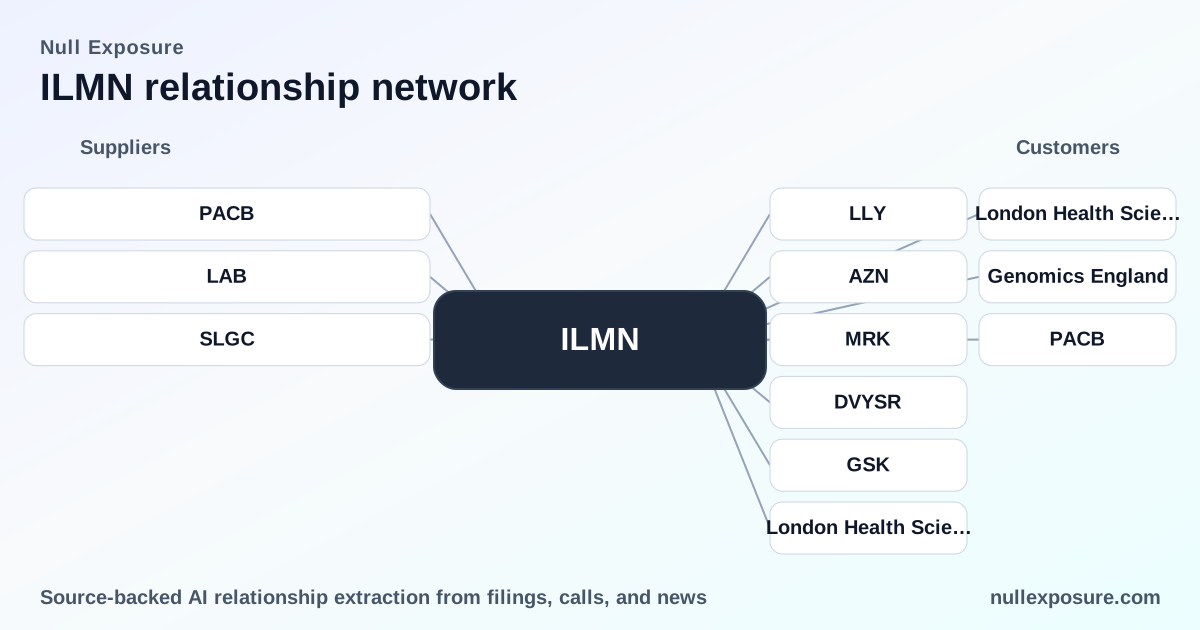
Illumina customer map: who pays for the sequencers and what it means for investors
Illumina sells sequencing instruments, consumables and associated laboratory services to a broad set of customers and monetizes through high-margin consumable sales, instrument sales with long lead backlogs, and recurring service/contracts. The business model is a classic hardware-plus-consumables platform: instruments drive adoption and recurring reagent and service revenue deliver predictable, high-margin follow‑through. For investors this translates into concentration on sequencing revenue (over 90% of sales), material international exposure, and a mix of large enterprise, government and non‑profit end customers that underpin durable demand.
If you want a concise commercial intelligence feed on Illumina relationships, visit https://nullexposure.com/ for structured coverage and source linkage.
How Illumina’s customer economics work in practice
Illumina sells instruments and consumables globally, and sells support and sequencing services where strategic. Sequencing revenue comprised over 90% of total revenue in 2025, making consumable and service follow‑on the primary long‑term cash generator. Backlog disclosure shows shipments scheduled across quarters and years, which reflects multi‑quarter contracting and the potential visibility into near‑term revenue. Customers range from large pharmaceutical partners to academic centers and government labs, which makes Illumina both a vendor to enterprise R&D budgets and a provider of clinical testing infrastructure.
Relationship roll call — who Illumina sells to and works with
Below I catalogue every customer relationship flagged in the source results, with a one‑to‑two sentence plain‑English summary and the originating source.
Caris (CAI)
Caris relies on Illumina as the sole supplier of NGS instruments and sequencing reagent kits for its clinical and research workflows, under an open‑offer supply agreement first noted in filings. Source: Caris Life Sciences S‑1 amendment and related filings (FY2025–FY2026).
Eli Lilly (LLY)
Eli Lilly is an announced founding partner in Illumina’s Billion Cell / Atlas collaboration to map disease biology, a partnership structured to give biopharma access to Illumina’s large multiomic collections. Source: Illumina Q4 2025 earnings call transcript and press coverage (March 2026).
AstraZeneca (AZN)
AstraZeneca is a founding pharmaceutical partner for the Billion Cell Atlas and is positioned to use the Atlas for target discovery and drug development. Source: Illumina Q4 2025 earnings call and multiple press reports (March 2026).
Merck / MSD (MRK)
Merck (MSD) is a founding partner of the Atlas and has public plans to use the resource to train drug discovery models, making it a strategic research customer for Illumina’s multiomic products. Source: Pharmaceutical‑Technology coverage and Illumina Q4 2025 remarks (March 2026).
GRAIL (GRALV)
GRAIL has been a vertical focal point in regulatory reviews because Illumina supplies essential sequencers to GRAIL and its competitors; regulatory history shows the acquisition and divestiture dynamics tied to that relationship. Source: European Commission and U.S. FTC reporting and contemporaneous coverage (2021–2023).
Exact Sciences (EXAS)
Exact Sciences historically uses Illumina sequencing platforms for parts of its pipeline and validates certain tests to be performed on Illumina instruments, embedding Illumina technology in clinical diagnostics workflows. Source: Exact Sciences 2025 10‑K and industry summaries (FY2025).
Devyser (DVYSR)
Devyser entered a strategic supply agreement to offer Illumina sequencing instruments and related products to Devyser customers, extending Illumina’s channel reach through third‑party test providers. Source: Devyser announcement reported on TradingView (FY2026).
Labcorp (LH)
Illumina expanded a collaboration with Labcorp to broaden access to advanced genomic testing in oncology, reflecting Illumina’s push into clinical testing partnerships with large diagnostics labs. Source: Labcorp earnings call excerpts and analyst coverage (Q1 2026).
Burning Rock (BNR)
Burning Rock became the first Chinese testing company to develop IVD tests using Illumina’s NextSeq 550Dx system under a China partnership, illustrating localized go‑to‑market in a strategic geography. Source: Illumina press release on the Burning Rock partnership (FY2020 coverage).
GSK
GSK participates as an early user of Illumina’s Protein Prep multiomic technology, contributing to multiomic dataset expansion for target and biomarker discovery. Source: Industry coverage reporting on multiomic integrations (March 2026).
London Health Sciences Centre Research Institute / London Health Sciences Center Research Institute
Researchers at the London Health Sciences Centre are early testers of Illumina’s five‑base multiomic solution and will demonstrate clinical utility for rare disease resolution, signaling adoption by major academic hospitals. Source: Illumina press releases and PR News Asia (FY2025 coverage).
Genomics England
Genomics England used Illumina Protein Prep in an expanded multiomics initiative within the 100,000 Genomes Project, illustrating public‑sector research adoption of Illumina’s proteomics integration. Source: Illumina company feature on Genomics England (FY2025).
SomaLogic (SLGC)
SomaLogic and Illumina announced a co‑development agreement to leverage SomaScan proteomics on Illumina NGS platforms, indicating a commercial convergence of proteomics and sequencing readouts. Source: SomaLogic/Illumina partnership announcement reported on BioSpace and related releases (FY2022).
Olink (OLK)
Olink’s high‑throughput proteomics platform was released with NGS readout compatibility on Illumina’s NovaSeq and NextSeq platforms, broadening proteomics workflows that rely on Illumina sequencing. Source: Olink press release via GlobeNewswire (FY2021).
Fulgent Genetics (FLGT)
Fulgent integrated Illumina’s TruPath Genome into its whole genome offering to cover complex variant classes, showing Illumina technology embedded in commercial clinical test suites. Source: Fulgent earnings call highlights and MarketBeat coverage (Q1 2026).
Bio‑Rad (BIO)
Bio‑Rad and Illumina launched a single‑cell genomics workflow integrating instruments and software, extending Illumina’s ecosystem into single‑cell solutions with collaborator platforms. Source: News‑Medical coverage of the Bio‑Rad/Illumina single‑cell equipment launch (FY2017 report).
PacBio (PACB / PacBio)
Illumina acquired short‑read sequencing assets from PacBio in a transaction where Illumina assumed liabilities and granted back licenses, reflecting strategic asset consolidation in sequencing IP and product lines. Source: Quiver Quant and related coverage of the PacBio transaction (FY2026).
Veritas Genetics
Veritas joined a new consortium with Illumina and partners to expand preventive genomics and related services, illustrating Illumina’s channel activity with consumer/clinical genomics firms. Source: Analyst and small‑cap coverage referencing consortium activity (March 2026).
Fuze Health
Fuze Health is a consortium partner with Illumina and Veritas in preventive genomics initiatives, representing a channel and service collaboration outside traditional pharma and research customers. Source: Sahm Capital analysis of alliances (March 2026).
PSNL
In a FY2024 filing, PSNL states that third‑party agreements with vendors like Illumina include non‑exclusive license rights essential to PSNL’s operations, which signals Illumina’s role as a technology licensor to downstream genomics service providers. Source: PSNL 2024 10‑K excerpts (FY2024).
What the relationship set signals about Illumina’s operating model and risk profile
- Contracting posture: Backlog and shipping schedules demonstrate multi‑quarter instrument deliveries and therefore revenue visibility, supporting forward sales recognition tied to scheduled shipments.
- Customer concentration and criticality: The customer base includes large pharma, government labs, academic/non‑profit institutions and major diagnostics companies, indicating both enterprise dependence and criticality of Illumina products to customers’ core workflows.
- Revenue mix and stickiness: With sequencing representing ~92% of revenue, instruments are a platform to sell high‑margin consumables and services—this creates durable recurring revenue but concentrates exposure to sequencing market dynamics.
- Geographic maturity: Illumina is global—roughly 48% of revenue is international—so macro and regulatory developments across regions are material to overall performance.
- Service role: Illumina operates as both seller of hardware and a service provider (genome sequencing services, instrument service contracts and licensing), which diversifies margins but also ties the company to continued operational support obligations.
If you want a deeper, source‑linked view of each relationship and how they affect revenue cadence, visit https://nullexposure.com/ for a structured breakdown.
Investment takeaway
Illumina’s revenue engine is platform economics: instrument placement drives recurring reagent and service sales, anchored by strategic partnerships with big pharma, large diagnostics labs and major academic centers. The relationship map confirms a highly commercialized, global customer base that secures demand but concentrates Illumina’s fortunes on sequencing adoption and regulatory/geopolitical conditions. For investors, focus on instrument backlog trends, consumable attach rates, and the evolution of the multiomic Atlas partnerships as catalytic drivers of long‑term monetization.