Immunocore (IMCR): Commercial partnerships, distribution reach, and what investors should price in
Immunocore is a commercial-stage biotechnology company that monetizes primarily through the sale and regional licensing of its lead product, KIMMTRAK, supported by a distributor network and selective multi-territorial partnership agreements. Revenue flows are product sales recognized at the point control transfers to distributors and healthcare providers, supplemented by territory-based commercial arrangements that extend market access without the company building full local infrastructure. For investors, the core investment thesis is straightforward: valuation hinges on continued KIMMTRAK uptake in the United States and Europe, plus the scalability of regional distribution and licensing agreements. For a concise view of the platform powering this analysis, visit https://nullexposure.com/.
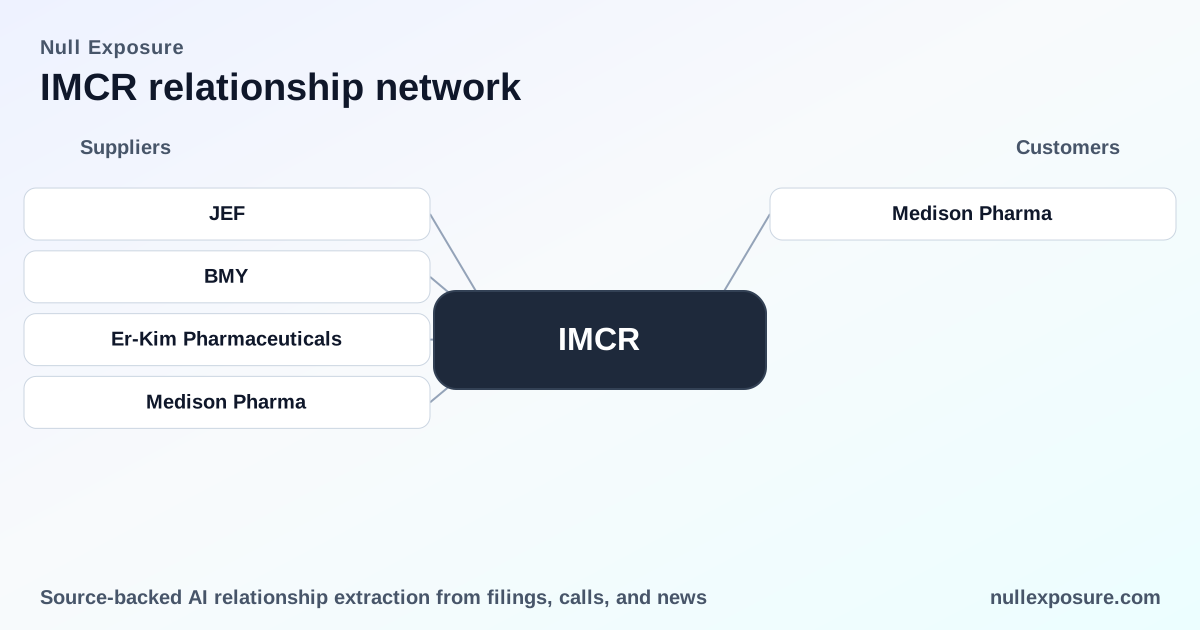
Market-facing partnerships documented in public releases show Immunocore is extending reach through distributors and regional partners rather than direct-market rollouts everywhere. The two recent public notices involving Medison Pharma illustrate this commercial strategy and its implications for revenue geography and execution risk.
What the Medison announcements signal about go-to-market strategy
Medison Pharma has expanded and deepened a longstanding multi-territorial relationship with Immunocore. One release announced the addition of new markets to an existing multi-territorial agreement; an earlier release documented the inclusion of South and Central America and the Caribbean into that same multi-territorial arrangement. These moves reflect Immunocore’s preference for regional distribution partners to commercialize KIMMTRAK in markets outside its core direct efforts.
- Medison Pharma expanded the multi-territorial agreement with Immunocore into additional markets, enabling broader regional commercialization under a partner-led model. According to a press release posted on presseportal.ch in March 2026, Medison described the addition of new markets to its agreement with Immunocore.
- Medison Pharma previously added South and Central America and the Caribbean to the multi-territorial agreement; that expansion was publicized via PR Newswire and references the earlier FY2022 scope extension into Latin America.
Both items are concrete examples of Immunocore using partner distribution to accelerate geographic coverage while concentrating its own commercial resources on priority markets.
You can review broader relationship signaling and partner-level detail at https://nullexposure.com/.
Every named customer relationship in the public signals
Medison Pharma — The company formalized an expanded multi-territorial commercialization arrangement with Immunocore, adding new markets to its remit; this continues a pattern of regional licensing to accelerate access to KIMMTRAK. Source: Presseportal press release, March 2026.
Medison Pharma — An earlier announcement documented the inclusion of South and Central America and the Caribbean into the same multi-territorial agreement, establishing Medison as Immunocore’s regional partner for Latin America. Source: PR Newswire release (referencing the FY2022 expansion).
How these relationships map to the operating model and constraints investors should price
-
Contracting posture and revenue recognition. Immunocore recognizes net revenue from sale of therapies at the point control transfers to a customer, typically on delivery to distributors and healthcare providers. This is a transactional, product-sale revenue model supplemented by licensing arrangements that transfer commercialization responsibilities to partners.
-
Geographic concentration and commercial focus. Company filings show revenue is concentrated in North America and Europe, with the United States accounting for the largest share ($226.7 million of $310.0 million sales in the year ended December 31, 2024) and Europe a material second. The business model is therefore inherently sensitive to commercial performance in the US and Europe while incremental upside depends on partner-led expansions in other regions.
-
Role mix: distributor and seller. Public disclosures clearly describe distributors as primary delivery points and Immunocore building its own commercial infrastructure selectively for direct sales. This hybrid model lowers capital intensity for geographic expansion but increases dependence on partner execution.
-
Product concentration and criticality. The company is focusing a significant portion of commercial resources on KIMMTRAK, its lead product and primary revenue driver. Revenue volatility and valuation are tightly correlated with KIMMTRAK uptake, reimbursement status, and competitive dynamics.
-
Reimbursement and government payor exposure. Public filings highlight the importance of adequate coverage and reimbursement from government and other third-party payors. Payor decisions are a material operating constraint for revenue growth and pricing power.
-
Maturity signal. Immunocore is a commercial-stage biotech with meaningful revenue (Revenue TTM ~$400M) but negative profitability metrics (Diluted EPS negative, operating margin and profit margin under pressure). The company is past early clinical-stage valuation dynamics but still in a commercialization ramp where execution, reimbursement, and distribution matter more than pipeline optionality for near-term value creation.
These constraints are company-level signals derived from public disclosures and should be treated as structural elements shaping Immunocore’s path to steady-state profit generation.
Investment implications and risk-adjusted view
-
Upside drivers. Continued uptake in the US and Europe is the primary lever for revenue expansion; partner expansions like the Medison agreements accelerate reach in Latin America and other markets with lower upfront investment. Positive payor decisions and expanded label use for KIMMTRAK will materially improve revenue visibility.
-
Key risks. High exposure to reimbursement outcomes and product concentration are immediate risk multipliers. The distributor-led expansion strategy reduces capital intensity but introduces execution and timing risk tied to partners’ commercial capabilities. Institutional ownership is high, but profitability metrics remain negative, requiring improvement in margins or successful label/market expansion to justify higher multiples.
-
What operators should monitor. Monitor shipment-to-sales cadence in new Medison markets, reported uptake metrics and inventory/reserve adjustments in regional disclosures, and any commentary on payor coverage for KIMMTRAK in new territories.
Bottom line for investors and operators
Immunocore’s commercial model is built on direct commercialization where necessary and partner distribution where it accelerates market access; valuation is therefore a function of KIMMTRAK acceptance in the US and Europe plus the execution capacity of regional partners like Medison. Reimbursement outcomes and distributor execution are the principal levers to watch.
For a concise, investor-ready consolidation of commercial signals and partner relationships, visit https://nullexposure.com/ for the underlying relationship references and sourcing.