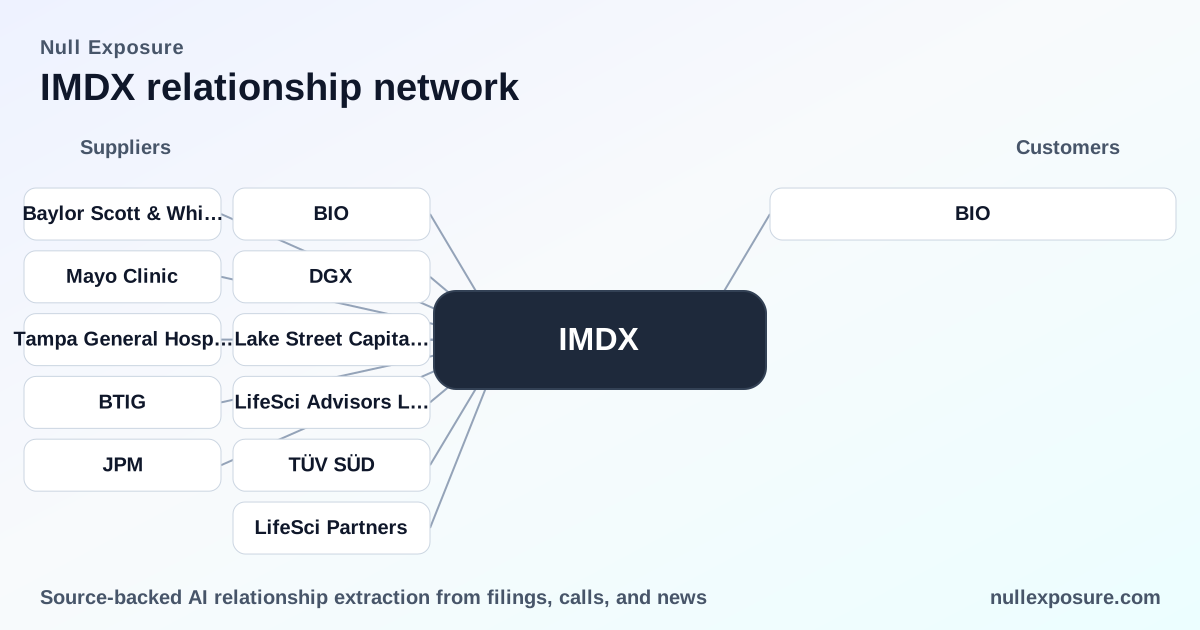
IMDX Customer Intelligence: How relationships shape risk and upside
Insight Molecular Diagnostics (IMDX) sells molecular diagnostic test kits that enable hospitals, transplant centers and labs to run in‑house testing, and supplements product revenue with fee‑for‑service Pharma Services. The company monetizes through kit sales and time‑and‑materials lab services; current financials show small revenue scale (Revenue TTM $4.06M) and negative operating performance (Operating Margin TTM -8.74, EBITDA -$28.3M), making customer relationships central to near‑term cash flow and strategic credibility. For immediate access to comprehensive relationship mapping and signals, visit https://nullexposure.com/.
Why customer intel matters for IMDX investors
IMDX is an early commercial diagnostic operator where a handful of institutional purchasers and one large Pharma Services client dominate working capital and revenue realization. Customer concentration is a structural risk and a lever for valuation — large, repeat institutional customers validate product fit but also create single‑point failure for receivables and near‑term cash flow. The company’s contracting posture is unit‑sale and service‑contract oriented: hospitals and labs buy tests and labs buy services; Pharma Services is billed T&M.
Relationship: BIO (ticker BIO)
Bio‑Rad Laboratories (listed as BIO in press references) participated in IMDX’s registered direct offering and is identified in reporting as a significant shareholder that bought on the same terms as other investors. Sahm Capital’s transaction notice from 11 February 2026 documents Bio‑Rad’s participation in the offering and confirms its shareholder position (Sahm Capital news release, Feb 11, 2026 — https://www.sahmcapital.com/news/content/imdx-announces-260-million-registered-direct-offering-2026-02-11).
Relationship: Bio‑Rad Laboratories, Inc.
Bio‑Rad Laboratories, Inc. is explicitly named in the same February 2026 offering announcement as a significant shareholder that participated alongside other investors in IMDX’s registered direct offering. This is the same investor relationship captured under the BIO ticker in external coverage and reinforces strategic investor support from a legacy diagnostics instrument and reagent company (Sahm Capital news release, Feb 11, 2026 — https://www.sahmcapital.com/news/content/imdx-announces-260-million-registered-direct-offering-2026-02-11).
What the Bio‑Rad participation means operationally
Bio‑Rad’s purchase in a financing is a credibility signal to the market and to potential institutional customers, and it can be interpreted as alignment with IMDX’s go‑to‑market for test kits and laboratory services. For operators, Bio‑Rad’s investment reduces immediate financing stress and may smooth commercial conversations with hospitals and labs that value supplier stability. From an investor perspective, Bio‑Rad’s involvement is a partial de‑risking factor for execution — but it does not remove the company’s dependence on a small number of large institutional buyers for receivables and services revenue.
Company‑level signals and constraints that shape customer risk
The underlying relationship data and company disclosures produce several actionable operating model signals:
-
Severe revenue/receivables concentration. According to company disclosures for the year ended December 31, 2024, one Pharma Services customer represented approximately 97% of accounts receivable. That level of concentration creates acute counterparty and cash‑flow risk for IMDX and makes credit terms with that customer a key valuation variable.
-
Institutional buyer posture. IMDX states that its customers are hospitals, transplant centers and labs, which establishes the firm’s contracting posture as selling into institutional procurement and clinical workflow cycles rather than direct‑to‑consumer channels.
-
Core product vs. services split. The business model is built around molecular diagnostic test kits that enable customers to run tests locally (a decentralized testing posture) while Pharma Services are provided on a time‑and‑materials basis. This hybrid model exposes IMDX to both product margins and variable service utilization dynamics.
-
Customer spend scale signal. Extracted signals indicate a customer spend band in the $1M–$10M range for material Pharma Services relationships. That spend profile is consistent with a single large contract driving the majority of AR while the broader installed base remains limited.
Taken together, these constraints define IMDX’s operating characteristics: high concentration, institutional buyer contracts, hybrid product/service revenue, and early commercial maturity with limited revenue scale. None of these factors is uniquely tied to the Bio‑Rad relationship; they are company‑level dynamics investors should monitor.
Financial context that amplifies customer importance
IMDX’s revenue base is modest (Revenue TTM $4.06M) with a gross profit of $2.31M and negative profitability metrics across the income statement. When a single Pharma Services customer accounts for most receivables, any delay or non‑payment materially alters liquidity and short‑term solvency. Meanwhile, Bio‑Rad’s support via participation in a registered direct offering relieves financing pressure but does not substitute for diversified, repeatable commercial sales.
Bottom line: what to watch and why it matters
- Monitor receivables and customer diversification. Given the 97% AR concentration, quarterly disclosures on accounts receivable and customer concentration must be read as forward signals for cash‑flow stress or recovery.
- Track Pharma Services revenue retention and contract terms. Time‑and‑materials billing gives IMDX variable cash flow; conversion of Pharma Services to recurring or multi‑year contracts would materially lower execution risk.
- Assess strategic investor activity. Bio‑Rad’s financing participation provides credibility and potential commercial pathways, but investors should verify whether that relationship evolves into distribution, co‑development, or supply agreements.
Investment implication: IMDX is a small‑scale diagnostic operator where upside depends on scaling kit adoption and reducing single‑customer exposure in Pharma Services; Bio‑Rad’s financial participation is positive for credibility, but the company’s near‑term valuation is governed by concentration and cash‑flow execution.
For a deeper read on relationship signals and how they affect valuation, visit https://nullexposure.com/ for detailed relationship maps, evidence traces, and monitoring workflows.