Immuneering (IMRX) — Strategic capital, one partner in focus, and what that means for investors
Immuneering (IMRX) develops targeted oncology and precision therapeutics using machine‑assisted discovery and bioinformatics, and it monetizes primarily through equity financings and strategic collaborations rather than product sales today. The company finances development with follow‑on offerings and selective strategic investments — most recently a material private placement with Sanofi — making capital markets and partner commitments the core revenue runway for the business. Learn more about our coverage at https://nullexposure.com/.
Where the company stands: a finance‑first early‑stage biotech
IMRX is an early‑stage biotech with a small reported revenue base (TTM revenue $455) and negative profitability (EBITDA -$59M; diluted EPS -$1.27). Market capitalization sits around $348M and analysts list a median target of $17 per share. The firm’s business model is development‑stage: value is created through pipeline progress and converted via financings and strategic placements rather than operating cash flows. That creates a capital‑markets exposure profile: share issuance and partnership terms determine dilution and runway more than product revenue today.
How the Sanofi transaction shows the operating mechanics
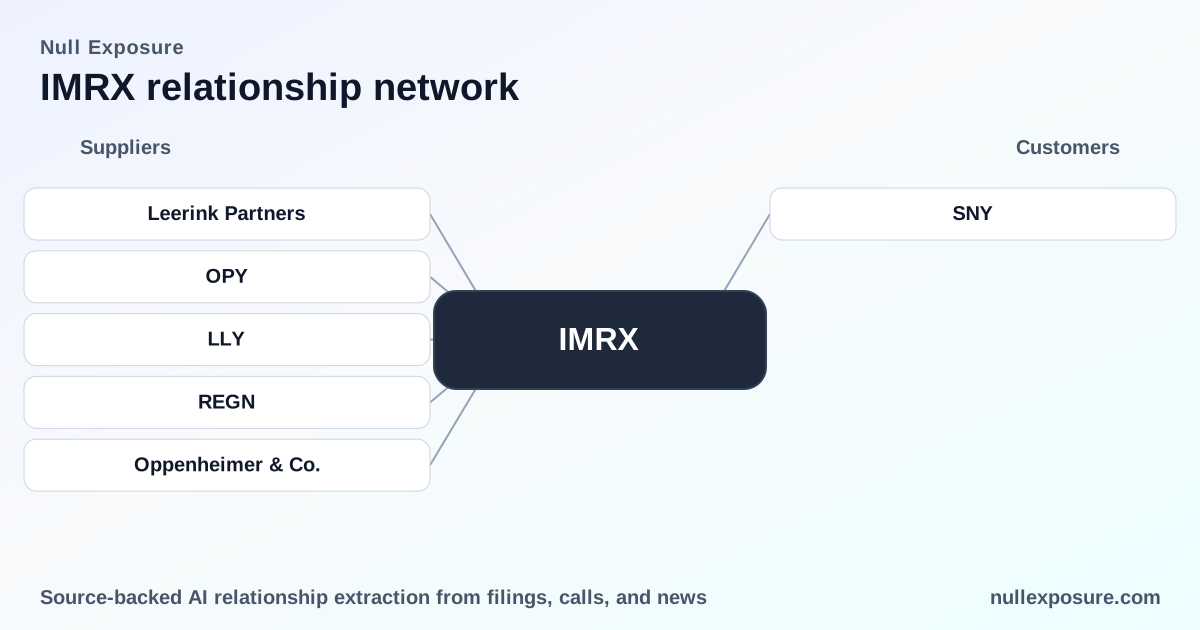
Sanofi’s purchase of Immuneering shares in a private placement is the dominant—and effectively sole—customer relationship documented in the set. That transaction exemplifies the company’s current contracting posture: equity sales to strategic partners executed alongside underwritten public offerings. For investors, this translates into two immediate structural implications: 1) access to partner capital reduces short‑term financing risk, and 2) concentration risk increases because a single strategic investor takes a meaningful position.
Exhaustive relationship log (each entry from source results)
-
Sanofi agreed to purchase 2,708,559 shares of Immuneering’s Class A common stock at $9.23 per share as a private placement concurrent with a public offering; reporting captured this after the public offering pricing was announced. Source: Investing.com report on the offering (first seen 2026‑05‑03): https://www.investing.com/news/company-news/immuneering-prices-175-million-public-offering-at-923-per-share-93CH-4254540.
-
Immuneering announced that Sanofi would purchase 2,708,559 shares at $9.23 per share in a private placement expected to close concurrently with the public offering; the release framed this as part of the offering package. Source: Manila Times / GlobeNewswire press release summarizing the offering terms (reported 2025‑09‑25): https://www.manilatimes.net/2025/09/25/tmt-newswire/globenewswire/immuneering-announces-pricing-of-175-million-underwritten-public-offering-of-class-a-common-stock-and-concurrent-25-million-private-placement-of-class-a-common-stock-to-sanofi/2190161.
-
The same Manila Times / GlobeNewswire item was indexed under Sanofi’s ticker (SNY) and reiterated the private placement of 2,708,559 shares at $9.23 per share alongside the public offering. Source: Manila Times / GlobeNewswire (duplicate listing, first seen 2026‑03‑10): https://www.manilatimes.net/2025/09/25/tmt-newswire/globenewswire/immuneering-announces-pricing-of-175-million-underwritten-public-offering-of-class-a-common-stock-and-concurrent-25-million-private-placement-of-class-a-common-stock-to-sanofi/2190161.
-
Immuneering disclosed that Sanofi entered a securities purchase agreement to buy $25.0 million of IMRX Class A common stock (or, alternatively, Class B non‑voting shares) at the public offering price as part of a Private Placement. Source: GlobeNewswire press release announcing the proposed offering and private placement (reported 2025‑09‑25): https://www.manilatimes.net/2025/09/25/tmt-newswire/globenewswire/immuneering-announces-proposed-underwritten-public-offering-of-class-a-common-stock-and-pre-funded-warrants-and-proposed-concurrent-private-placement-of-class-a-common-stock-and-class-b-common-stock-to-sanofi/2190017.
-
A second index entry repeating the securities purchase agreement language recorded Sanofi’s $25.0 million commitment to the private placement, noting that Sanofi could receive Class A common stock or non‑voting Class B stock at the offering price. Source: GlobeNewswire / Manila Times aggregation (duplicate listing, first seen 2026‑03‑10): https://www.manilatimes.net/2025/09/25/tmt-newswire/globenewswire/immuneering-announces-proposed-underwritten-public-offering-of-class-a-common-stock-and-pre-funded-warrants-and-proposed-concurrent-private-placement-of-class-a-common-stock-and-class-b-common-stock-to-sanofi/2190017.
-
Immuneering’s official GlobeNewswire release stated Sanofi’s securities purchase agreement for $25.0 million in the Private Placement, confirming this element in the company’s offering materials. Source: GlobeNewswire press release by Immuneering (published 2025‑09‑24): https://www.globenewswire.com/news-release/2025/09/24/3155839/0/en/Immuneering-Announces-Proposed-Underwritten-Public-Offering-of-Class-A-Common-Stock-and-Pre-Funded-Warrants-and-Proposed-Concurrent-Private-Placement-of-Class-A-Common-Stock-and-Cl.html.
What this relationship bundle tells investors about IMRX’s operating model
- Contracting posture: IMRX structures capital access through coordinated underwritten offerings with simultaneous private placements to strategic partners. That puts the company in a financing‑first posture rather than licensing‑for‑royalty posture today.
- Concentration: With Sanofi taking a large private placement, investor concentration increases; that is a two‑edged sword — it validates science with a blue‑chip partner while concentrating governance and funding exposure.
- Criticality: The Sanofi transactions are capital commitments, not service contracts; their criticality is to IMRX’s runway and perceived de‑risking by the market. Sanofi’s stake is material to funding near‑term development.
- Maturity: Financials indicate pre‑commercial maturity: negligible revenues, meaningful R&D burn, and reliance on capital markets and partnerships to fund operations.
There are no constraint excerpts in the dataset to attach as formal limits on supply, performance, or contractual exclusivity; the information set is limited to announced securities purchase agreements and offering documents. That absence is itself a signal: no public operational constraints (for example, supplier lock‑ins or customer exclusivity) were flagged in the material reviewed.
Investment implications and what to watch next
- Key positives: The Sanofi private placement is a credible validation event that materially strengthens IMRX’s near‑term financing profile and signals partner interest in clinical or platform potential.
- Key risks: The company remains development‑stage with negative EBITDA and minimal revenue, so execution hinges on pipeline progress and the ability to access further capital without excessive dilution. Sanofi’s concentrated investment increases both support and single‑counterparty exposure.
- Catalysts to monitor: closing of the private placement, use of proceeds disclosures, clinical readouts, and any subsequent collaboration or licensing terms that convert capital into milestone or royalty economics. Analyst sentiment and the reported $17 target price will recalibrate if the private placement closes at the disclosed pricing and the company publishes use‑of‑proceeds and milestone plans.
For a deeper, transaction‑level review of IMRX partner activity and capital events, visit https://nullexposure.com/.
Bottom line
Immuneering is operating as a development‑stage biotech that monetizes through strategic equity placements and public offerings rather than product revenues. Sanofi’s $25M private placement and the 2.7M share purchase at $9.23 per share are the dominant customer/partner disclosures in the reviewed set and the central determinant of near‑term runway and market perception. Investors should prioritize deal close confirmation, disclosure of proceeds allocation, and upcoming clinical milestones as the primary value drivers.