Immunovant (IMVT): Commercial runway hinges on clinical progress and a deep-pocketed parent
Immunovant is a clinical-stage biopharmaceutical company that develops monoclonal antibodies targeting autoimmune diseases; it monetizes by advancing candidates through clinical trials toward regulatory approval and, if approved, commercial sales — supplemented today by equity financing backed by its controlling stockholder. Investors should evaluate Immunovant as a development-stage therapeutics business with revenue upside tied to successful late‑stage readouts and a balance-sheet profile materially influenced by Roivant’s continued capital support. For a structured view of customer and stakeholder signals, see more at NullExposure.
Quick investor thesis: how the company operates and makes money
Immunovant operates as a classic clinical-stage biotech: it invests R&D capital into a pipeline (notably anti‑FcRn programs), advances candidates through clinical endpoints, and will only monetize at scale through product approval and commercialization or via licensing/partnering transactions. Near-term value drivers are clinical momentum, capital access, and strategic support from its controlling shareholder, which together determine the company’s ability to reach commercialization without dilutive distress.
Key operating-model signals investors should track
- Capital and contracting posture: Immunovant requires periodic equity financing to fund trials and build commercialization infrastructure; recent transactions show the company relies on sponsor-led capital injections rather than product revenues.
- Ownership concentration and influence: A controlling stockholder purchases in financings, which reduces market liquidity for free float holders but provides a predictable source of capital and strategic alignment.
- Commercial scope and maturity: The business is clinical-stage with no product revenue to date; management projects building a U.S. sales and distribution organization and broader global infrastructure if candidates are approved. That path establishes a long lead time to commercialization and significant operational scaling risk.
- Payer and reimbursement risk: Government and commercial payor coverage is an explicit constraint on future revenue, making pricing and market access an important post-approval execution risk.
These signals translate into an operating profile where clinical success is critical, capital sponsorship is a material support factor, and commercial execution will require new capabilities and resources.
Customer and stakeholder relationships — what the record shows
OABI — third‑party recognition of clinical momentum
In an OABI earnings call for fiscal 2025 Q4, Immunovant was cited for “strong progress” and “clinical momentum in the anti‑FcRn space,” indicating that industry peers and market commentators observe and reference Immunovant’s development trajectory. According to an OABI earnings call (2025 Q4), the company’s anti‑FcRn programs are seen as advancing. (Source: OABI earnings call, 2025 Q4)
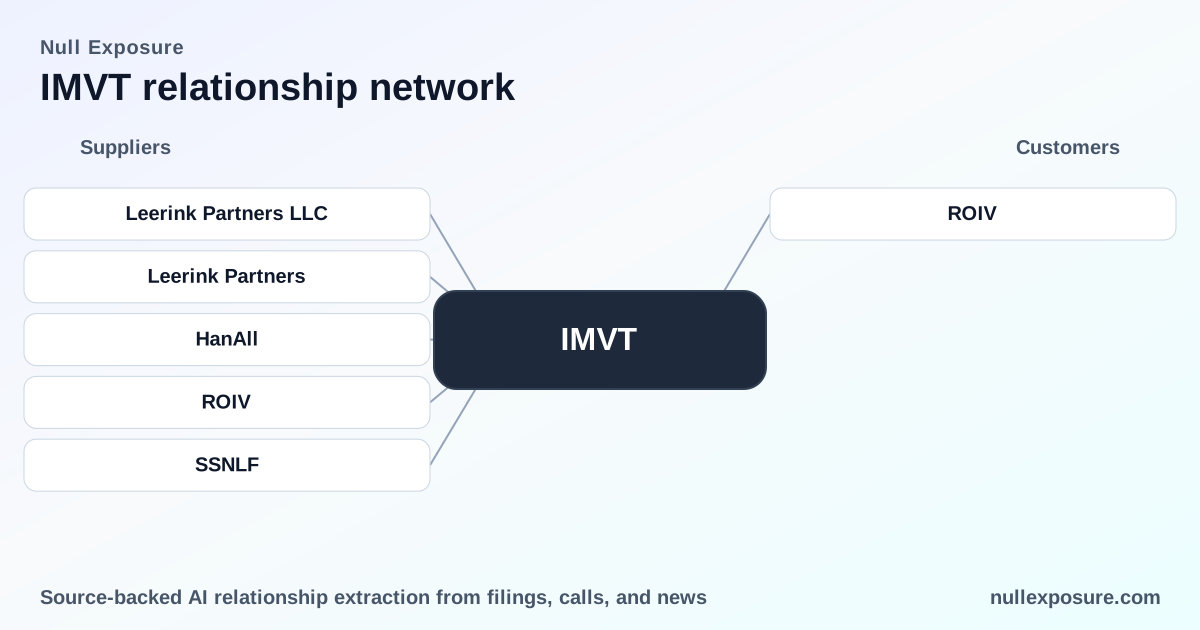
Roivant Sciences Ltd. / ROIV — controlling stockholder supporting a $550M offering
Multiple press releases reported that Roivant Sciences Ltd., Immunovant’s controlling stockholder, agreed to purchase shares in a $550 million common stock financing priced in December 2025. This underwriting confirms both capital access and the practical influence of Roivant on financing outcomes. A Globe and Mail press release (Dec 2025) and a GlobeNewswire/ManilaTimes distribution (Dec 11, 2025) reported Roivant’s participation in the offering and its position as the company’s controlling shareholder. (Sources: Globe and Mail press release, Dec 2025; GlobeNewswire/ManilaTimes distribution, Dec 11, 2025)
Note: the public record contains multiple identical press distributions documenting the same transaction; both sources corroborate Roivant’s participation and the financing size.
What each relationship implies for shareholders
- OABI mention: Peer recognition of pipeline progress provides an independent signal that Immunovant’s programs are visible in the competitive landscape — a positive for investor confidence in scientific momentum. The mention does not imply commercial adoption, only clinical and R&D recognition from a market participant.
- Roivant participation: Roivant’s purchase in the equity financing is a strong capital support signal that reduces near‑term funding risk and supports execution of clinical and operational plans. At the same time, concentrated ownership introduces governance and liquidity dynamics investors must price.
Constraints and business-model characteristics to factor into valuation
The company disclosures and relationship evidence highlight several company-level constraints that shape strategic and valuation outcomes:
- Government reimbursement risk is a company-level reality. Immunovant explicitly states there is no assurance of coverage or adequate reimbursement under government programs, which directly affects pricing power and peak‑sales scenarios post‑approval. This is a structural commercial risk, not tied to any single partner.
- Global commercialization requires new infrastructure. The company acknowledges the need to build additional infrastructure to support global sales and marketing if its products are approved, which implies significant incremental SG&A investment, partner-selection risk, and execution risk for international markets.
- U.S. market focus at launch. Management expects to build a focused U.S. sales, distribution, and marketing organization for initial market entry, implying a phased commercial roll‑out where North America is prioritized and international expansion follows.
Taken together, these constraints indicate a staged commercialization plan with concentrated up‑front investment and material exposure to payer negotiations and reimbursement outcomes.
Risk versus opportunity — how to think about IMVT exposure
- Opportunities: Successful pivotal readouts for anti‑FcRn assets would unlock primary commercialization value and create optionality for licensing or partnership monetization. Continued Roivant support reduces bankruptcy and funding tail risk.
- Risks: Clinical failure, unfavorable payer pricing, or slow build‑out of commercial infrastructure would materially impair valuation. Additionally, high insider/control concentration affects free-float liquidity and governance dynamics.
Bottom line and next steps for investors
Immunovant is a capital-intensive, clinical-stage investment whose upside is concentrated in trial outcomes and whose near-term stability is materially underwritten by Roivant’s balance-sheet participation. Active monitoring should prioritize clinical readouts, subsequent financing terms, and evolving statements on commercialization strategy and payer engagement.
For a concise, transaction‑level view and ongoing tracking of IMVT stakeholder signals, visit NullExposure.