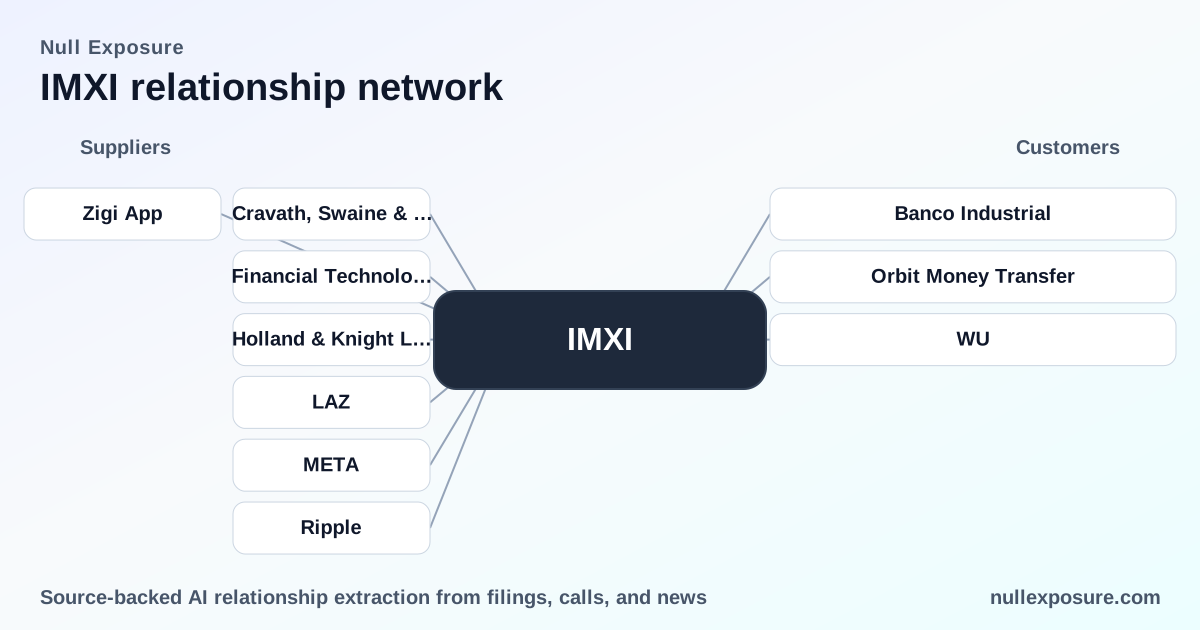
Intermex (IMXI): Remittance merchant with growing B2B digital footprint and concentrated corridor exposure
International Money Express (Intermex, IMXI) operates an omnichannel remittance business that collects transaction fees from individual senders across the U.S., Canada and parts of Europe and delivers payments to beneficiaries primarily in Latin America, the Caribbean, Africa and Asia. The company monetizes through consumer-paid transfer fees and related FX spreads, shared with local sending and paying agents, while expanding revenue channels by licensing Intermex Digital Solutions to banks and digital partners. For investors, the story is a mix of stable fee-based cash flow from a high-volume corridor and accelerating B2B digital relationships that diversify distribution but leave the business exposed to corridor concentration and M&A/ regulatory headlines.
Visit our research hub for more coverage: https://nullexposure.com/
What Intermex sells, and where that matters
Intermex is a services business: remittance revenue derives primarily from fees paid by consumers who send money, executed through a network of authorized retail agents, company-operated stores and digital channels. The operating model is optimized for the North America → Latin America corridor: that corridor is the primary revenue engine and therefore a critical concentration risk for the business. The company also sells its digital platform capabilities to financial institutions and payment partners, turning operational infrastructure into a second, growing monetization vector.
Key commercial relationships — a concise inventory
Below I walk through every customer/partner reference surfaced in the recent feed and what each relationship means for IMXI’s go-to-market and risk profile.
Banco Industrial
Intermex partnered with Guatemala’s Banco Industrial to bring a digital remittance product to market via the bank’s new Zigi mobile platform. According to the company press release, Intermex Digital Solutions powers Banco Industrial’s Zigi App to enable Guatemalans to receive remittances digitally (GlobeNewswire, Dec 2, 2025). This is a strategic B2B client win that converts Intermex’s payout network into a white‑label digital proposition.
Zigi (the app)
Zigi is the digital financial platform launched by Banco Industrial and powered by Intermex; the app is the customer-facing product of that same partnership. The GlobeNewswire release describes Zigi as Banco Industrial’s digital remittance app “powered by Intermex Digital Solutions,” effectively making Zigi both a distribution channel and a proof point for Intermex’s B2B software offering (GlobeNewswire, Dec 2, 2025).
Orbit Money Transfer
Intermex expanded into Canada through a distribution and payout partnership with Orbit Money Transfer, connecting Orbit’s senders to Intermex’s payout network across Latin America and the Caribbean. Media coverage noted the tie-up as an expansion move that allows Orbit customers to access Intermex’s retail and digital payout rails for faster delivery (Finviz/Intellectia coverage, March 2026). This transaction underscores Intermex’s strategy of scaling reach via third-party send partners rather than relying solely on company-operated outlets.
LA Galaxy / Dignity Health Sports Park
Intermex signed a sports marketing and sponsorship agreement, becoming a founding partner of Dignity Health Sports Park and the official international remittance partner of LA Galaxy, supporting brand visibility among remittance-sending communities in the U.S. The sponsorship was announced in a company press release dated May 29, 2025 and is designed to strengthen Intermex’s consumer brand in key urban markets (FinancialContent press release, May 29, 2025).
The Western Union Company (WU) — M&A/Investigation headline
A shareholder-alert press release flagged an investigation into IMXI related to its sale to The Western Union Company, creating a near-term legal and disclosure overhang tied to the proposed transaction. The PR Newswire item described an investigation concerning Intermex’s sale to Western Union and is the source of heightened attention around the deal process (PR Newswire, March 2026). This development elevates regulatory, litigation and execution risk around any strategic transaction.
Operating-model constraints and what they imply for investors
The information set provides several company-level signals about how Intermex runs and scales its business:
- Counterparty type: Individual-focused revenue — Intermex’s core revenue is fee income from consumer senders, which makes the company’s economics highly transactional and volume-sensitive rather than enterprise-contract reliant.
- Geography: North America-focused distribution with LatAm payout concentration — The company operates primarily from the U.S./Canada to Latin America and the Caribbean, with growing presence in EMEA markets, supporting both scale and corridor concentration.
- Materiality: Remittance corridors are critical — Money remittances to Mexico, Guatemala and other LAC countries are the primary revenue source and therefore a critical dependency for cash generation.
- Role: Seller of services and platform — Intermex is primarily a seller of remittance services and increasingly a vendor of digital solutions to financial institution partners.
- Segment: Services-first business model — The firm’s single reportable segment is money remittal services delivered through omnichannel retail and digital platforms.
These constraints imply a contracting posture where Intermex must both defend volume-driven consumer margins and pursue B2B relationships to diversify distribution and raise margins on digital services. Concentration in specific corridors increases volatility to macro migration flows and FX; digital partnerships reduce cash-flow volatility but require execution and integration.
Investment implications and risk checklist
- High-margin repeat revenue from consumer fees supports steady EBITDA generation, but top-line growth depends on transaction volumes and pricing in competitive corridors.
- B2B partnerships (Banco Industrial/Zigi, Orbit) are strategic: they convert Intermex’s payout rails into scalable, lower-capex revenue streams and expand reach into Canada and Guatemala.
- Brand investments (LA Galaxy) indicate a push to defend and grow share among U.S.-based senders; marketing spend is earnings-accretive only if it sustains or grows transaction frequency.
- M&A/Regulatory overhang (Western Union investigation) is the most immediate risk to valuation and near-term cash outcomes; legal or regulatory friction could delay or alter sale economics.
- Geographic concentration creates sensitivity to corridor-specific regulation, FX volatility and migration flows; diversification into EMEA and digital services reduces but does not eliminate that exposure.
Bottom line: durable service economics with execution and M&A risk
Intermex delivers fee-for-service economics anchored in the North America→LatAm corridor, with growing emphasis on monetizing its platform through B2B deals such as Banco Industrial/Zigi and Orbit. These partnerships are material strategic upgrades to distribution and monetization, while the Western Union-related investigation introduces a distinct near-term governance and execution risk that investors must price. For further, regularly updated coverage and relationship intelligence, see https://nullexposure.com/.