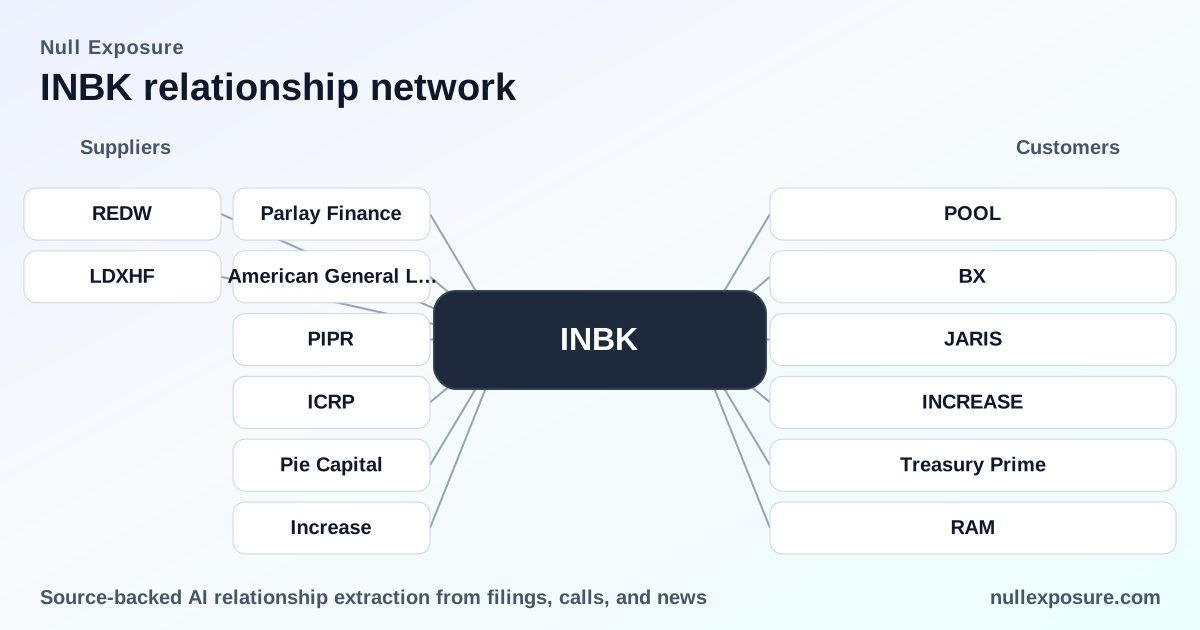
First Internet Bancorp (INBK): Customer Relationships and Strategic Implications
Thesis — First Internet Bancorp operates as a digital-first regional bank that monetizes through deposit gathering, loan originations (including SBA and public finance), servicing revenue, and Banking-as-a-Service (BaaS) partnerships. The company converts balance-sheet lending into fee and capital-efficient outcomes through loan sales and retained servicing, and it leverages third‑party fintech and BaaS partners to scale deposit and payment flows without a traditional branch footprint. For deeper coverage of relationships and signals, visit https://nullexposure.com/.
How First Internet makes money and structures customer flows
First Internet Bank of Indiana is a digital depositor and originator: it wins consumer and small-business deposits nationwide, originates a mix of commercial, small-business, municipal and consumer loans, and captures economics both on balance sheet and through sale-and-servicing arrangements. Key monetization levers include net interest margin on retained loans, gains on sale for loans originated under embedded finance arrangements, and recurring loan-servicing revenue from sold portfolios. Management actively uses strategic loan sales to reshape capital and rate-risk profiles while expanding fee-generating BaaS relationships.
Company-level customer profile and operating constraints
Investors should treat these signals as company-level operating characteristics rather than relationship-specific claims:
- Customer mix is diversified across government, non‑profit, individuals and small businesses. First Internet underwrites municipal and not-for-profit public finance loans as well as SBA-backed small-business loans and retail consumer products, indicating a multi-segment revenue base.
- Nationwide digital reach with regional portfolio concentration. The bank acquires deposits across the U.S. via digital channels without branches, while some loan portfolios remain concentrated in the Midwest and Southwest.
- Service-provider posture where it retains loan servicing. The firm recognizes servicing assets and records loan servicing revenue ($6.2M in 2024), showing an operating model that sells assets but preserves recurring servicing fees.
- Services segment importance. Loan servicing and embedded finance are strategic services lines that materially contribute to fee revenue and product differentiation.
These constraints point to a contracting posture that is partnership-oriented (BaaS and embedded finance deals), a concentration profile that balances nationwide deposit sourcing with regional asset pockets, and a mature product set that includes both balance-sheet lending and fee-based servicing.
Relationship map: what matters for investors
Below I summarize every named customer and partner relationship cited in public materials and call transcripts. Each entry is a concise, plain-English description with source attribution.
Blackstone / BX / Blackstone Real Estate Debt Strategies (BREDS)
First Internet completed a substantial strategic sale of single‑tenant lease financing loans to Blackstone-affiliated vehicles, approximately $850–869 million, which strengthened capital and improved the bank’s rate-risk profile. According to the company’s public disclosures and reporting, this sale accelerated progress toward profitability goals and materially altered First Internet’s balance-sheet composition (ConnectMoney reported the $869M agreement as of March 2026; company highlights and earnings commentary referenced the ~$850M sale in the Q4 2025 transcript and TradingView summary, March 10, 2026).
POOL (Pool Corporation / “pool money”)
Management announced that “pool money” was being brought live, indicating an activation of a deposit or cash-management initiative branded as POOL money. This initiative was discussed on the Q4 2025 earnings call transcript (InsiderMonkey transcript, March 10, 2026), signaling a new deposit product or platform activation tied to First Internet’s digital deposit strategy.
JARIS
First Internet records a gain on sale for embedded finance loans originated for JARIS, indicating a revenue stream from originating loans for fintech partners and then monetizing those assets via sale. This arrangement was disclosed on the Q4 2025 earnings call transcript (InsiderMonkey transcript, March 10, 2026) and demonstrates the bank’s embedded-lending commercialization pathway.
INCREASE
First Internet Bank was a co‑winner of American Banker’s payments innovation of the year for work with INCREASE, reflecting a successful collaboration to deliver higher‑fidelity ACH and improved payment reliability. That accolade was noted in the Q4 2025 transcript and positions payments innovation as a strategic capability (InsiderMonkey transcript, March 10, 2026).
Treasury Prime
Treasury Prime announced a formal Banking-as-a-Service partnership with First Internet Bank to extend embedded finance offerings to fintech and small-business clients; this formalized BaaS distribution channel dates to an announced agreement in 2022 (reported by FFNews, 2022). The Treasury Prime partnership underpins First Internet’s strategy to scale product distribution without branch expansion.
RAM
Management identified RAM as the largest single source of deposits, describing it as “the biggest source of deposits for us” on the company earnings call. This is a critical deposit-concentration signal for investors because RAM is a primary funding source referenced in the Q4 2025 earnings call transcript (InsiderMonkey transcript, March 10, 2026).
Strategic takeaways and risk considerations
- Capital and rate-risk management through loan sales is now a core lever. The Blackstone transaction is transformative for capital allocation and demonstrates management’s willingness to monetize large portfolios to accelerate returns on assets.
- BaaS and embedded finance are material growth vectors. Partnerships with Treasury Prime, INCREASE, and JARIS show First Internet executes a two-pronged strategy: originate loan volume and monetize through sale/gain-on-sale plus recurring servicing fees.
- Deposit concentration warrants monitoring. RAM’s outsized role as the largest deposit source and the activation of branded deposit initiatives like POOL expose the company to counterparty and product-concentration risks that investors should track.
- Service revenue stabilizes fee income. Loan servicing revenue ($6.2M in 2024) gives the bank recurring, non‑interest income that offsets interest-margin variability and demonstrates maturity in selling-with-servicing economics.
What investors should watch next
- Execution and economics of the POOL launch and its impact on deposit costs and retention.
- Ongoing servicing revenue trends and the pace of gains-on-sale from embedded finance partners (JARIS and others).
- Any follow‑on transactions with Blackstone-affiliated vehicles or other institutional buyers that could further reshape capital and rate-risk metrics.
For a deeper, interactive view of these customer relationships and signals, explore our research hub: https://nullexposure.com/.
Bold final note: First Internet Bancorp is operating as a hybrid balance-sheet lender and platform provider; its partner contracts (BaaS, embedded finance, and large-sale dispositions) are the company’s primary levers to convert scale into durable profitability.