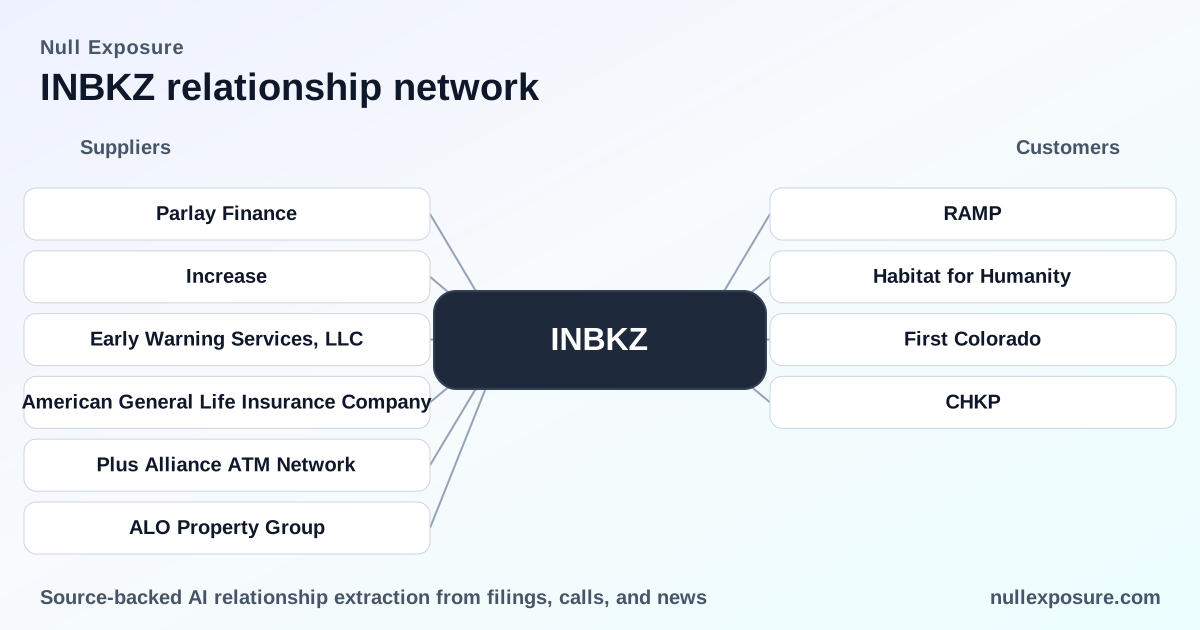
First Internet Bancorp (INBKZ) — customer map and commercial logic
First Internet Bancorp operates as a digital-first bank that monetizes through interest income on loans, deposit-funded lending spreads, fee income from banking services, and targeted gains on loan sales and embedded-finance programs. The company sources deposits both directly from retail and small-business customers and indirectly through platform partnerships, uses those deposits to fund consumer, mortgage and commercial loans, and periodically sells loan pools to institutional buyers to manage capital and interest-rate risk. For investors and operators, the critical questions are how durable partner-sourced deposits are, how repeatable loan-sale economics will be, and the degree to which small-business and platform relationships concentrate funding or credit risk. Learn more at https://nullexposure.com/.
How partners and customers actually interact with the bank
Below I walk through every customer relationship surfaced in available reporting and filings, summarizing what each partner contributes to First Internet’s business and citing the public source for that conclusion.
Ramp — a major deposit source and payments pilot
First Internet identifies Ramp as “the biggest piece” of partner-sourced deposits and a pilot participant for the bank’s business ACH/payments dashboard, underscoring Ramp’s role as both a deposit originator and payments customer. According to the Q4 2025 earnings call transcript (Investing.com, May 3, 2026), Ramp is the largest single source of deposits for the bank; American Banker (March 2026) also reported Ramp is piloting the bank’s business ACH dashboard.
Pool — new embedded-program customer coming online
Pool is an upcoming program partner that First Internet expects to bring live imminently; management described Pool as a program that fits the bank’s selective pipeline of “something special.” The Q4 2025 earnings call transcript notes Pool will be coming live within days of the call (Investing.com, May 3, 2026).
Blackstone — loan-sale buyer that improved capital and rate profile
First Internet completed a strategic sale of roughly $850 million of single-tenant lease financing loans to Blackstone, a transaction management flagged by management as strengthening capital and improving interest-rate risk metrics. That sale was disclosed in the Q4 2025 earnings call transcript (Investing.com, May 3, 2026).
Habitat for Humanity — community lending partner for mortgages
First Internet entered a $16 million lending partnership with Habitat for Humanity to support home purchases in Indianapolis, reflecting the bank’s community lending and mortgage origination activity. The arrangement was reported by local news outlet YouAreCurrent (Nov 2, 2022) and cited in later aggregate coverage.
Jaris — embedded finance loan originations with gain-on-sale economics
Management identified gain-on-sale income tied to embedded-finance loans originated for Jaris, indicating First Internet originates consumer or specialty loans for platform partners and realizes sale economics when those loans are transferred. This revenue detail was disclosed in the Q4 2025 earnings call transcript (Investing.com, May 3, 2026).
First Colorado — assigned authority and contractual claim history
First Colorado granted First Internet Bank of Indiana authority to act on its behalf, and an assignment was transferred in the context of a claims matter reported in legal and insurance press. That assignment and related litigation were covered by Insurance Business Magazine (2025 coverage referenced March 2026 reporting).
Increase — platform deposit program partner
First Internet holds deposits placed through a program with Increase, identifying Increase as a platform partner whose program contributes deposits to the bank’s balance sheet. Management mentioned these deposits in the Q4 2025 earnings call transcript (Investing.com, May 3, 2026).
Check (CHKP) — payments/dashboard pilot customer
Check is a business customer piloting First Internet’s ACH payments dashboard alongside Ramp, enabling customers to see when payments clear and to guarantee timely payroll delivery to recipients; this demonstrates the bank’s effort to productize payments visibility for B2B customers. American Banker (March 2026) reported Check and Ramp as pilot customers for the dashboard; related mentions appear in the same coverage under the ticker CHKP.
CHKP (duplicate listing) — same relationship reported under ticker
The dataset lists Check again under the CHKP ticker; the underlying fact is identical: Check/CHKP are pilot customers for the bank’s business ACH/payments dashboard as reported by American Banker (March 2026).
What the relationship map implies about First Internet’s operating model
- Digital-first, nationwide customer posture. First Internet conducts consumer and small-business deposit operations primarily through digital channels with no traditional branch network, which drives scale efficiencies but concentrates operational dependency on platform integrations and digital deposit sourcing.
- Small-business and SBA lending emphasis. Management highlights the bank’s position as a leading SBA 7(a) lender and nationwide small-business lender, which signals a strategic focus on small-business credit products and related servicing workflows.
- Partner-driven deposit concentration. The prominence of Ramp and Increase as deposit sources signals concentration risk in partner-sourced funding; these relationships are high-impact for liquidity and therefore critical to day-to-day funding.
- Active capital management via loan sales. The Blackstone loan sale and gain-on-sale activity with embedded finance partners like Jaris show First Internet uses disposals to manage capital and interest-rate exposure rather than holding all originated paper to maturity.
- Mixed counterparty footprint. Constraints data indicate dealings across individuals, small businesses, and government/municipal segments, positioning the bank as a multi-segment provider rather than a narrowly retail or institutional franchise.
- Relationship roles are plural. First Internet functions as a buyer, seller and service provider — offering loans, hedging instruments (interest rate swaps to loan customers), and payments services — which increases complexity but diversifies revenue levers.
Investment implications and risk checklist
- Key strength: Partner programs (Ramp, Increase, Check) deliver low-cost, scalable deposits and product distribution that support loan growth and NIM expansion when deposit pricing remains stable.
- Key risk: Funding concentration from a few platform partners creates potential liquidity vulnerability if partnerships change or deposit flows decline.
- Capital flexibility: The Blackstone loan sale demonstrates the bank’s ability to free capital and adjust interest-rate risk — a positive governance tool to preserve ROA targets.
- Revenue mix nuance: Embedded-finance gain-on-sale streams (Jaris) supplement interest income but create earnings variability tied to program origination volumes and market appetite for loan purchases.
- Reputational/community angle: The Habitat for Humanity partnership positions the bank favorably in community lending and CRA-type optics, which supports franchise value in local and regulatory contexts.
If you want an enterprise-ready view of how these partner relationships translate into credit and funding sensitivities for valuation or counterparty monitoring, Null Exposure maintains ongoing tracking and signal synthesis at https://nullexposure.com/.
Bottom line
First Internet Bancorp operates a digital, partnership-led banking model that monetizes through loan spreads, fees, and selective loan sales; its performance will be driven by the durability of platform deposit relationships, the repeatability of embedded-finance economics, and disciplined capital-management transactions like the Blackstone sale. Investors should weight deposit concentration and loan-sale dependence against the bank’s clear strengths in SBA and small-business lending when forming a view on downside exposure and upside scalability.