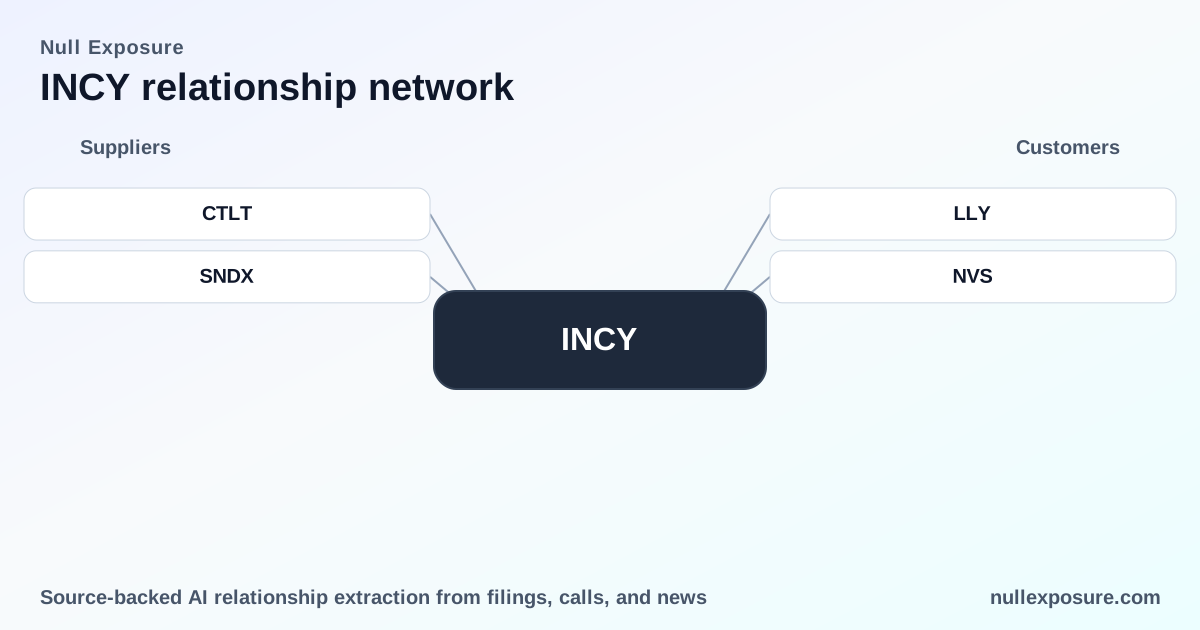
Incyte’s customer map: royalties, licensing partners, and commercial channels that drive revenue
Incyte monetizes a hybrid commercial model: the company sells proprietary products in the U.S. while licensing approved molecules for ex‑U.S. commercialization, collecting royalties and milestone payments. That dual path — direct product sales (notably Jakafi/ruxolitinib in the U.S.) plus partner royalties (Novartis, Lilly) and collaborative clinical programs — produces recurring, high‑margin revenue captured in company filings that show trailing‑twelve‑month revenue of roughly $5.36 billion (latest quarter ended 2026‑03‑31). For investors, the question is not whether Incyte sells drugs; it is which counterparty relationships and commercialization channels determine the stability and upside of those cash flows. Visit https://nullexposure.com/ for full coverage of these counterparties and contracts.
The commercial mechanics that matter to investors
Incyte’s model mixes direct commercialization, licensing, and clinical collaborations. In the U.S., Incyte directly markets certain products; outside the U.S. it relies on global pharma partners for distribution and commercialization, converting R&D value into royalty streams and milestone income. That structure creates specific operating characteristics:
- Contracting posture: Incyte uses third‑party commercial partners for ex‑U.S. markets and sells into specialty and retail pharmacy channels via distributors and wholesalers, exposing the company to contractual terms negotiated with large distributors and exclusive wholesalers.
- Concentration: A small set of partners and legacy products account for a disproportionate share of partner‑driven revenue, concentrating counterparty and product risk.
- Criticality: Partner relationships are critical to foreign market access and recurring royalty receipts; a deterioration in a major partner contract would have an outsized impact on top‑line durability.
- Maturity: Flagship products such as Jakafi are mature revenue drivers, producing steady cash flows but facing lifecycle management and competition; simultaneous clinical collaborations offer growth vectors to offset maturity risk.
The company‑level disclosure that commercialized products are “sold to specialty and retail pharmacies, specialty distributors and wholesalers in the United States” and “an exclusive wholesaler outside of the United States” signals a channel‑dependent commercialization strategy with meaningful distributor counterparty exposure.
Key implication for investors: royalty stability depends as much on partner execution and contractual terms as on Incyte’s own sales capability.
Customer relationships that move the P&L
Eli Lilly — an early licensee that produces royalty income
Incyte discovered the JAK inhibitor baricitinib (Olumiant) and licensed that program to Eli Lilly, generating ongoing royalty income that contributes to Incyte’s top line. According to ContractPharma coverage from March 10, 2026, Incyte is recognized as the discoverer of Olumiant and Lilly commercializes the product; TradingView analysis on May 3, 2026 also highlights Olumiant royalties as a contributor to recent revenue. Eli Lilly functions as a royalty partner converting discovery value into recurring cash flow.
Novartis — ex‑U.S. commercialization partner and a material contract counterparty
Novartis licensed ruxolitinib (Jakafi) from Incyte for development and commercialization outside the United States; outside the U.S. the compound is marketed as Jakavi and generates royalty flows back to Incyte, while Incyte retains U.S. commercialization. Novartis’s own press materials from March 10, 2026 confirm the licensing arrangement, and regional reporting (March 2026) records a $242.2 million contract dispute settlement tied to the Novartis agreement plus a related $76.3 million asset impairment recorded by Incyte. Those events underscore that Novartis is both a revenue source and a counterparty risk for Incyte’s international economics.
Actuate Therapeutics — a clinical collaborator in combination trials
Actuate Therapeutics initiated a Phase 1b trial combining its elraglusib with Incyte’s PD‑1 inhibitor retifanlimab and standard chemotherapy in advanced pancreatic cancer; the GlobeNewswire release on May 2, 2026 announced the collaboration and trial start. This relationship is collaborative and clinical in nature — a development‑stage partnership that expands the clinical footprint of Incyte’s immuno‑oncology assets rather than generating immediate royalties.
What these relationships imply for valuation and risk
- Revenue durability: Royalty income from established partners (Novartis, Lilly) generates high‑margin, recurring revenue that supports Incyte’s operating leverage; company filings show strong gross profit and operating margin metrics consistent with a royalties‑plus‑sales model.
- Counterparty concentration risk: A handful of large partners account for a meaningful portion of partner revenue; disputes or renegotiations (as with the Novartis settlement) translate into near‑term P&L volatility and potential impairment charges.
- Channel and contractual exposure: The firm's reliance on specialty distributors and an exclusive ex‑U.S. wholesaler introduces operational dependency on distribution partners, which affects inventory flow, reimbursement timing, and working capital dynamics.
- Growth vs. maturity tradeoff: Mature core products provide cash but limit growth; ongoing clinical collaborations and lifecycle filings (including extended‑release formulations) are the primary pathways to re‑rate growth expectations.
Investors should weigh the stability of royalty contracts and the legal/contractual posture of distribution agreements as much as pipeline upside. Contract disputes have direct P&L consequences, as the 2025 settlement demonstrates.
Bottom line — where the trade stands
Incyte is a hybrid commercial and licensing company: it captures high‑value royalties from global partners and sells certain products directly in the U.S., while clinical collaborations extend its therapeutic reach. The business earns robust margins and cash generation today, but valuation is sensitive to partner contract integrity, distribution counterparty risk, and product lifecycle dynamics.
For institutional investors and corporate strategists evaluating Incyte’s customer relationships, prioritize three assessments: contractual exposure with major partners, the structure of distribution channels, and the pipeline collaborations that can replace mature product revenue over the medium term. For a deeper counterparty and contract map tailored to investment diligence, visit https://nullexposure.com/.
Bold takeaway: Incyte’s revenue profile is durable because of strong royalties and U.S. product sales, but that durability is concentrated across a small set of counterparties — making contract terms, dispute history, and distribution arrangements the principal levers for downside risk and upside re‑rating.