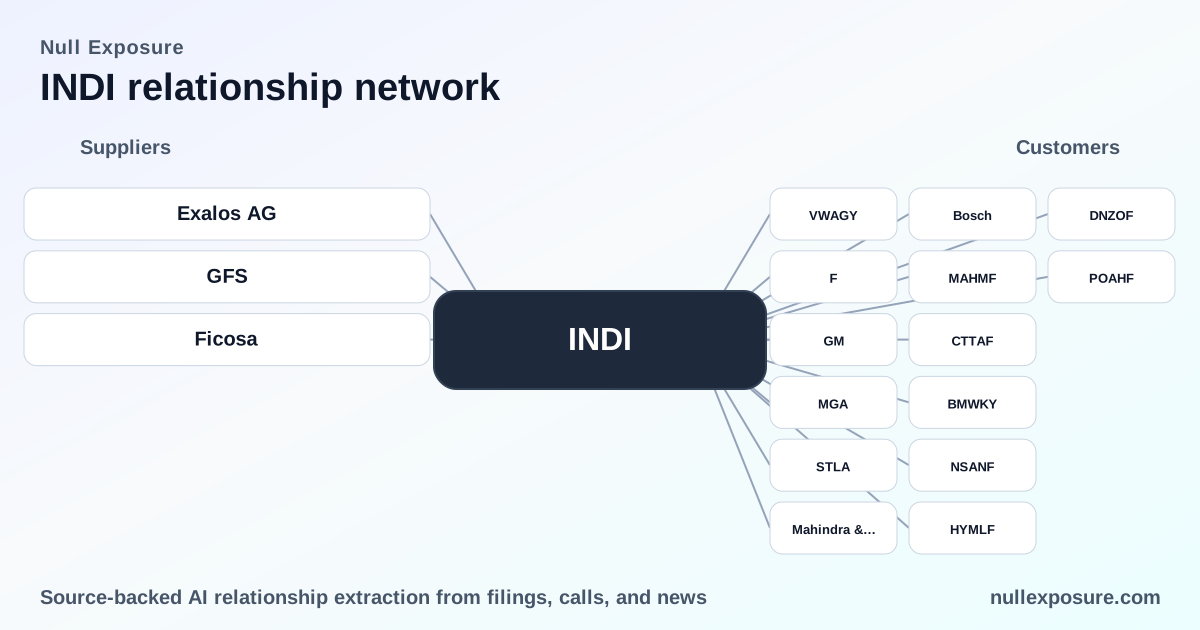
Indie Semiconductor (INDI): Customer Relationships That Drive Revenue and Risk
Indie Semiconductor designs mixed-signal microcontrollers and complementary in-cabin and ADAS software, selling hardware and software bundles to Tier‑1 suppliers and OEMs; the company monetizes through product sales, multi-year engineering contracts and recurring software programs tied to vehicle platforms. For investors, the outcome is a revenue mix with meaningful Asian concentration, a blend of short‑term recognition and select multi‑year projects, and customer relationships that are commercially critical but concentrated.
Explore a concise, finance‑grade brief on Indie’s customer roster and what each relationship implies for revenue durability and downside risk. For a deeper commercial map and alerts, visit https://nullexposure.com/.
How Indie’s contracts and footprint shape cash flow and risk
Indie’s disclosures indicate two parallel contracting postures: a majority of performance obligations are expected to be recognized within 12 months, yet the company has executed large multi‑year engineering programs that provide episodic revenue and margin uplift. The company reports that roughly 99% of unrecognized performance obligations as of year‑end 2024 are due to be recognized within the next 12 months, signaling near‑term revenue visibility, while other disclosures reference a multi‑year NRE project that materially reduced contract revenue as it wound down—evidence of lumpy, project‑driven revenue.
Geography and customer type are central to the business model. Asia accounted for the majority of product shipments in 2024 (≈66%), with notable revenue outflows to Greater China and South Korea; North America and Europe are material but smaller. Indie positions itself as an approved vendor to Tier‑1 automotive suppliers, selling to large enterprise counterparties and OEMs, which grants defensive commercial positioning but also concentration exposure: management states that the loss of an unnamed customer would be material to consolidated results. Finally, Indie sells both hardware and software—a hybrid model where software drives higher margin and recurring upside while hardware creates product revenue spikes and working‑capital demands.
Customer list and what each relationship means for investors
Below are every customer relationship surfaced in the results, with plain‑English takeaways and source references.
Mahindra & Mahindra Limited — strategic OEM win for in‑cabin monitoring
Indie was selected to supply its emotion3D in‑cabin monitoring software and driver/occupant monitoring system technology for Mahindra’s Premium Electric Origin SUVs, representing a program win that can translate to multi‑year software revenue as vehicles ramp. Source: MarketScreener/Business Wire and multiple news reports (first reported Feb–May 2026), e.g., https://www.marketscreener.com/news/Indie-Semiconductor-Prices-Upsized-Private-Offering-of-140-Million-Convertible-Senotes-42346095/ and Investing.com items from May 2026.
Ford Motor Co. — OEM customer list inclusion
Indie lists Ford among its OEM customers for ADAS and user‑experience platforms, signaling access to high‑volume North American programs that underpin scale potential. Source: press release coverage aggregating customer relationships (Mar 2026), https://www.theglobeandmail.com/investing/markets/stocks/PUGOY/pressreleases/21371642/indie-semiconductor-is-driving-adas-gains-globally/
General Motors Co. — named OEM customer
GM is identified as a customer in Indie’s commercial disclosures, consistent with Indie’s positioning for mainstream ADAS and cockpit electronics content across large North American vehicle programs. Source: Globe and Mail press release (Mar 2026), https://www.theglobeandmail.com/investing/markets/stocks/PUGOY/pressreleases/21371642/indie-semiconductor-is-driving-adas-gains-globally/
Stellantis NV — another OEM channel to global platforms
Stellantis appears on Indie’s customer roster, providing potential program scale across European and North American vehicle lines where Stellantis sources Tier‑1 electronics and software. Source: Globe and Mail press release (Mar 2026), https://www.theglobeandmail.com/investing/markets/stocks/PUGOY/pressreleases/21371642/indie-semiconductor-is-driving-adas-gains-globally/
Volkswagen AG — listed major automaker customer
Indie cites Volkswagen among its OEM customers, which connects Indie technology to significant European and global vehicle volumes and longer product lifecycles. Source: Globe and Mail press release (Mar 2026), https://www.theglobeandmail.com/investing/markets/stocks/PUGOY/pressreleases/21371642/indie-semiconductor-is-driving-adas-gains-globally/
Hyundai — OEM presence in Asia
Hyundai’s inclusion demonstrates Indie’s penetration into major South Korean OEM programs and supports the company’s heavy Asia revenue concentration. Source: Globe and Mail press release (Mar 2026), https://www.theglobeandmail.com/investing/markets/stocks/PUGOY/pressreleases/21371642/indie-semiconductor-is-driving-adas-gains-globally/
Nissan — another Asia OEM customer
Nissan is listed among customers, reinforcing Indie’s exposure to APAC vehicle production and program ramps. Source: Globe and Mail press release (Mar 2026), https://www.theglobeandmail.com/investing/markets/stocks/PUGOY/pressreleases/21371642/indie-semiconductor-is-driving-adas-gains-globally/
BMW — premium OEM relationship
BMW’s appearance indicates Indie has design wins in luxury segments where higher per‑vehicle content and software features can lift ASPs and margins. Source: Globe and Mail press release (Mar 2026), https://www.theglobeandmail.com/investing/markets/stocks/PUGOY/pressreleases/21371642/indie-semiconductor-is-driving-adas-gains-globally/
Porsche — high‑end OEM mention
Porsche is cited alongside other premium OEMs, suggesting platform opportunities for differentiated in‑cabin and ADAS experiences. Source: Globe and Mail press release (Mar 2026), https://www.theglobeandmail.com/investing/markets/stocks/PUGOY/pressreleases/21371642/indie-semiconductor-is-driving-adas-globally/
Magna International Inc. (MGA) — Tier‑1 supplier client
Magna is identified as a Tier‑1 supplier customer, reflecting Indie’s commercial routes into OEMs through established supplier partners and adding scale via Tier‑1 program relationships. Source: Globe and Mail press release (Mar 2026), https://www.theglobeandmail.com/investing/markets/stocks/PUGOY/pressreleases/21371642/indie-semiconductor-is-driving-adas-gains-globally/
Denso — Tier‑1 supplier relationship
Denso’s listing signals further Tier‑1 integration and access to OEM programs, particularly in Asia where Denso has broad OEM relationships. Source: Globe and Mail press release (Mar 2026), https://www.theglobeandmail.com/investing/markets/stocks/PUGOY/pressreleases/21371642/indie-semiconductor-is-driving-adas-gains-globally/
Continental — Tier‑1 supplier customer
Continental is named as a Tier‑1 partner, consistent with Indie’s strategy to distribute semiconductor and software content through established suppliers. Source: Globe and Mail press release (Mar 2026), https://www.theglobeandmail.com/investing/markets/stocks/PUGOY/pressreleases/21371642/indie-semiconductor-is-driving-adas-gains-globally/
Bosch — large program win supporting Toyota and Lexus
Indie captured a large occupant monitoring program win with Bosch that supports Toyota and Lexus platforms, demonstrating program scale via Tier‑1 OEM integrations and the commercial value of Indie’s occupant monitoring stack. Source: Globe and Mail press release (Mar 2026), https://www.theglobeandmail.com/investing/markets/stocks/PUGOY/pressreleases/21371642/indie-semiconductor-is-driving-adas-gains-globally/
Investment implications: concentration, cadence and optionality
- Concentration and criticality: Indie’s customers are major OEMs and Tier‑1 suppliers; losing a material customer would have a measurable impact on consolidated results, which makes customer retention and program ramp execution critical. This is a company‑level signal from management commentary about materiality.
- Contracting cadence: Expect a mix of short‑term revenue recognition (most performance obligations recognized within 12 months) and episodic multi‑year NRE projects; this generates revenue lumpiness but also bridges to recurring software revenue as programs scale.
- Geographic exposure: APAC is the dominant region for shipments, so macro and supply‑chain dynamics in Asia will disproportionately affect top‑line volatility.
- Business model characteristics: Indie operates as a seller to large enterprises, with active relationships across hardware and software segments; maturity is demonstrated by approvals with Tier‑1 suppliers and established OEM program wins.
Bottom line and next steps
Indie’s commercial footprint is strategically placed: OEM and Tier‑1 relationships provide pathway to scale while creating concentration risk and lumpy revenue patterns. For investors, the key monitorables are program ramp timelines, software attach rates, and geographic shipment trends. For ongoing tracking and relationship analytics, consult our platform at https://nullexposure.com/ for structured alerts and commercial signals.