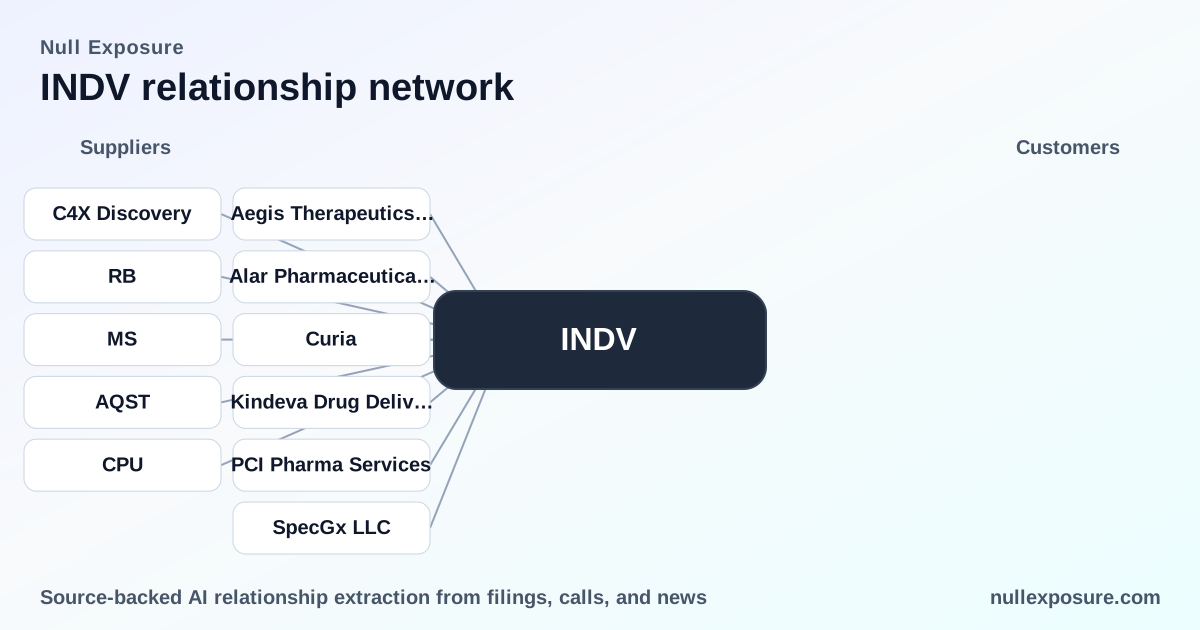
Indivior PLC (INDV): Customer Relationships and Commercial Risks for Investors
Indivior manufactures and sells buprenorphine-based treatments for opioid dependence, monetizing through prescription drug sales distributed primarily in the U.S. via large wholesalers, federal and state payors, and retail pharmacy channels. The company’s cash generation rests on a compact commercial footprint: a narrow set of high-volume products sold through concentrated distribution partners and reimbursed by third-party payors. For a succinct view of the company’s investor-facing profile, see Null Exposure’s overview: https://nullexposure.com/.
How Indivior actually gets paid — the commercial engine
Indivior’s revenues are product-sales driven: it manufactures (directly or via partners) branded buprenorphine formulations and sells them into wholesale distribution channels that route to commercial managed care, Medicaid, federal programs, and pharmacies. As of the latest quarter (2026-03-31) the company reports $1.29 billion in trailing twelve‑month revenue and $467 million of EBITDA, reflecting high gross margins and a focused portfolio anchored in a few core products. The company’s U.S. market dominance is a defining feature: disclosures show roughly 85% of net revenue originates in the U.S., and the business employs a global footprint of about 1,000 people with products available in 30+ countries.
Key operating-model characteristics investors should register:
- Contracting posture — distributor-centric: Indivior uses formal distribution agreements with the three largest U.S. wholesalers, which route product into commercial and government channels. Company disclosures attribute 55%, 54%, and 55% of global net revenue to those three wholesalers in 2024, 2023, and 2022, respectively.
- Customer concentration — material: The top three wholesale customers are material to revenue, and the company’s largest single customer represented roughly 19–22% of net revenues in recent years.
- Criticality — therapy essential, reimbursement-dependent: Products treat opioid dependence — a high-priority public-health area — but sales are dependent on third-party reimbursement and government procurement channels.
- Geographic concentration with global reach: The revenue base is heavily U.S.-centric (North America), although Indivior maintains distribution and product registrations across EMEA and APAC pockets (Australia, parts of Europe, Canada).
- Maturity — cash-generative, branded specialty: Strong operating margins and positive ROA/ROE indicate a mature commercial franchise focused on maximizing lifecycle value for core products.
These attributes create a classic premium‑pharma risk/reward profile: high margin, high concentration, and high public/government exposure. For a broader corporate snapshot, Null Exposure’s company hub remains the fastest route back: https://nullexposure.com/.
Manufacturing and third-party production relationships in the record
The dataset contains one reported customer-scope relationship: Aquestive Therapeutics (AQST). Below is a plain-English account of that specific relationship.
- Aquestive Therapeutics (AQST) — Aquestive continues to manufacture Indivior’s Suboxone® Sublingual Film and other oral-film collaborations for multiple parties, indicating a trusted contract-manufacturing relationship where Aquestive handles production for Indivior’s film-based product. This is described in Aquestive’s FY2026 business update. (Source: Aquestive press release reported on InvestingNews, March 2026: https://investingnews.com/aquestive-therapeutics-reports-fourth-quarter-and-full-year-2025-financial-results-and-provides-business-update/)
This relationship is a clear example of manufacturing outsourcing for a key dosage form; while only one third‑party manufacturer is named here, the commercial model depends on these types of partnerships to support global supply and product formats.
What the constraint signals tell you about customer risk and negotiating leverage
Company-level disclosures embedded in the record provide hard signals on counterparty profile and geographic mix that are material to underwriting Indivior credit or equity exposure.
- Government as a counterparty: Indivior explicitly lists state health departments, substance‑abuse centers, and federal agencies as primary customers for certain offerings (for example, OPVEE-related channels), which establishes direct government procurement exposure and connects revenues to public budgets and policy cycles.
- Large wholesalers dominate distribution: The three largest U.S. wholesalers collectively account for a majority of net revenue across multiple years, indicating significant negotiating leverage concentrated in few distributors and potential single‑point channel risk.
- U.S.-centric revenue concentration: With ~85% of revenue originating in the U.S., Indivior’s topline tracks U.S. prescribing, reimbursement and regulatory environments; international sales are present but non-core.
- Material customer concentration: The top three customers’ share of revenue is material and stable year-over-year, so product access or contract changes with any of those customers would have immediate P&L implications.
- Distributor role and reimbursement exposure: The company depends on wholesale and third‑party payors for channel access and reimbursement; payor policy changes can compress demand or pricing.
These constraints combine into a commercial picture where supply‑chain and channel relationships are as consequential as pharmacology: one or two distributor agreements materially affect cash flow timing and realized pricing.
Investment implications — risk, optionality, and what to watch
Investors should weight the following factors when evaluating Indivior exposure.
- Concentration risk is the dominant operational lever. The wholesale concentration creates negotiating vulnerability; any dispute or contract re-pricing could have outsized earnings impact given the 55%+ share represented by the top channels.
- Government exposure reduces demand volatility but increases policy risk. Contracts with public entities and Medicaid/Federal programs can be stable, but they are sensitive to reimbursement policy and budget cycles.
- Outsourced manufacturing partners are operational fault lines. The relationship with Aquestive highlights reliance on external manufacturers for specific formulations; manufacturing interruptions or capacity constraints at third parties would affect product availability and revenue recognition.
- Profitability supports strategic options. With healthy gross and operating margins and positive EBITDA, Indivior can invest in lifecycle management and international expansion, but such moves will only dilute concentration risk slowly.
- Catalysts to monitor: wholesale contract renewals, government procurement announcements (OPVEE and similar programs), manufacturing capacity disclosures, and U.S. reimbursement policy changes.
Bottom line for operators and allocators
Indivior is a focused, cash-generative specialty pharmaceutical company whose commercial performance is tightly coupled to a few wholesalers and to U.S. reimbursement channels. That configuration gives the company robust margins and predictable cash flow in stable states, but it concentrates counterparty and policy risk. Operational diligence should prioritize contract renewal timelines with major wholesalers, the health of third‑party manufacturers (like Aquestive), and signs of changing reimbursement posture in U.S. public payor channels.
For deeper dashboards and relationship maps that help underwrite concentration and supplier risk, visit Null Exposure: https://nullexposure.com/.