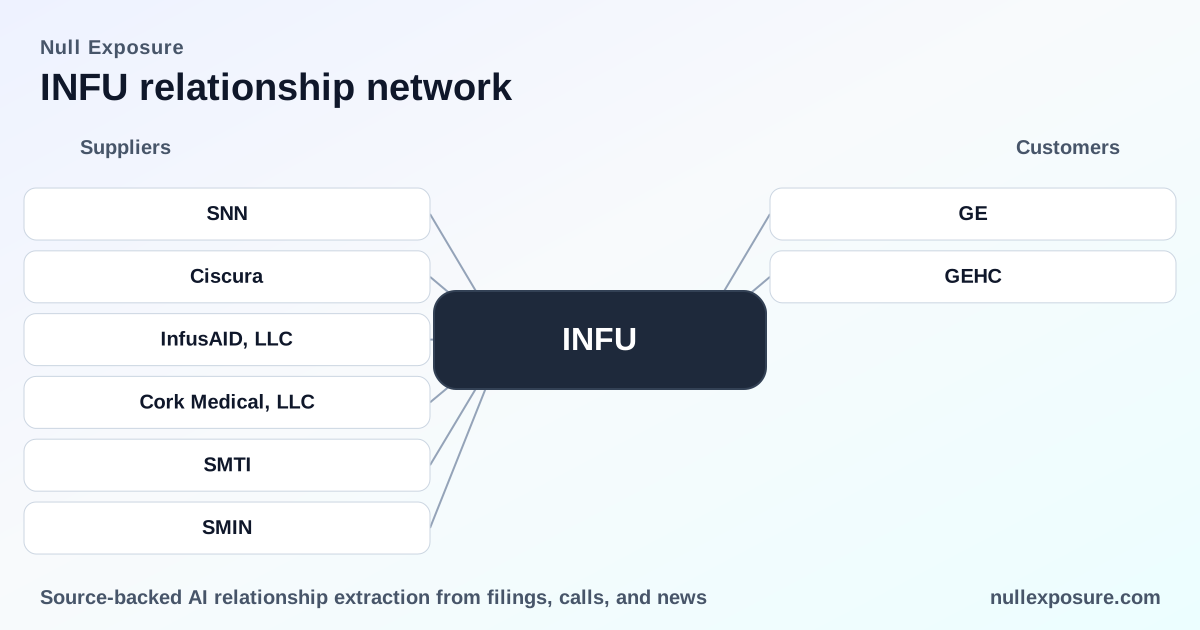
InfuSystem Holdings (INFU): Customer Map and What It Means for Revenue Risk and Upside
InfuSystem operates as a national supplier and servicer of ambulatory infusion pumps and related consumables, monetizing through equipment rental/sales, disposables, billing services for third‑party payers, and on‑demand biomedical support. Revenue is driven by recurring service contracts, payor reimbursement schedules, and strategic OEM/biomed relationships that both scale technician capacity and expose the company to discrete contract renegotiations. For a quick gateway to the underlying relationship intelligence, visit NullExposure for the full platform: https://nullexposure.com/
How InfuSystem’s customer model converts into cash flow
InfuSystem’s operating model blends product supply with services: the company supplies Durable Medical Equipment (DME) and consumables, manages logistics and third‑party billing, provides 24/7 nursing support, and performs biomedical maintenance. This hybrid seller/service_provider posture generates recurring annuity‑like revenue from rentals and disposables while concentrating operational risk in contracting and reimbursement. Short-term payer arrangements and automatic one‑year renewals create steady turnover but leave revenue exposed to annual renegotiation cycles that can move topline quickly.
Relationship-by-relationship: what the headlines say
CMS — payment policy development that expands reimbursement
TradingView reported that on December 10, 2025 InfuSystem announced CMS approval for separate payment for two infusion pumps under the NOPAIN Act, creating a clearer reimbursement route for specific pump models that supports equipment utilization and billing economics. (TradingView, December 10, 2025)
GE Healthcare — contract restructuring that subtracts from revenue
A Globe and Mail press release noted the restructuring of the GE Healthcare biomedical services contract will reduce InfuSystem’s annual revenue by $7.1 million starting in 2026, roughly 5.5% of topline, an explicit near‑term headwind to growth and a measurable sensitivity in guidance. (The Globe and Mail, FY2026 press release)
American Oncology Network — targeted outpatient oncology supply agreement
OpenPR reported that InfuSystem entered an agreement effective January 1, 2022 to provide ambulatory infusion pumps and related services to American Oncology Network, LLC, anchoring device and consumables volume in outpatient oncology channels. (OpenPR, February 2022 summary)
GE (general biomed onboarding) — scaling technician network
A Yahoo/Minerva Advisors piece described InfuSystem’s completion of GE onboarding and the addition of incremental projects to its growing national network of technicians, signaling capacity expansion in the Biomed segment that supports broader service coverage and incremental revenue opportunities. (Yahoo/Minerva Advisors, FY2024 commentary)
GE Healthcare (analyst coverage) — sensitivity flagged by investors
Sahm Capital’s commentary highlighted that contract changes such as the GE Healthcare restructuring make the company’s revenue growth assumptions sensitive, reinforcing investor scrutiny around how renewal outcomes translate to reported growth rates. (Sahm Capital, February 26, 2026)
GE Healthcare (management outlook) — pro forma growth after adjustment
An InsiderMonkey transcript summarized management’s view that net revenues on a pro forma basis should increase ~6.8% for 2026 after adjusting for the GE Healthcare contract restructuring, indicating internal confidence in organic underlying demand once the known reduction is normalized. (InsiderMonkey, Q4 2025 earnings call transcript)
GE Healthcare (repeat coverage) — consistent media focus on the same contract risk
Sahm Capital covered the GE Healthcare contract restructure in multiple pieces, reiterating that the restructuring introduces downside risk to the company’s stated growth assumptions and is a key variable for 2026 modeling. This duplicate coverage underlines persistent market attention to the GE relationship. (Sahm Capital, February 26, 2026)
What the relationship map implies for investors
The relationship tapestry shows a mix of defensive reimbursement wins, concentrated contract risk, and service expansion:
-
Contracting posture — short-term, renewable agreements. InfuSystem maintains large numbers of payer contracts that are typically one‑year terms with automatic renewals. That structure supports annual churn management but leaves significant exposure to payor negotiations on a yearly cadence.
-
Geographic focus — North America dominance. The company operates across seven U.S. and Canadian locations and serves hospitals, oncology practices and ambulatory centers, concentrating revenue generation in NA healthcare markets.
-
Concentration — no single customer >10% of revenue. Company disclosures state no single payer or customer exceeded 10% of net revenue in 2023–24, a corporate‑level signal of customer diversification that reduces counterparty concentration risk at the revenue line.
-
Role and criticality — seller and service provider. InfuSystem is both a device supplier and a mission‑critical service provider (biomedical maintenance, 24/7 nursing, billing). This dual role creates sticky economics with high switching friction for customers, but also embeds the company in workflows that expose it to payer policy changes.
-
Maturity and scale — national provider with technician network expansion. Management commentary on GE onboarding and network buildout points to a scaling services platform that can leverage incremental contractor relationships into technician‑driven revenue.
-
Materiality of specific relationships. The GE Healthcare restructure exemplifies how a single contract negotiation can have a multi‑percent impact on topline (a reported $7.1M, ~5.5%), demonstrating that operational concentration at the contract level can create outsized volatility despite customer diversification.
Investment implications — upside and risks
- Upside drivers: New CMS reimbursement for two pumps expands revenue capture opportunities; national biomed scale and AON contract deepen oncology penetration; management’s pro forma growth guidance suggests organic demand resilience after one‑time contract adjustments.
- Key risks: Annualized payer contract terms create recurring renegotiation risk; the GE Healthcare contract example shows discrete renegotiations can remove multiple percentage points from revenue, and investor models must incorporate such event risk into scenarios.
For a deeper read and to track new relationship changes as they surface, visit NullExposure’s coverage hub: https://nullexposure.com/
Bottom line for operators and allocators
InfuSystem’s business combines recurring consumables and rental economics with service revenue that is operationally critical to outpatient infusion workflows. Investors should value the company for durable service relationships and expanding technician reach while modeling explicit scenario sensitivity around large vendor/biomed contracts and annual payer renegotiations. The GE Healthcare case is the practical example: even with broad customer diversification, single‑contract restructuring can materially reshape near‑term revenue.