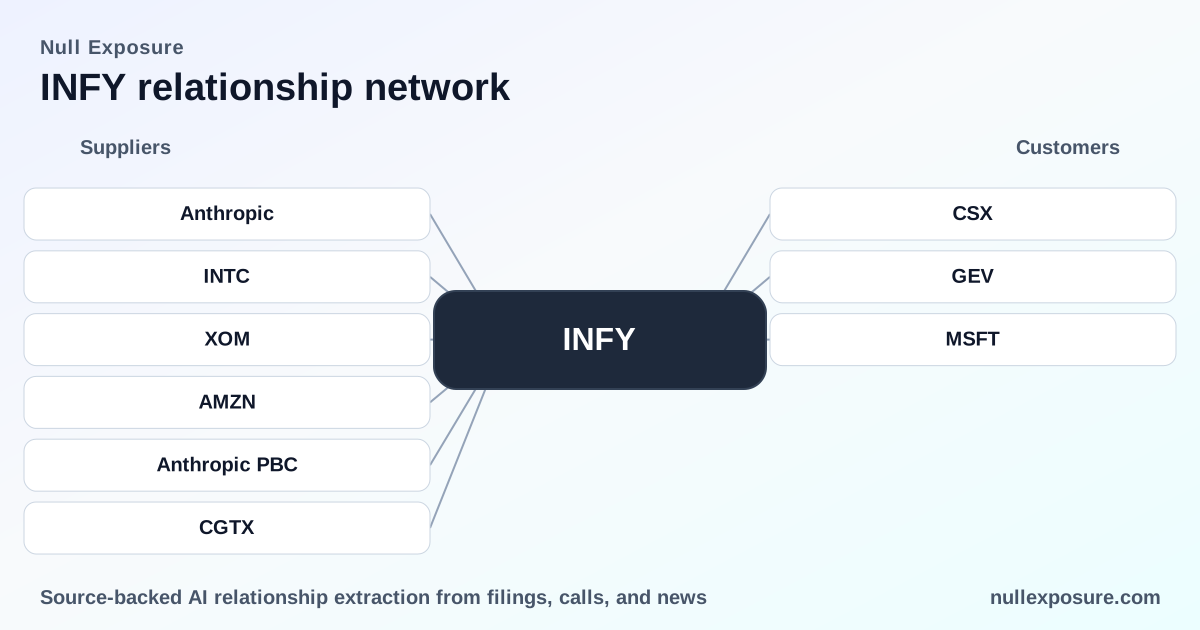
Infosys (INFY) Customer Relationships: a deal-by-deal read for investors
Infosys monetizes by selling long-duration digital transformation, cloud, AI and managed-services engagements to large enterprises across industries. The firm converts project-based delivery into annuity-style revenue through multi-year capability centers, platform licenses (Finacle, Equinox), and strategic cloud/AI partnerships, creating predictable cash flow while capturing upside from AI-enabled services adoption. For active diligence on client-level risk and concentration, see more at https://nullexposure.com/.
High-level investment thesis in one paragraph
Infosys is an established services platform that converts technical talent and partner ecosystems into recurring commercial arrangements with large corporates; its revenue mix is driven by long-term outsourcing and platform deals, strategic alliances with hyperscalers and AI vendors, and a steady cross-sell pipeline into clients' cloud and data modernization programs. The firm’s margin profile and valuation reflect this durability, but investment returns depend on continued success scaling AI services and defending legacy accounts against insourcing and competition.
Big-picture operating model signals investors should read into
- Contracting posture: Infosys favors multi-year, large-ticket engagements and capability centers that embed the company into clients’ operating models, increasing switch costs and revenue visibility.
- Concentration & criticality: Client roster shows industry leaders across banking, telecom, logistics and entertainment — critical systems work (core banking, data platforms, GCC operations) gives Infosys leverage but raises reputational and delivery risk.
- Maturity: The company is an incumbent with recurring platform revenue and strategic partner alliances (Microsoft, Intel, Anthropic etc.), indicating a transition from labor arbitrage to higher‑value AI and platform services.
These are company-level signals informed by the relationship logs and filings; they explain why Infosys trades with a premium to pure labor providers.
Client roster — deal-by-deal summaries
Below are concise, source-linked summaries for every client relationship surfaced in the results.
Truist (TFC)
Infosys won a >$500 million mandate to build and operate a global capability center in India for Truist, signifying one of its largest single-client commitments in FY2026. According to Charlotte Business Journal (Apr 30, 2026), the deal is structured around establishing and running the Hyderabad GCC.
Nu Skin (NUS)
Nu Skin is adopting Infosys’ Equinox digital commerce platform to accelerate social commerce and localized product initiatives in India, reflecting platform sales rather than pure outsourcing. A PR Newswire release (Mar 2026) described the collaboration to modernize consumer and affiliate experiences.
LivePerson (LPSN)
Infosys invested in a service practice to support LivePerson’s Conversational Cloud and migrated infrastructure to public cloud to scale conversational AI services for enterprise customers. Infosys and LivePerson announced the partnership via PR Newswire (2026).
ABN AMRO Bank (ABN)
Infosys extended a strategic collaboration with ABN AMRO to support sustainable and profitable growth through 2028, emphasizing bank-level transformation and long-duration objectives. Upstox’s live coverage of Infosys’ Q4 (Apr 23, 2026) cited the extension.
Mercedes‑Benz / Daimler (MBG / DAI)
Market reporting referenced potential revenue exposure (circa $150 million) tied to Daimler and Mercedes‑Benz, underscoring how large automotive accounts can materially affect near-term revenue if contract churn occurs. Outlook Business and Mint coverage noted these client dynamics in FY2026 reporting (May 2026).
CSX (CSX)
CSX completed a large-scale data-platform modernization in collaboration with Infosys and Microsoft, consolidating legacy systems into a cloud-native environment to enable AI-ready analytics. Finviz and SimplyWall Street reported the CSX modernization win (Mar 2026).
Liberty Global (LBTYA / LBTYK / LBYAV)
Liberty Global expanded a strategic collaboration with Infosys, where Infosys will provide services estimated at €1.5bn over five years (€2.3bn if extended to eight) — a material multi-year telecom engagement. PR Newswire and Liberty Global’s 10‑K referenced the expanded program and partnership language (FY2023–FY2024 disclosures).
GE Vernova (GEV)
Infosys public materials and press coverage highlight an AI-first strategic collaboration with GE Vernova to commercialize industrial AI use cases; corporate communications included a video and position statement on the initiative. Finviz coverage (Mar 2026) referenced the GE Vernova tie-up.
Intel (INTC)
Infosys deepened its strategic collaboration with Intel to accelerate moving enterprises from AI pilots to scaled production, focusing on performance optimization and measurable outcomes for enterprise clients. Upstox’s Q4 liveblog (Apr 23, 2026) documented the expansion.
Old National Bank (ONB)
Infosys BPM supported Old National Bank’s digital transformation with process optimization, automation and AI-enabled capabilities, reflecting the BPM arm’s role in mid‑market banking modernization. Upstox’s Q4 liveblog (Apr 23, 2026) included the announcement.
Producers Savings Bank Corporation
Infosys Finacle is modernizing Producers Savings Bank’s technology landscape in the Philippines via a Finacle core‑banking upgrade to enable faster, personalized experiences — a classic platform implementation sale. Upstox’s live coverage noted the Finacle engagement (Apr 23, 2026).
Madison Square Garden Sports / MSG Entertainment (MSGS) and Sphere Entertainment (SPHR)
Infosys renewed and expanded multi‑year digital innovation partnerships with MSGS, MSG Entertainment and Sphere Entertainment, acting as Official Digital Innovation Partner across venues and franchises. Devdiscourse and MarketScreener reported the renewals (2025–2026).
Crocs (CROX)
Infosys partnered with Crocs to drive IT and business-process transformation using AI and advanced automation, highlighting retail and consumer goods as target verticals for AI services. Upstox’s Q4 liveblog (Apr 23, 2026) cited the collaboration.
ExxonMobil (XOM)
Infosys worked with ExxonMobil on high-efficiency cooling systems and infrastructure to support growing AI and HPC workloads, indicating infrastructure advisory and systems-integration scope. Upstox’s Q4 coverage (Apr 23, 2026) mentioned the collaboration.
Anthropic
Infosys announced a strategic collaboration with Anthropic to deploy agentic and workflow automation capabilities across regulated industries, signaling an investment in next‑generation AI tooling partnerships. Upstox’s Q4 liveblog (Apr 23, 2026) recorded the announcement.
Cursor
Infosys partnered with Cursor to help enterprises build and scale AI-powered digital solutions and accelerate AI value delivery, reflecting a pattern of small-batch specialist alliances. Upstox’s Q4 notes included the collaboration (Apr 23, 2026).
Vanguard / Malvern (VGVT)
Reporting noted Vanguard reclaiming previously outsourced jobs from Infosys in Malvern, underlining insourcing risk and the potential for client churn or scope reductions in legacy outsourcing relationships. Vista.today and related reporting covered the Vanguard reclaim event (2025–2026).
Incora
Infosys entered a strategic collaboration with Incora to use AI for resilient, faster and more accurate supply‑chain operations globally, targeting manufacturing and logistics transformation. Upstox’s Q4 liveblog (Apr 23, 2026) referenced the collaboration.
Citizens Financial Group (CFG)
Infosys collaborated with Citizens to accelerate AI-driven transformation across banking operations, product development and customer experience, pointing to continued expansion in retail and commercial banking accounts. Upstox’s live reporting on Q4 results (Apr 23, 2026) listed the engagement.
Daimler (DAI)
Daimler is named in market reports as part of the set of automotive clients that have contributed to recent revenue volatility, reinforcing the sensitivity of Infosys to auto-sector contract cycles. Outlook Business (May 2026) relayed Mint-sourced reporting on the exposures.
Microsoft (MSFT)
Multiple modernization projects (notably CSX) referenced Microsoft as a partner in cloud and AI deployments, confirming Infosys’ go‑to‑market strategy of bundling services with hyperscaler platforms to access blue‑chip accounts. Coverage by Meyka and Finviz in Mar 2026 mentioned the Microsoft tie-ups.
Cognition (CGTX)
Infosys announced a strategic collaboration with Cognition to accelerate enterprise AI value journeys with agentic engineering capabilities, underlining an ecosystem approach to AI productization. Upstox’s Q4 liveblog (Apr 23, 2026) covered the tie-up.
What this roster tells investors about risk and upside
- Upside: Large, multi‑year platform and capability-center wins (Truist, Liberty Global) materially improve revenue visibility and create cross‑sell avenues into AI and cloud services. Strategic partner play (Microsoft, Intel, Anthropic) positions Infosys to capture higher-margin AI engineering work.
- Risk: Exposure to a handful of large clients means wins and losses are meaningful to short‑term revenue; recent reporting on Daimler/Mercedes‑Benz and Vanguard’s job reclamation highlight client churn and insourcing risk. Delivery failures on critical systems (core banking, GCC operations) carry reputational and financial downside.
Bottom line and where to look next
Infosys’ customer list in FY2025–FY2026 shows a deliberate pivot from pure labor arbitrage to platform, cloud and AI-first services sold via long-duration contracts and strategic alliances. That structurally supports recurring revenue growth, though investors should track contract retention and the cadence of large renewals closely. For a continuous feed of client-level signals and deal analysis, visit https://nullexposure.com/.
Bold headline takeaways: Infosys is increasingly monetizing AI and platform transitions via large, multi-year contracts — that is the core of its re‑rating opportunity, but client concentration and insourcing dynamics remain the principal execution risks.