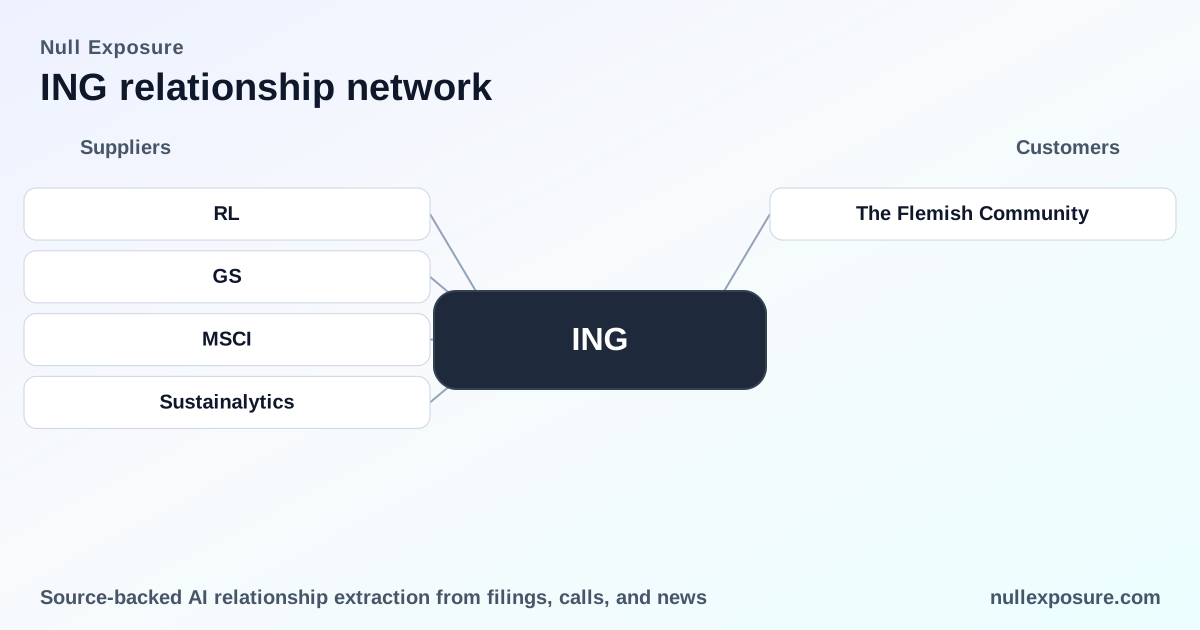
ING Group NV (ING) — customer relationship map and what it signals to investors
ING is a diversified banking group that monetizes through retail and commercial banking franchises, wholesale financial markets activity, and capital markets services — including underwriting, syndication and loan origination. Its Financial Markets and investment-banking arm routinely acts as co-manager, underwriter and syndicate lead, converting deal flow into fee income while its bank balance sheet supports syndicated loans and asset finance. For investors, these customer ties are a direct read on ING’s capital-markets franchise strength and fee pipeline as well as its loan book risk appetite.
If you want a concise index of ING’s active customer mandates and capital-markets roles, this review aggregates public mentions and their investor implications. For a practical view of how these relationships map to market access and fee potential, visit https://nullexposure.com/.
Why these relationships matter to shareholders
ING’s pattern of activity — repeated co-management slots on corporate offerings, stabilization and syndicate leadership on bilateral term loans — signals a hybrid operating posture: a client-facing capital markets business that also deploys balance-sheet capital. That combination delivers recurring fees and interest income but also exposes the bank to underwriting, syndication and counterparty execution risk during stressed markets.
- Fee diversification: consistent co-manager roles on bond and securitization deals point to steady origination and underwriting revenue.
- Balance-sheet deployment: lead roles in syndicated loans indicate willingness to hold or distribute credit exposure.
- Market presence: stabilization manager appointments and repeated participation across sectors demonstrate distribution reach.
For further detail on transaction-level activity and how that informs credit and revenue models, see https://nullexposure.com/.
Relationship-by-relationship rundown
Below are the customer and deal relationships surfaced in public reporting; each entry contains a plain-English summary and the original source context.
PennantPark Floating Rate Capital (PFLT)
ING Financial Markets LLC acted as a co-manager on PennantPark’s notes offering in March 2026, joining Oppenheimer and Regions Securities on the syndicate. This placement underscores ING’s ongoing role in arranging debt for specialty finance issuers and its participation in BDC-related capital markets activity. Source: Yahoo Finance coverage of the March 2026 offering.
The Flemish Community
ING Groep is listed as the stabilisation manager for a Flemish Community issuance, indicating ING’s use as a distribution and post-issuance market-support agent for supranational or government-related paper. That role demonstrates institutional trust and execution capability in public-sector debt placements. Source: Reuters reporting via TradingView (February–March 2026).
Sunrun (RUN)
ING served as a co-manager on a $584 million securitization of residential solar and storage assets, a transaction that positions ING within the green asset-backed securitization market and supports recurring structuring fee streams tied to renewable-energy financiers. Source: Cleantechnica report on the April 2026 securitization.
Hawaiian Holdings / HASI (HASI)
A Form 424B5 SEC underwriting schedule lists ING Financial Markets LLC allocated $16 million of a note issuance, reflecting ING’s participation as a named underwriter and capital commitment in fixed-income deals. This is a direct example of fee income generation through placement and the bank’s willingness to take principal positions. Source: SEC filing (424B5), March 2026.
Orchid Island Capital (ORC)
Orchid Island’s portfolio disclosures show ING Financial Markets LLC holding ~381,030 securities (representing a stated percentage and yield in March 2026), signifying ING’s active trading or placement positions in RMBS sectors — a niche that provides secondary-market liquidity and trading profits. Source: Globe and Mail/GlobeNewswire investor release (March 2026).
Capital Product Partners LP (CPLP)
A shipping-sector disclosure notes that a syndicate of banks led by ING Bank N.V. provided a term loan for delivery financing, with an outstanding principal around $123 million as of expected vessel delivery in 2021. This illustrates ING’s exposure to asset-backed shipping finance and more broadly to structured term-lending for maritime assets. Source: VesselFinder news item referencing CPLP disclosures (noted in 2021).
Global Development JSC (attempted sale of Russian unit)
Bloomberg reported that ING terminated an agreement to sell its Russian unit to Global Development JSC because the buyer could not realistically obtain required approvals, showing ING’s conservative approach to cross-border disposal risk and regulatory compliance in high-friction markets. The decision highlights governance discipline in exit processes. Source: Bloomberg article, April 2026.
Vornado Realty Trust (VNO)
ING Financial Markets LLC appeared as a co-manager on Vornado’s $500 million public offering of 7-year notes, joining other regional and global banks in the syndicate and highlighting ING’s role in U.S. real-estate debt placements. This participation reinforces the bank’s connectivity to real-estate capital markets and fee opportunities from corporate issuers. Source: market news reporting (March 2026).
What the collection of relationships reveals about ING’s operating model
Collectively, these mandates show a balanced client-facing capital markets business that executes across securitization, corporate bonds, government-related stabilization and bilateral syndicated lending. From a business-model perspective:
- Contracting posture: ING operates as both fee-for-service advisor/co-manager and as a principal underwriter/credit provider; this duality increases revenue variability but widens opportunity capture.
- Concentration: activity spans multiple sectors (renewables, RMBS, shipping, REITs, municipal/supranational issuers), suggesting sector diversification in fee pools rather than concentration in a single client industry.
- Criticality: roles such as stabilization manager and syndicate lead are highly strategic — they reinforce distribution relationships with institutional investors and public issuers and thus are critical to sustaining recurring fees.
- Maturity of engagements: transactions range from short-form co-management on securities to multi-year term loans and attempted divestitures, indicating a mix of high-turnover, market-facing activity and longer-term credit exposure.
Investment implications and risks
- Positive: persistent co-manager and syndicate roles imply a reliable pipeline of capital-markets fees and trading revenues; balance-sheet syndication activity supports net interest income.
- Negative: underwriting and principal positions create mark-to-market and credit risk, particularly in stressed segments (shipping, RMBS, assets with geopolitical exposure such as the attempted Russian disposal).
- Operational: regulatory friction in cross-border exits (as with the terminated Eurasia sale) flags governance and execution risk on complex disposals.
For portfolio managers focused on bank fee-revenue growth and wholesale distribution strength, these relationships confirm ING’s active market positioning; for credit analysts, the same relationships require monitoring of underwriting exposures and sectoral concentrations.
To explore how these and other counterparty relationships aggregate into revenue and credit exposure, visit https://nullexposure.com/ for transaction-level intelligence and analytics.
Bottom line
ING’s public customer mentions from early 2026 illustrate a robust capital-markets franchise that monetizes through repeated underwriting, syndication and trading roles, with a diversified exposure across renewables securitizations, RMBS, shipping finance and corporate bonds. That mix produces steady fee flow while embedding balance-sheet and disposal execution risk that investors and analysts must price into valuation and credit assessments.