Ingram Micro Holding (INGM): Customer Relationships That Drive a Global IT Distribution Franchise
Ingram Micro monetizes a global IT distribution and services platform by selling hardware, software and cloud subscriptions through a vast reseller network and value-added services; revenue is earned from product distribution margins, logistics and value-added services, and recurring cloud/subscription fees from the Cloud Marketplace and CloudBlue. The company’s economics rest on scale in physical distribution, a growing subscription services mix, and a deep channel ecosystem that routes manufacturer products to resellers and end customers worldwide. For more detailed relationship signals and commercial context, see https://nullexposure.com/.
Why investors should focus on customer relationships, not just topline growth
Ingram Micro’s competitive advantage is its partner ecosystem: manufacturers, resellers and managed service providers that rely on the company to simplify supply chains and deliver subscription orchestration. That ecosystem insulates gross margin but imposes operational complexity — the business mixes spot product flows with recurring subscription revenue, and contract terms vary by service line. Understanding who buys and who partners with Ingram is therefore central to forecasting gross margin stability, working capital needs, and the trajectory of recurring revenue.
The relationship map: what public sources reveal
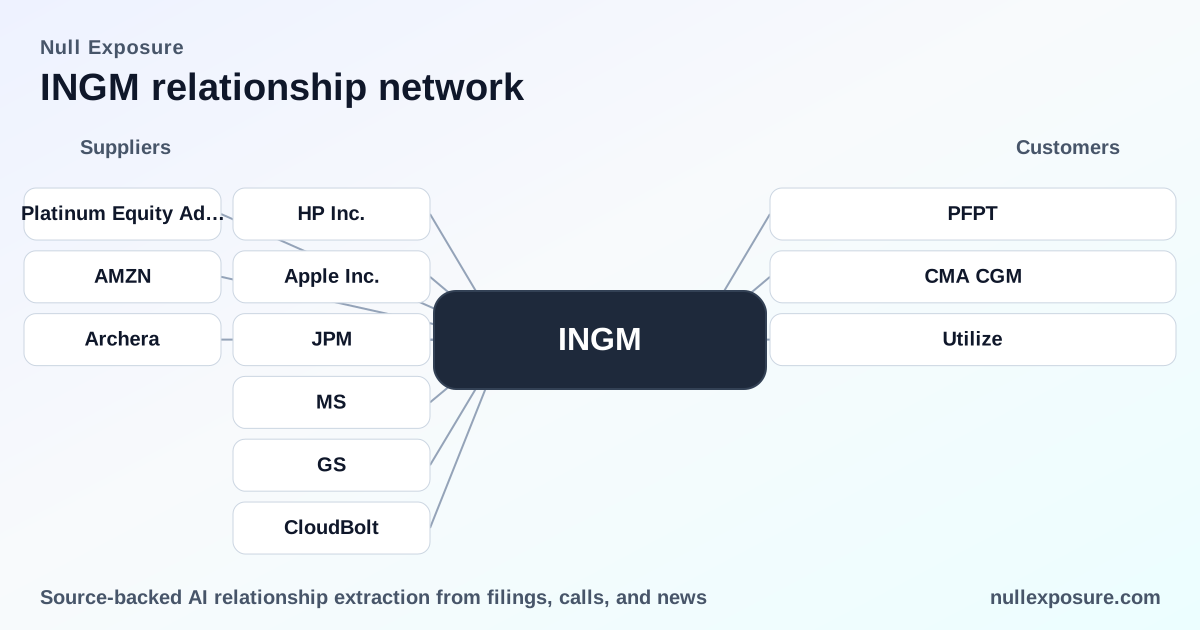
Below are the principal customer and partner relationships surfaced in public filings and press coverage. Each relationship is described in plain English with a concise source reference.
-
Proofpoint (PFPT) / Proofpoint — Ingram Micro publicly highlighted Proofpoint’s use of the Xvantage platform to automate go‑to‑market workflows, tying cloud and quote-to-cash automation to Ingram’s digital transformation messaging. This showcases how Ingram leverages third-party platforms to streamline reseller and vendor interactions. According to a Simply Wall St piece referencing coverage on March 10, 2026, Ingram spotlighted this Proofpoint use case in FY2025 reporting. (Simply Wall St, March 2026)
-
CMA CGM — In 2022 Ingram Micro sold most of its Commerce & Lifecycle Services (CLS) division to CMA CGM for approximately $3 billion, a strategic divestiture that refocused the firm on core IT distribution and cloud services while monetizing logistics assets. The transaction is cited in corporate press material and recap coverage discussing Ingram’s NYSE listing. (Platinum Equity press release / company news, referenced 2026)
-
Utilize (Trust X Alliance member) — U.K.-based solution provider Utilize is active in Ingram Micro’s Trust X Alliance, where partners collaborate on sustainability and go‑to‑market best practices; Ingram positions Trust X as a community to drive partner-led innovation and ESG compliance. A CRN profile from 2024 quotes Guy Hocking of Utilize on sustainability becoming a commercial requirement for solution providers in the Alliance. (CRN, 2024)
-
NSIT (NSIT) — NSIT listed Ingram Micro among its top five partners for 2025, alongside Microsoft, TD Synnex, Google and Cisco — highlighting Ingram’s role as a critical distributor and partner to solution vendors in the channel. This appears in NSIT’s FY2025 Form 10‑K. (NSIT 10‑K, FY2025)
-
SCKT (SCKT) — SCKT’s FY2024 filing identifies Ingram Micro as one of its largest distributors, confirming that Ingram supports online resellers globally and sits in the top cohort of distribution partners for hardware and mobility products. (SCKT 10‑K, FY2024)
What these relationships collectively reveal
Taken together, the relationships emphasize three structural truths:
- Breadth and depth in the reseller channel. Ingram is the preferred distributor for leading resellers and many solution providers, demonstrated by NSIT and SCKT disclosures naming Ingram among top partners and largest distributors respectively.
- Hybrid commercial model: product distribution plus subscriptions. The Proofpoint use case and Cloud Marketplace references show Ingram’s dual role routing traditional product sales while growing subscription and orchestration services.
- Strategic capital recycling. The CMA CGM divestiture shows management’s willingness to monetize non-core logistics assets to sharpen focus on high-margin services and cloud orchestration.
Contracting posture, concentration and commercial constraints
Public filings and excerpts define Ingram Micro’s operating model characteristics and contract structure as company-level signals:
- Contract mix is heterogeneous: some services use multi‑year (3–5 year) contracts (Other services), while Technology Solutions and Cloud product flows are often spot purchase orders; the cloud business also sells subscriptions through Ingram Micro Cloud Marketplace and CloudBlue SaaS. This means forecast models must separate recurring subscription growth from volatile spot product volume. (Company disclosure language)
- Global footprint with regional reporting segments: operations are organized into North America, EMEA, Asia‑Pacific and Latin America; the U.S. and India are notable markets. Revenue and receivables are widely dispersed, and no single customer exceeds 10% of net sales — a signal of low concentration and high geographic diversification. (Company disclosure language)
- Materiality and exposure: trade receivables are broad and no receivable accounted for >10% of total trade AR at year‑end, indicating immaterial counterparty concentration at the customer level. Guarantees to finance providers supporting a limited number of customers account for less than 1% of consolidated net sales — immaterial to top-line exposure but relevant to working capital arrangements. (Company disclosure language)
- Role diversity: Ingram serves as distributor, reseller enabler and service provider, supporting value‑added resellers, MSPs, cloud providers and corporate resellers; this multiplicity of roles both stabilizes demand and complicates margin mix. (Company disclosure language)
Operational implications for investors
- Predictability vs. volatility: subscription revenue improves predictability and elevates gross margin sustainability; spot product sales increase revenue volatility and working capital intensity. Model recurring revenue separately and track Cloud Marketplace growth rates as a margin lever.
- Scale benefits and margin pressure: scale allows better terms with manufacturers and logistics efficiency, but distribution is a low-margin, high‑volume business; incremental margin expansion will come from services, cloud, and higher-value value‑added offerings.
- Low counterparty concentration reduces single‑counterparty risk, but reliance on a broad reseller base makes Ingram sensitive to cyclical IT spend and channel inventory cycles.
Key takeaways for decision-makers
- Ingram Micro is a global distribution platform monetizing both product flows and subscription services; its risk‑return profile is shaped by the mix between spot hardware distribution and recurring cloud/subscription products.
- Public documentation and press highlights confirm deep reseller relationships (NSIT, SCKT), active platform partnerships in cloud orchestration (Proofpoint), partner community programs oriented to ESG and GTM (Utilize / Trust X), and prior strategic divestitures that refocused the company (CMA CGM transaction).
For a deeper read on relationship analytics and to monitor evolving partner exposures, visit https://nullexposure.com/ — our platform centralizes signals across filings and news for investor workflows.
Closing perspective
Ingram Micro’s current investment case is twofold: preserve scale-derived distribution economics while accelerating higher-margin recurring services. Investor focus should be on the pace of cloud subscription growth, margin conversion from services, and inventory/receivables dynamics driven by the reseller network. The public relationship evidence supports a view of Ingram as a well‑positioned channel intermediary with diversified customer exposure and a deliberate shift toward software‑centric monetization.