Ingredion (INGR): Customer relationships that shape revenue durability and margin leverage
Ingredion manufactures and sells starches, sweeteners and specialty ingredients to food, beverage and industrial customers worldwide, monetizing through a combination of contracted firm-price sales, spot transactions and fee-based price adjustments tied to raw-material costs. The company’s commercial model blends short-term transactional flexibility with targeted longer-term agreements (notably in beverages and specialty solutions) and strategic channel partnerships for new offerings such as pharma and sugar-reduction platforms. For investors, the key lens is how this mix affects revenue visibility, pass-through pricing and margin sensitivity to commodity cycles.
If you want a single-source view of customer signals and partner moves for diligence, visit https://nullexposure.com/.
How Ingredion sells: the commercial posture that drives risk and upside
Ingredion is a seller of ingredient solutions across more than 60 industries, and its contracts demonstrate a deliberate mix of term structures that balance customer stickiness and pricing agility. Public disclosures describe:
- Short-term firm contracts that typically last up to one year for finished corn-based products, which provide near-term revenue certainty but require frequent renewal and renegotiation.
- Spot and fee-based sales that link selling prices to raw-material inputs, creating direct margin exposure to commodity volatility but enabling quick competitive response.
- Longer-term arrangements—notably in the beverage sector—where multi-year terms deliver higher revenue visibility and strategic alignment.
These contract signals imply moderate revenue concentration by geography (notably North America and Latin America), a global manufacturing footprint across U.S., Canada, Asia‑Pacific and Europe, and an operational profile that mixes mature commodity lines with higher-value solutions. The combined effect: steady core cash flow with episodic margin variability, and upside from solutions-led growth if innovation and channel partnerships scale.
One-page coverage of every customer relationship in the record
Below are the relationships surfaced in public filings and media coverage, summarized in plain English.
-
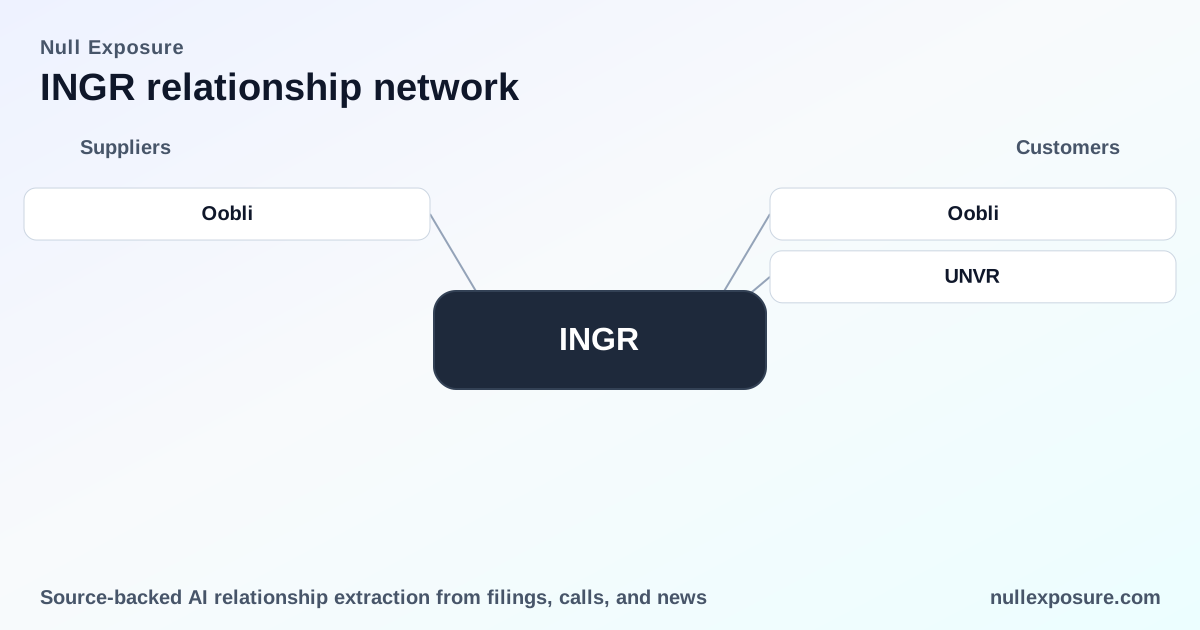
Oobli — Ingredion is advancing a proprietary sugar reduction taste modulation platform in collaboration with Oobli through a strategic commercial partnership, positioning Ingredion to introduce lower‑sugar formulations to food and beverage customers; this was disclosed on Ingredion’s Q4 2025 earnings call in March 2026. (Source: INGR Q4 2025 earnings call, March 2026)
-
Univar Solutions (UNVR) — Univar Solutions was selected as Ingredion Pharma Solutions’ distributor for the United States and Canada, establishing a channel partnership to scale Ingredion’s pharma-focused ingredient sales through Univar’s distribution network; this selection was reported in media coverage citing a Feb. 24 announcement and re‑reported across March–May 2026. (Source: Finviz coverage citing the Feb. 24 announcement; MarketScreener reporting, March–May 2026)
Why each relationship matters to investors
Oobli partnership: accelerates product innovation in sugar reduction, addressing consumer demand and regulatory pressure on added sugars; the collaboration signals Ingredion’s push into higher-margin solutions that can partially offset commodity-exposed volumes. (Earnings call, 2025Q4)
Univar distribution: expands go‑to‑market reach for pharma ingredients in North America, converting product capability into scalable channel sales and reducing commercial friction for smaller pharma customers; the partnership effectively outsources distribution logistics to a specialized third party. (Market and news coverage, Feb–May 2026)
Operating constraints and what they tell us about business characteristics
Ingredion’s own disclosures define the operating boundaries investors should model:
-
Contract mix and revenue visibility: public language confirms a mix of short-term firm contracts (typically up to one year), spot sales, and fee-based contracts that adjust to raw-material inputs, plus select multi-year contracts in beverages. These choices produce partial revenue predictability with regular repricing risk and require active commodity risk management.
-
Geographic exposure: consolidated sales reporting shows material North American sales (U.S.) and meaningful Latin American receipts (Mexico, Brazil), together with a global manufacturing footprint spanning APAC and EMEA. This geography breadth reduces single-market concentration but creates exposure to FX, local raw-material supply and regional demand cycles.
-
Role & segment focus: Ingredion is principally a seller of core starches and sweeteners, while also developing higher-value solutions and pharma ingredients—a product portfolio that blends mature commodity lines with innovation-driven segments.
These signals indicate a mature industrial supplier with defensive demand characteristics but cyclical margin exposure tied to corn and other commodity inputs; strategic partnerships (Oobli, Univar) provide a pathway to incrementally lift margins through solutions and channel scale.
Investment implications: where value and risk concentrate
-
Growth levers: innovation partnerships and distribution alliances accelerate penetration into higher-margin categories (clean label, sugar reduction, pharma), which can improve revenue mix and justify multiple expansion if execution converts R&D into repeatable sales.
-
Margin sensitivity: the firm’s mix of spot and fee‑based contracts implies direct pass-through of raw‑material inflation to customers in many instances, but also leaves pockets of margin slippage when input costs spike faster than contract adjustments.
-
Geographic diversification: broad presence across North America, Latin America, APAC and EMEA reduces single-country sales risk while increasing complexity and working-capital demands.
-
Execution risk: successful monetization of partnerships depends on commercial scaling—from pilots to multi‑market rollouts—so investor returns hinge on distribution effectiveness and customer adoption.
Risks and the watchlist for the next 12 months
- Monitor the conversion of Oobli pilots to customer‑facing formulations and the pace at which Univar drives pharma revenue in North America.
- Track raw‑material cost curves and the company’s ability to pass through inflation under short‑term and spot contracts.
- Watch regional demand trends in Mexico and Brazil as indicators of Latin America performance and margin resilience.
Final takeaways
- Ingredion is a fundamentally defensive ingredient supplier with embedded commodity exposure—the company offsets that exposure through a portfolio of contract types and a growing emphasis on solutions.
- Partnerships are the strategic vector for margin uplift: the Oobli collaboration targets sugar reduction innovation, while Univar’s distribution role accelerates pharma channel reach.
- For investors, focus on execution metrics: commercial rollouts from partnerships, cadence of contract renewals, and the company’s ability to preserve margins while scaling solutions revenue.
Explore comprehensive customer and partner signals, competitive context, and relationship timelines at https://nullexposure.com/ for deeper diligence.