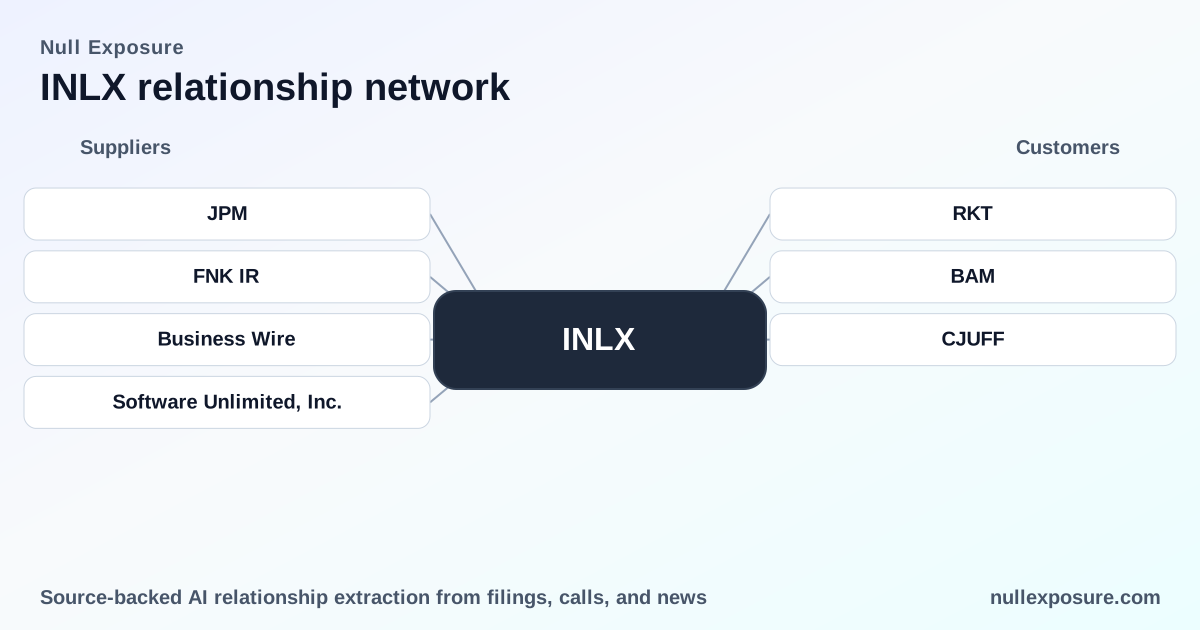
Intellinetics (INLX): Customer Relationships That Drive a Niche Document Services Franchise
Intellinetics operates a two‑pronged business: a Document Conversion services arm that digitizes and stores paper records, and a Document Management software arm that sells on‑premise licenses, SaaS subscriptions, and accompanying professional services. The company monetizes through a mix of recurring billing for storage and SaaS, point‑in‑time license revenues, and fee‑for‑service conversion projects, producing a revenue profile that is concentrated in U.S. government work on one side and lower‑concentration commercial software sales on the other. For investors evaluating customer risk and revenue durability, the most important signals are government concentration, a history of contract renewals, and a hybrid services/software contracting posture. Learn more at https://nullexposure.com/.
How the customer base structures cash flow and risk
Intellinetics’ customer mix creates two distinct cash‑flow dynamics. The Document Conversion segment is services‑heavy and project oriented, generating large, sometimes lumpy contracts tied to government budgeting cycles. The Document Management segment is software and subscription oriented, delivering recurring revenue through SaaS and support.
- Contracting posture: Government business is typically short‑term (commonly 12 months), while software revenue combines point‑in‑time license recognition and monthly/annual SaaS billing. This hybrid model requires active sales and contract management across different renewal cadences.
- Concentration and criticality: Government contracts dominate consolidated revenue (roughly 80% for recent years), and the State of Michigan is material to the Conversion business (about 69% of that segment and 40% of consolidated revenue in 2024). That concentration is a critical single‑customer risk for consolidated performance.
- Geography and customer scale: Revenues are primarily U.S. based, with non‑U.S. sales non‑material. The Document Management segment shows low customer concentration (two largest customers combined accounted for ~7% and ~2% of segment revenues in 2024/2023), which offsets some consolidated concentration risk.
- Relationship maturity and renewal behavior: Government contracts have historically renewed on original terms, and the company expects to recognize nearly all remaining performance obligations within 12 months — signals of operational continuity for the short term.
- Revenue mix: The business earns the majority of revenue from professional services, with software maintenance and SaaS following — a structure that supports both near‑term cash collection and a stickier recurring base.
Collectively, these signals define a company with high revenue concentration risk on the conversion side, moderate recurring revenue stability on the software side, and a contracting mix that requires active budget and renewal monitoring.
What management called out on the 2025 Q3 earnings call
Management used the Q3 2025 earnings call to reference specific customer relationships and billing practices that clarify how revenue gets recognized and how the company engages enterprise clients. Below are every named relationship that was recorded in the call transcript dataset.
RKT (ticker inferred RKT)
Management noted, “We will bill them on a recurring basis,” using Rocket Mortgage as the comparable billing model for storage and recurring fees for RKT. This suggests a subscription or storage‑based arrangement rather than a one‑off conversion engagement. Source: INLX 2025 Q3 earnings call (document inlx-2025q3-earnings-call, first seen 2026‑03‑07).
Rocket Mortgage
Management explicitly compared a new or ongoing customer engagement to their approach with Rocket Mortgage, emphasizing a recurring billing model for storing boxes and related services; Rocket Mortgage is used as the operational precedent for enterprise recurring revenue. Source: INLX 2025 Q3 earnings call (document inlx-2025q3-earnings-call, first seen 2026‑03‑07).
BAM (Brookfield implied, inferred symbol BAM)
Management referenced Brookfield in the context of enterprise clients inquiring about risk management and legal document handling, indicating discussions at the corporate governance or compliance level that could translate into enterprise document management sales or services. Brookfield’s inquiry signals interest from large institutional clients in risk and legal document workflows. Source: INLX 2025 Q3 earnings call (document inlx-2025q3-earnings-call, first seen 2026‑03‑07).
Brookfield
The earnings call named Brookfield directly as one of Constellation’s largest clients and noted their inquiries on risk and legal document handling, which underscores the company’s engagement with sophisticated enterprise buyers and the potential for higher‑value services or integrations. Source: INLX 2025 Q3 earnings call (document inlx-2025q3-earnings-call, first seen 2026‑03‑07).
CJUFF (Constellation Homebuilders inferred, inferred symbol CJUFF)
Management referred to Constellation Homebuilders’ largest user event of the year, suggesting active user engagement and potentially broader adoption across a channel or client community. This indicates that Constellation is a visible commercial adopter and an event‑driven opportunity to expand footprint. Source: INLX 2025 Q3 earnings call (document inlx-2025q3-earnings-call, first seen 2026‑03‑07).
Constellation
Constellation was named with reference to its homebuilders unit’s major user event, implying a commercial relationship characterized by user training, product adoption events, and an opportunity for upsell of services and software across a customer base. Active user events indicate a degree of product engagement and an installation base that management can monetize via subscriptions and services. Source: INLX 2025 Q3 earnings call (document inlx-2025q3-earnings-call, first seen 2026‑03‑07).
Investment implications: revenue durability versus concentration risk
Intellinetics’ customer references and company‑level constraints together form a clear investment thesis:
- Positive: recurring revenue mechanics exist. Management’s repeated references to recurring billing for enterprise clients such as Rocket Mortgage and RKT confirm that the firm can convert storage and management services into subscription cash flows, improving predictability on the Document Management side.
- Negative: single‑customer concentration is real and material. The State of Michigan’s outsized share of the conversion business (69% of that segment; 40% of consolidated revenue in 2024) creates acute revenue volatility risk if public budgets or procurement dynamics change.
- Segment diversification reduces some risk. The Document Management segment’s low customer concentration and active enterprise engagements (Brookfield, Constellation) provide avenues for margin expansion and recurring ARR growth, balancing the conversion segment’s project volatility.
- Contracting and timing risk remain. Government contracts are typically short‑term and tied to state, local, and federal budgets. Investors should track renewal cycles, budget calendars, and the pipeline for SaaS transitions that convert one‑time license or conversion revenue into recurring streams.
Actionable takeaways
- Monitor renewal notices and budget cycles for the State of Michigan as a near‑term determinant of consolidated revenue stability.
- Track the conversion‑to‑SaaS transition for enterprise clients mentioned on calls (Rocket Mortgage, Constellation, Brookfield) to assess the trajectory of recurring revenue.
- Gauge commercial expansion in the Document Management segment, where low concentration and active user events suggest scalable margins if SaaS adoption increases.
For a focused feed of customer‑level signals and to track how these relationships evolve in quarterly commentary, visit https://nullexposure.com/.
Intellinetics therefore presents a classic small‑cap trade: a durable software services underpinning offset by acute concentration in a single public‑sector customer, with the Q3 2025 call showing management actively pivoting more customer relationships into recurring billing arrangements that improve revenue visibility.