INmune Bio (INMB): Customer Relationships and Commercial Signals Investors Should Know
INmune Bio operates as a clinical-stage immunotherapy developer that sells research- and trial-grade biological materials while advancing innate-immune therapeutics through clinical programs. The company monetizes through a combination of direct product sales (notably CORDStrom/MSC products) to research customers and by advancing drug candidates toward clinical milestones and partnering opportunities that drive longer-term licensing or collaboration revenue. For investors evaluating customer exposure, the company’s revenue base is currently transactional and limited, and capital raises are a material component of runway. For more context on how we source these signals, visit https://nullexposure.com/.
Quick take: What these customer signals mean for value and risk
INmune’s commercial activity is early, low-volume, and concentrated geographically, with revenue tied to research and clinical supply rather than commercial drug sales. The company plays the role of a seller of investigational-grade products to external researchers and clinical programs, which creates predictable but modest short-term revenue and positions INmune for partner-led upside if its therapeutic candidates advance. Capital markets activity (an ATM raise netting $5.3 million) underscores ongoing funding dependence and the materiality of non-customer financing to operations.
Company-level operating model signals
- Contracting posture and role: INmune acts as a seller of core product (CORDStrom) for research use and clinical trials, indicating a supplier-facing contracting posture rather than a platform or services model. This is a company-level statement drawn from the 2024 Form 10‑K.
- Concentration and geography: The company recorded sales to a single UK customer in 2023–2024, signaling limited geographic diversification and at least one active EMEA relationship, but revenue quantum from that customer has been small.
- Relationship maturity and criticality: Sales in 2023 and 2024 demonstrate active, transaction-level customer engagements rather than mature, recurring commercial contracts.
- Funding context (spend band signal): Management accessed capital markets via an ATM program that produced net proceeds of roughly $5.3 million in early 2025, which is material to short-term liquidity given the company’s limited operating revenue.
These characteristics drive a simple investor framework: short-term revenue is limited and concentrated, commercial risk is low per-transaction but high at the corporate level due to funding needs, and upside depends on clinical progress and partnering.
Customer relationships called out in the 2024 filing
Below I cover every customer relationship extract cited in INmune’s FY2024 Form 10‑K filing. Each entry is summarized in plain English with the cited source.
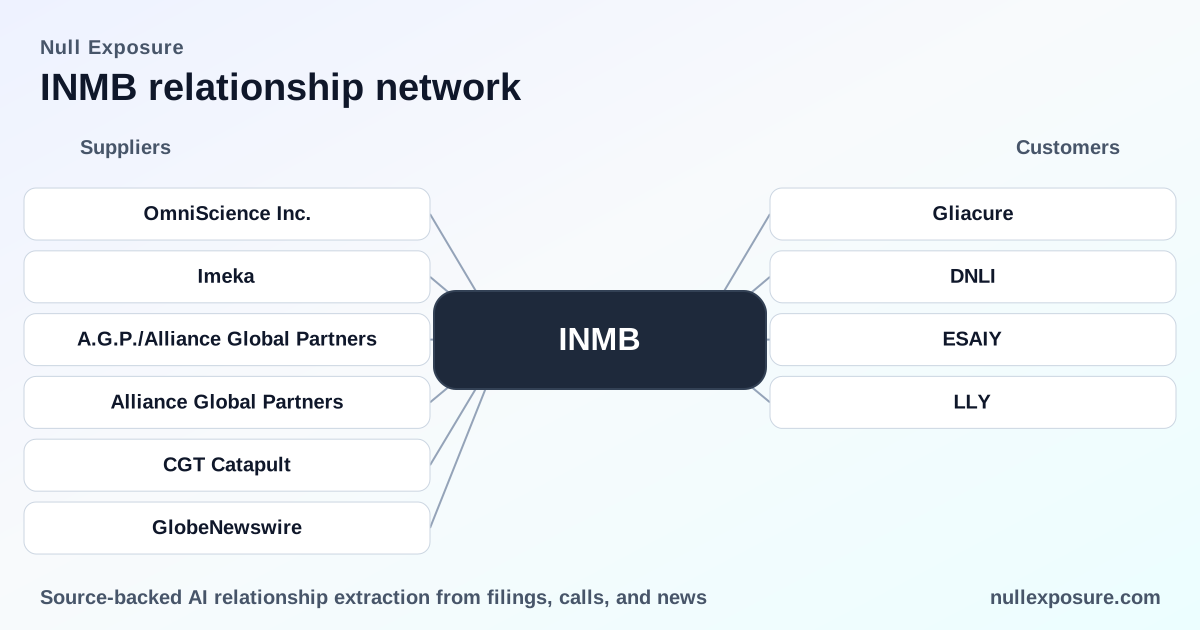
Gliacure
INmune’s filing references Gliacure in the context of Alzheimer’s drug development, noting that Gliacure is developing a small-molecule candidate (GC021109) that targets microglial cells. According to INmune Bio’s 2024 Form 10‑K (FY2024), this mention contextualizes the Alzheimer’s competitive landscape rather than a commercial partnership. (Source: INmune Bio 2024 Form 10‑K)
Denali Therapeutics
Denali (DNLI) is noted for developing DNL747, which targets TNF-pathway signaling proteins involved in inflammation and cell death. INmune’s FY2024 filing references Denali to map adjacent therapeutic approaches in the neuroinflammation space. (Source: INmune Bio 2024 Form 10‑K)
DNLI (duplicate listing)
The filing also lists DNLI as a referenced company name reflecting the same Denali program, DNL747, underscoring that INmune’s competitive and collaborator landscape discussion explicitly names DNLI and its TNF-pathway program. (Source: INmune Bio 2024 Form 10‑K)
ESAIY
Eisai (listed under the ticker ESAIY) is referenced in connection with Lecanemab (Leqembi), which received approval for early Alzheimer’s disease in January 2023; INmune uses this as a market precedent in its 10‑K narrative. This citation positions FDA-approved anti-amyloid therapies as part of the therapeutic background against which INmune’s approaches compete or complement. (Source: INmune Bio 2024 Form 10‑K)
Eisai (company name variant)
Eisai is also separately cited by name for Lecanemab’s approval, reiterating the same point: regulatory precedent for anti-amyloid agents has shifted the clinical landscape in early AD. INmune’s FY2024 filing cites this development as context for its own neuro-immune strategy. (Source: INmune Bio 2024 Form 10‑K)
Lilly
INmune’s 10‑K mentions Lilly’s Donanemab as a third anti-amyloid therapy expected to gain approval in 2Q24, using this expectation to frame competitive dynamics in early Alzheimer’s disease development. This positions external approvals as meaningful comparators for INmune’s pipeline decisions. (Source: INmune Bio 2024 Form 10‑K)
LLY (duplicate listing)
The ticker LLY is also listed in the filing with the same Donanemab mention, showing INmune references both corporate names and tickers when describing the broader AD treatment market. (Source: INmune Bio 2024 Form 10‑K)
What investors should read into these mentions
- Context, not commercial revenue: The referenced names are primarily competitive and market-context citations in INmune’s 10‑K; none of the excerpts provide evidence of large strategic supply contracts or licensing deals with these big biopharma firms. The company frames its products and pipeline relative to these external programs.
- Active small-scale product sales: Separately, the 10‑K records sales of MSCs to a single UK customer in 2023–2024 ($155k in 2023 and $14k in 2024), which confirms active seller behavior and low-dollar transactional revenue in EMEA.
- Funding dependence: The ATM raise that generated net proceeds of $5.3 million in early 2025 is a material operational input given minimal product revenue—capital markets, not customer receipts, currently underpin the balance sheet.
Bottom line for investors
INmune’s customer footprint today is transactional and early-stage: the firm sells core biological products into research and trial settings, with at least one small UK customer relationship evidencing active sales. The major named industry players (Denali, Eisai, Lilly) are referenced as market comparators, not confirmed paying partners in the excerpts reviewed. Investor upside is primarily tied to clinical and partnership progress rather than current customer revenue, and runway will continue to be influenced by capital raises like the $5.3 million ATM in early 2025.
If you want a structured view of INmune’s partner and customer landscape alongside extraction sourcing, learn more at https://nullexposure.com/.