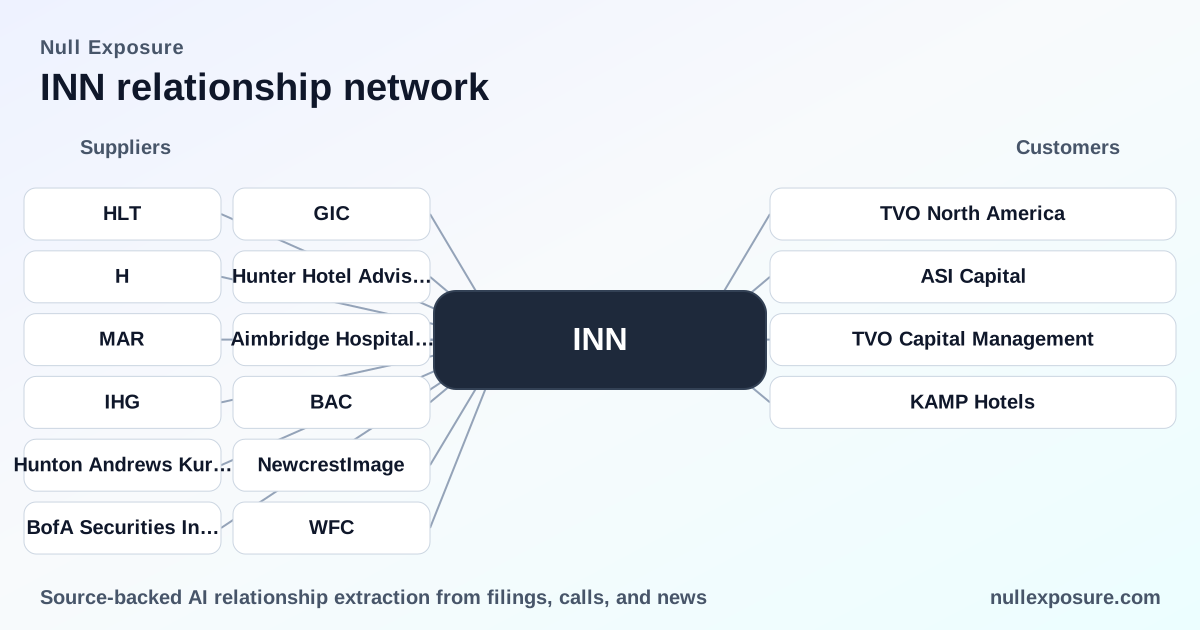
Summit Hotel Properties (INN): Customer relationships that shape cash flow and G&A
Summit Hotel Properties is a self‑managed lodging REIT that owns premium‑brand hotels and monetizes through room sales, ancillary hotel operations and fee income from joint ventures. The company’s operating cash flow is driven by its portfolio of branded hotels across 25 U.S. states and by structuring JV arrangements that convert asset value into recurring fee income; these dynamics directly affect corporate overhead coverage and distributable cash. For a quick tour of our coverage and data tools, visit https://nullexposure.com/.
How Summit makes money and why customer relationships matter
Summit’s core revenue model is straightforward: sell guestrooms and capture hotel operating profit, while treating dispositions and joint ventures as levers to optimize return on invested capital. The company reports one GAAP segment tied to lodging investments and uses a mix of asset sales and JV structures to improve margins and cover corporate expenses. That combination of operating revenue and structured fee income produces a hybrid cash profile: hotel operations supply variable, market‑sensitive cash, while JV fees create a more predictable offset to corporate G&A.
- Contracting posture: Summit operates as both an owner/operator and a seller of assets; it is self‑managed and engages in joint ventures to monetize assets while retaining upside through promotes.
- Concentration: The portfolio is U.S.‑centric—97 properties, 14,553 guestrooms across 25 states at end‑2024—so macro U.S. lodging trends dominate performance.
- Criticality: Joint ventures that deliver recurring fee income are strategically important for covering fixed corporate costs.
- Maturity: The company has an established REIT operating model (organized in 2010) and regularly cycles assets through sale or JV to optimize returns.
Key takeaway: Summit’s earnings and balance of variable vs. fee income hinge on a small number of structural relationships (JV partners and buyers), making each named counterparty meaningful to analysts modeling G&A coverage and asset turnover.
The GIC joint venture — a material fee stream for FY2026
Summit’s JV with GIC produces net fee income that, in FY2026, covers roughly 15% of annual pro‑rata cash corporate G&A (exclusive of any promote distributions Summit may earn). This is a meaningful recurring offset to overhead and reduces the cash burden on operations when occupancy or ADR softness appears. The detail was disclosed in Summit’s Q1 FY2026 earnings call transcript and reported in multiple outlets including Investing.com and The Globe and Mail. (FY2026 earnings call transcript coverage published May 2026.)
KAMP Hotels — counterparty in a 2025 disposition
An affiliate of Summit sold a Texas Courtyard hotel to an affiliate of Amarillo‑based KAMP Hotels on October 20, 2025. This transaction is an example of Summit using asset sales to recycle capital and sharpen portfolio composition. Hotel Management covered the transaction in its October 2025 reporting.
TVO North America — an earlier purchaser (2017)
TVO North America purchased the Courtyard by Marriott in East Central El Paso for $11.2 million, a transaction reported in July 2017 by the El Paso Times. This history is relevant when tracing Summit’s disposition activity and the market of regional buyers that acquire its assets.
TVO Capital Management — investment arm participation in 2017
TVO Capital Management, TVO’s investment arm, was reported in July 2017 as a purchaser of the 90‑room El Paso property (in partnership with ASI Capital). That transaction illustrates the role of smaller, regionally focused investment managers in Summit’s buyer pool and secondary market liquidity for select assets. (El Paso Times, July 2017.)
ASI Capital — partner in the 2017 purchase
ASI Capital was identified alongside TVO Capital Management in the same July 2017 El Paso Times article as a partner in the acquisition of the Courtyard property. ASI’s involvement is another data point on the types of private buyers active in transactions with Summit affiliates.
Putting the relationship map to work for investors
Each named counterparty in the coverage set reflects one of Summit’s commercial vectors:
- GIC is a strategic JV counterparty that supplies recurring fee income and helps stabilize corporate overhead coverage.
- KAMP Hotels, TVO North America, TVO Capital Management and ASI Capital represent the active buyer universe for asset dispositions—regional operators and private capital that absorb noncore properties or reposition assets.
These two vectors (JV fee income versus sale buyers) are the levers management uses to influence liquidity, G&A coverage and portfolio quality. Modelers should treat JV fee schedules and promote economics as structural offsets to corporate costs, while disposition timing and buyer appetite determine near‑term cash generation and capex flexibility.
Risk and concentration considerations that arise from the relationships
- Revenue sensitivity: Because Summit’s core revenue is guestroom sales, a downturn in U.S. lodging demand will transmit directly to operating cash; the GIC fee stream partially mitigates that exposure by covering a material share of G&A in FY2026. The company’s FY2026 disclosures tie that fee to about 15% of pro‑rata cash corporate G&A, which is a quantifiable cushion reported on the earnings call in May 2026.
- Buyer market: The buyer universe for dispositions includes regional operators and private capital (examples: KAMP, TVO, ASI), indicating reasonable secondary market depth but also dependence on cyclical investor appetite for lodging assets.
- Geographic concentration: Summit’s portfolio is U.S.‑centric (25 states; 97 properties, 14,553 rooms at 12/31/2024)—a company‑level signal that U.S. macro and travel patterns dominate risk and opportunity.
What investors should watch next
- Track the timing and economics of any further JV promotes or fee adjustments with GIC, since changes here directly shift corporate cash requirements.
- Watch disposition cadence and buyer diversity—continued sales into a narrow buyer pool could compress pricing; broader buyer participation (institutional vs. regional operators) preserves options.
- Monitor U.S. lodging indicators (demand, ADR) given Summit’s geographic concentration and single reportable segment status.
For an organized view of counterparties, transaction history and earnings call disclosures that drive these conclusions, see our broader company coverage at https://nullexposure.com/.
Bottom line: Summit mixes operational hotel revenues with JV fee income and selective dispositions to manage cash and corporate overhead; GIC stands out as a material recurring fee partner in FY2026, while a set of regional buyers (KAMP, TVO, ASI) populate its disposition market—both dynamics should be baked into any valuation or risk model.