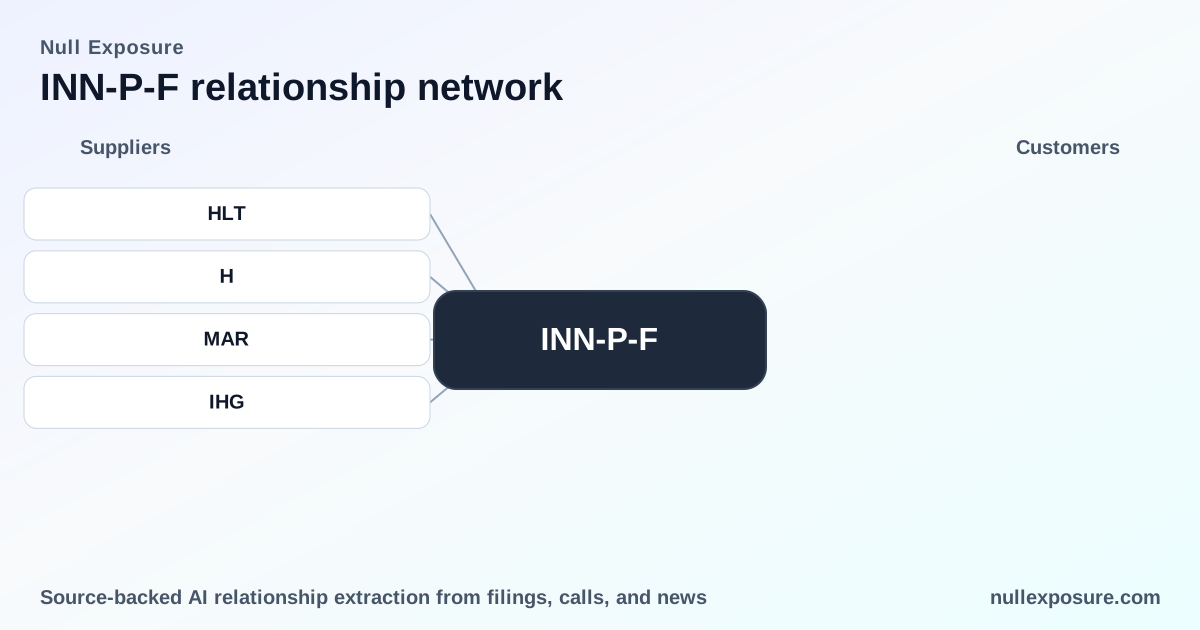
INN-P-F: How a GIC Joint Venture Directly Supports Summit’s Corporate Cash Profile
INN-P-F is a series of preferred shares tied to Summit Hotel Properties, a REIT that acquires and operates upper-upscale and upscale hotels across the U.S. The company monetizes through operating income from its hotel portfolio, strategic joint ventures that generate fee and promote income, and capital recycling executed through asset sales and third‑party capital partnerships; holders of INN-P-F receive priority dividend cash flows backed by Summit’s asset-level cash generation and corporate cash management. For investors evaluating INN-P-F, the most material customer relationship disclosed in public filings for FY2026 is a fee-bearing joint venture with GIC that directly offsets a measurable portion of Summit’s corporate G&A. Explore further investor intelligence at https://nullexposure.com/.
The headline relationship: GIC joint venture reduces Summit’s corporate cash burden
According to Summit’s FY2026 earnings call transcript published on InsiderMonkey (May 3, 2026), the GIC joint venture generates net fee income payable to Summit that covers approximately 15% of annual pro rata cash corporate G&A expense, excluding any promote distributions Summit might earn during the year. This is a direct, recurring cash inflow to the corporate entity rather than property-level NOI, and it meaningfully improves Summit’s corporate cash position. (Source: FY2026 earnings call transcript, InsiderMonkey — published May 3, 2026.)
Why this matters for preferred holders
- Predictable corporate cash relief. The GIC fee income reduces the corporate cash required to support overhead and governance functions, increasing the likelihood that corporate-level obligations — including preferred dividends — remain funded from operating cash available to the REIT.
- Alignment with capital partners. A fee-bearing JV with a large institutional investor like GIC signals durable capital relationships that can be tapped for balance sheet relief or transaction execution.
Every customer relationship disclosed (FY2026 results)
- GIC — Summit’s joint venture with GIC produces net fee income that covers roughly 15% of Summit’s annual pro rata cash corporate G&A, excluding promote distributions; this income is recorded at the corporate level and supports Summit’s overhead cash requirements (InsiderMonkey, FY2026 earnings call transcript, May 3, 2026).
How the operating model and business-model signals shape risk and return
Summit’s public disclosures and the GIC relationship reveal a set of company-level operating characteristics investors should internalize when evaluating INN-P-F.
- Contracting posture: fee-forward and JV-centric. Summit demonstrates a contracting posture that prioritizes joint-venture structures and fee arrangements with capital partners. Those contracts convert asset ownership risk into recurring fee income and promote opportunities. This posture reduces dependency on single-asset cash flows and shifts a portion of earnings to contractually specified management fees.
- Concentration and counterparty quality. The presence of a strategic partner like GIC indicates low counterparty concentration risk in capital markets terms, because GIC is a large, sophisticated institutional investor likely to honor long-term commitments. For preferred investors, the implication is improved resilience of corporate fee streams.
- Criticality of the relationship. The GIC JV is material to corporate cash management — covering ~15% of corporate G&A is not cosmetic; it meaningfully reduces the cash Summit must generate or raise elsewhere to fund overhead, governance, and potential dividend coverage at the corporate level.
- Maturity and repeatability. Fee income from large JVs tends to be contractually predictable across the partnership lifecycle. That said, promote distributions are reported separately and will vary by asset-level performance; the disclosed 15% figure explicitly excludes promotes and therefore represents a conservative floor for recurring cash support.
What investors should watch next
- Visibility into promote economics. The FY2026 disclosure excludes promote distributions; promote income would be incremental upside to the 15% G&A coverage and should be tracked in subsequent quarter filings and JV waterfalls.
- Duration and escalation of fee schedules. Confirm whether fee income is fixed, indexed to performance, or subject to step-downs as assets are sold; those contract terms determine how long the 15% coverage persists.
- Corporate dividend funding sources. Preferred holders should monitor cash flow allocation between property-level distributions, corporate fees, and any cash retained for capex or debt service. The GIC fee provides a predictable line item in that equation.
Risk considerations that affect INN-P-F valuation
- Operational cyclicality. Hospitality remains cyclical; property-level NOI volatility will influence promotes and asset sale timing, which in turn affects any incremental cash above the base fee.
- Counterparty and contract dependency. While GIC’s involvement strengthens the counterparty profile, reliance on fee income from a small number of JVs concentrates contractual exposure at the corporate level.
- Disclosure granularity. The public disclosure quantified a single metric for FY2026; investors must rely on ongoing filings to convert a point-in-time percentage into a multi-year projection for dividend coverage and corporate liquidity planning.
Bottom line: GIC JV materially supports corporate cash; watch promotes and fee tenor
The GIC joint venture is a tangible, quantifiable benefit to Summit’s corporate cash flow — responsible for roughly 15% of annual pro rata cash corporate G&A in FY2026. For INN-P-F holders, this reduces the corporate cash burden and strengthens the dividend funding profile relative to a REIT without such fee-bearing partnerships. The next step for investors is to monitor promote realizations, fee escalation clauses, and any expansion or contraction of JV activity that would change the corporate cash equation.
For a concise view of commercial relationships and their investor implications, visit https://nullexposure.com/ and review our analytical coverage.