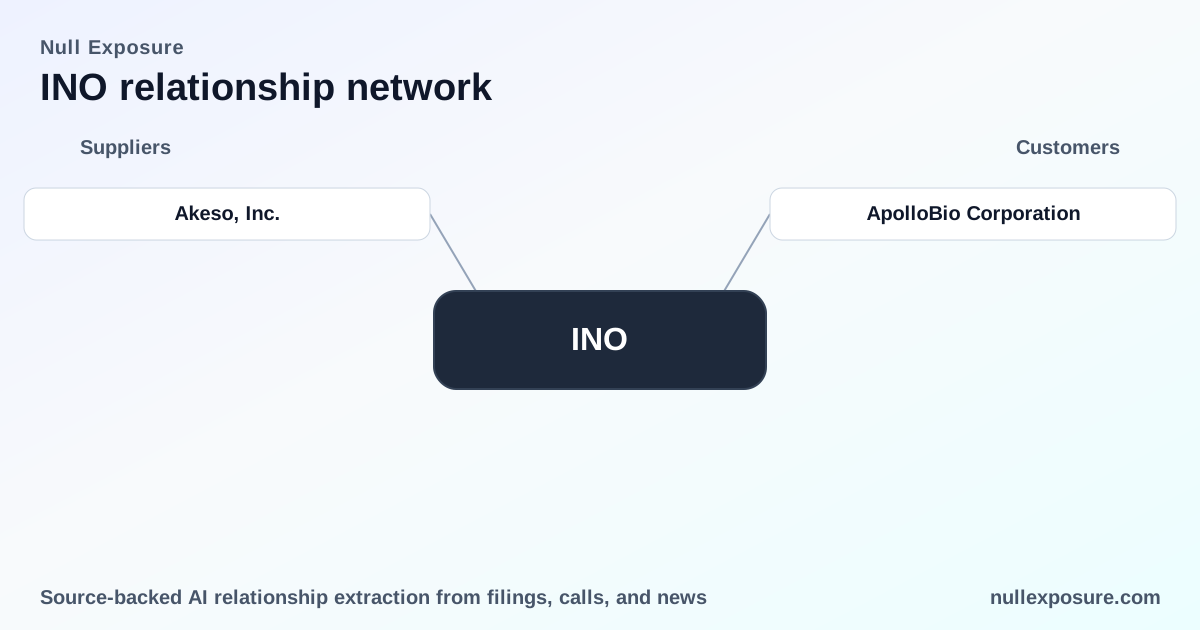
Inovio (INO) — Customer Relationships and Revenue Concentration: ApolloBio Dominance
Inovio Pharmaceuticals develops and commercializes DNA-based therapeutics and delivery devices, monetizing through collaborative licensing, milestone and royalty streams, and sales of its electroporation device, CELLECTRA. The company’s near-term revenue profile is driven by a single counterparty relationship that both funds clinical advancement and concentrates commercial risk, while device regulatory approvals expand distribution optionality in Europe. For investors and operators, the focus is simple: track the commercial and clinical progression of the ApolloBio collaboration and the revenues tied to device commercialization. For more context on supplier and customer mapping, visit https://nullexposure.com/.
The investor thesis up front
Inovio operates as a platform biotech combined with a medical-device business: it licenses vaccine and therapeutic candidates to collaborators for regional clinical development and commercialization, and it sells or licenses the CELLECTRA electroporation device to enable DNA delivery. Revenue is heavily concentrated in partnership fees and collaborator-driven commercialization rather than broad direct product sales, which makes partner execution and contract terms the principal drivers of near-term cash receipts and investor outcomes.
Relationship inventory — the single material customer: ApolloBio
ApolloBio Corporation is Inovio’s material collaborator on VGX-3100 for cervical HSIL in China. According to Inovio’s 2024 Form 10-K, ApolloBio is conducting a Phase 3 clinical trial for VGX-3100 in China and plans to pursue regulatory approval and potential commercialization in that jurisdiction. The 10-K explicitly states that ApolloBio accounted for 100% of Inovio’s revenue in 2024 and 29% in 2023, underscoring ApolloBio’s outsized commercial significance to Inovio’s current revenue base. (Source: Inovio 10-K, FY2024)
Why this single relationship matters
- Revenue concentration is extreme: One counterparty supplied all reported revenue in 2024, creating a single-point dependence for near-term top-line performance. That concentration transforms partner milestones, payment timing, and China regulatory outcomes into company-level cash-flow events.
- Clinical progress directly maps to commercialization upside: ApolloBio’s Phase 3 progress for VGX-3100 in China translates to regulatory filing potential and licensing/royalty realizations in that territory if the trial endpoint is met and approval is secured (Inovio 10-K, FY2024).
- Contractual criticality is explicit: Inovio’s filings label ApolloBio’s contribution as both material and critical to revenue, which elevates counterpart risk to a strategic company risk rather than a typical account-management issue (Inovio 10-K, FY2024).
Operating-model constraints and what they imply
The company-level signals drawn from public excerpts define a business with these characteristics:
- Concentrated counterparty exposure: The firm’s contracting posture relies on deep, exclusive collaborations rather than broad direct-market commercialization. That concentration requires rigorous partner governance and contingency planning.
- Geographic revenue concentration: United States receipts, with EMEA device readiness: Inovio reports that all revenue in 2023–2024 was earned in the United States, which signals that contractual cash flows and device orders to date are US-centric, even as CE-marking of the CELLECTRA 5PSP opens EMEA commercial channels. This dichotomy means regulatory approvals in other regions add optionality rather than immediate revenue diversification.
- Device commercialization maturity in markets recognizing CE-mark: The company has CE-marked its CELLECTRA 5PSP model for EU commercialization, which is a maturity signal for the device business and creates a parallel route to monetize the underlying delivery platform across territories that accept CE-marking.
- Materiality and criticality are documented: Inovio’s own disclosure tags at least one customer relationship as both material and critical, elevating counterparty operational continuity and contract performance to board-level strategic risks.
These factors together indicate a business that is operationally lean but counterparty-dependent: commercial upside is high when partner execution is successful, and downside is concentrated if the principal collaborator underperforms or alters commercialization plans.
Practical implications for investors and operators
- Monitor ApolloBio trial and regulatory milestones: Trial enrollment pace, DSMB readouts, regulatory interactions in China, and any commercialization agreements or milestones posted by ApolloBio will directly impact Inovio’s revenue trajectory and valuation multiples. (Source: Inovio 10-K, FY2024)
- Evaluate contract clauses around payments and exclusivity: The economics of the ApolloBio collaboration—milestone timing, royalty rates, territorial exclusivity, and termination provisions—determine how much of clinical success converts to Inovio cash flow. Inovio’s filing underscores the revenue dependence, so operators should prioritize understanding payment triggers in diligence.
- Watch device commercialization in EMEA as a diversification lever: CE-marking of CELLECTRA 5PSP enables sales and service revenues in Europe and markets recognizing CE. That channel is the most plausible route to reduce single-counterparty concentration over time. (Source: Inovio 10-K, FY2024)
If you want a structured view of counterparties and contractual concentration for biotech portfolios, Null Exposure maintains a dedicated mapping service; explore options at https://nullexposure.com/.
Scenario framing and downside controls
- Upside scenario: ApolloBio’s Phase 3 succeeds, China filing proceeds, and milestone/royalty payments convert to sustained revenue, while CELLECTRA EMEA sales begin to diversify receipts.
- Base scenario: Clinical progress is modestly delayed, producing intermittent milestone payments but continued heavy reliance on ApolloBio.
- Downside scenario: Trial failure, regulatory setbacks, or a termination of the collaboration would cause a severe revenue shock given the 100% revenue concentration reported in 2024.
Operators should negotiate or renegotiate contractual fallback provisions—escrowed payments, staged deliverables, or non-exclusive device pathways—to mitigate single-customer dependence.
Key takeaways
- ApolloBio is both material and critical to Inovio’s reported revenue profile; the 2024 Form 10-K records ApolloBio as the source of 100% of 2024 revenue and 29% in 2023. (Source: Inovio 10-K, FY2024)
- Clinical and regulatory outcomes for VGX-3100 in China will be the dominant near-term value driver. (Source: Inovio 10-K, FY2024)
- The CELLECTRA CE-marking is an actionable diversification vector that positions Inovio to monetize device sales in EMEA and markets recognizing CE marking, reducing long-term counterparty concentration risk if commercialized successfully. (Source: Inovio 10-K, FY2024)
For actionable monitoring templates and counterparty scorecards that map clinical milestones to contractual cash flows, Null Exposure’s platform provides ready-to-use frameworks at https://nullexposure.com/.
How to follow updates
Track Inovio’s SEC filings and ApolloBio clinical registry updates, and prioritize disclosures referencing contract revenues, milestone receipts, and CE-mark commercialization activity. Those items will be the most reliable signals of changing counterparty risk and revenue durability.