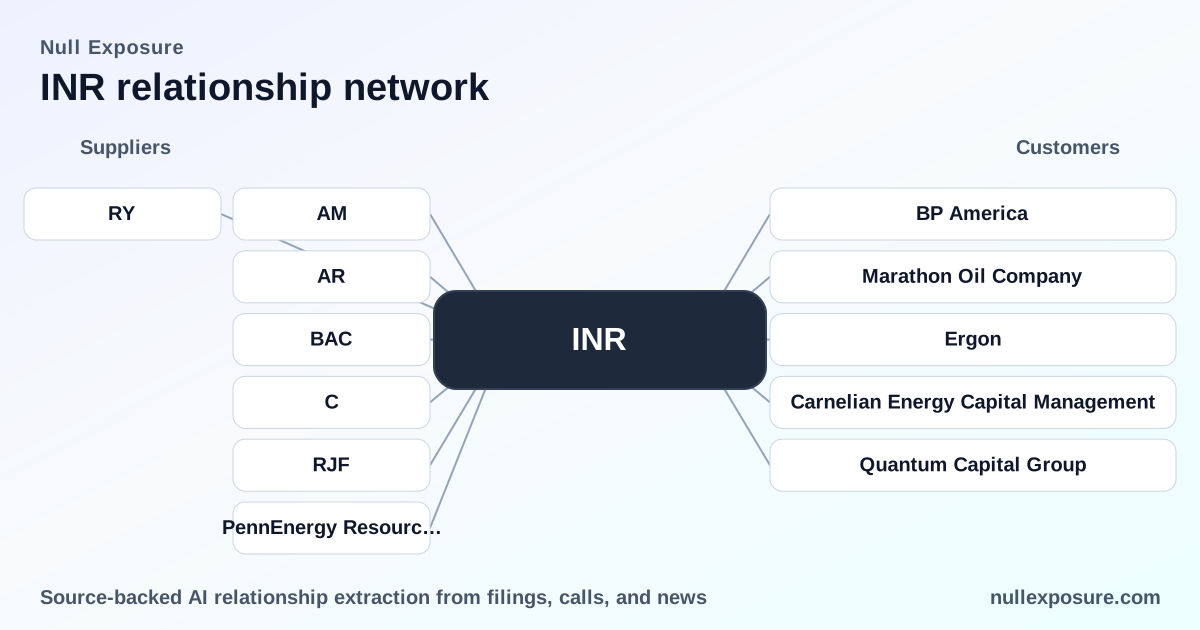
Infinity Natural Resources (INR) — customer relationships and commercial posture
Infinity Natural Resources operates as an upstream oil and gas E&P focused on the Appalachian Basin, monetizing by producing and selling oil, natural gas and NGLs to third‑party purchasers. Revenue comes from physical commodity sales delivered to large, creditworthy purchasers, with pricing tied to prevailing market benchmarks and contractual differentials, and receivables show significant concentration in a small set of buyers. For a concise map of counterparties and corporate signals, see NullExposure's platform for relationship intelligence: https://nullexposure.com/.
Investment thesis — clear cashflow through concentrated offtake
INR is a growth‑oriented independent producer that converts produced volumes into cash through short‑notice commodity sales to majors and midstream buyers. The business monetizes directly at the wellhead and through processing, which produces both margin and working capital exposure; material customer concentration and daily settlement mechanics create both upside on commodity rallies and downside through counterparty dependence.
Who is buying INR’s production — an at‑a‑glance map
INR’s filings and recent press coverage identify a small set of large purchasers that account for the majority of commodity revenue. Below I list each counterparty mentioned in public records with a concise, plain‑English takeaway and the supporting source.
Marathon Oil Company
Marathon accounted for the largest share of INR’s commodity revenues in 2024, representing roughly 49–55% of receivables and 55% of commodity revenue for the year. According to INR’s Form 10‑K for the year ended December 31, 2024, Marathon was the single largest purchaser and made up the majority of amounts due from purchasers. (INR 2024 Form 10‑K / FY2024)
BP America
BP America was the second‑largest counterparty in INR’s receivables and commodity sales mix, accounting for about 17–25% of reported purchases and receivables in the 2023–2024 disclosures. The company’s 2024 10‑K lists BP America among purchasers representing a material portion of balances due from customers. (INR 2024 Form 10‑K / FY2024)
Ergon
Ergon is identified in INR’s historical receivable breakdown as a smaller but still material purchaser, contributing low‑double-digit shares of receivables in 2023; it is listed alongside Marathon and BP in the company’s receivables rollforward. The 2023 disclosure in INR’s filings shows Ergon at roughly an 11% share of receivables as of December 31, 2023. (INR 2024 Form 10‑K describing FY2023 / FY2024 comparisons)
Carnelian Energy Capital Management, L.P.
Carnelian is a financial investor that participated in a strategic preferred stock placement tied to an equity investment announced in 2026; Carnelian purchased $75 million of preferred stock as part of a $350 million financing package. Press coverage of the transaction reports Carnelian’s stake alongside a larger institutional buyer. (Pulse2 report on the 2026 strategic equity investment; LeLezard coverage, March–May 2026)
Quantum Capital Group
Quantum participated as the lead investor in the same 2026 preferred stock offering, purchasing $275 million of preferred stock in the $350 million financing that increased strategic capital for the company’s Antero Ohio position. Multiple press releases and news outlets referenced Quantum’s $275 million commitment in March–May 2026. (Pulse2 and LeLezard reports on the 2026 strategic equity investment)
SBSW (Sibanye Stillwater) — market mention, not a confirmed INR counterparty
A commodities news article referenced a transaction involving Sibanye Stillwater and ioneer Ltd (ASX: INR) — a different company that shares the ticker INR on Australian markets — this mention does not establish a commercial relationship between Sibanye and Infinity Natural Resources; it is a ticker collision in press coverage. The article described Sibanye’s battery‑metals investments and cited a ioneer project, not Infinity Natural Resources’ Appalachian operations. (news.metal.com, March 2026)
How the contract and operating posture shapes risk and cashflow
INR’s public disclosures and constraint signals describe a hybrid commercial model with specific operational implications:
-
Contracting posture: The company operates a mix of short‑term and longer‑dated revenue arrangements. Some contracts are short‑term or renewed in six‑month increments, commodity sales are often spot/production‑day contracts that do not create long‑lived performance obligations, but the company also reports that the majority of revenue contracts have terms greater than twelve months. This combination creates both pricing flexibility and revenue timing variability. (Company 10‑K statements)
-
Counterparty profile: Purchasers are large enterprises and majors (utilities, LNG players, industrial customers and super‑majors), which supports credit quality but concentrates exposure in a handful of buyers. (Company disclosures)
-
Geography: Production and sales are domestically focused within the continental United States, which reduces cross‑border settlement risk but concentrates exposure to US pipeline and regulatory dynamics. (Company disclosures)
-
Concentration and criticality: The largest purchaser accounted for approximately 55% of commodity revenue in 2024, making revenue highly concentrated and therefore material and critical to near‑term cashflow. The company warns that losing a major purchaser could materially and adversely impact revenues. (10‑K / FY2024)
-
Relationship maturity and stage: Commodity sales are active and transactional — revenue is recorded in the month production is delivered and many sales originate upon production, so there are no long‑dated performance obligations outstanding for daily commodity sales. (10‑K disclosures)
-
Core product orientation: INR derives the bulk of revenue from produced oil, natural gas, and NGLs, so customer relationships are fundamentally tied to commodity volumes and pricing rather than service contracts. (Company filings)
Investment implications — what investors should watch
- Concentration risk is the principal near‑term operational risk: the top counterparty constitutes a majority of commodity revenue, which creates single‑counterparty dependency that can amplify downside if volumes, pricing or offtake terms change.
- Cashflow resilience benefits from strong counterparties (majors and midstream players), but the mixed contract mix (spot vs. some >12‑month contracts) means revenue volatility tracks commodity prices and production timing.
- Capital or strategic transactions (the 2026 preferred stock investments) signal access to committed capital from institutional backers, which supports development plans but also changes the capitalization mix and potential governance dynamics. (Pulse2 / LeLezard coverage of 2026 financing)
Bold takeaway: INR is a cash‑generative E&P with concentrated commercial relationships; investors should value the company for its production economics while pricing in material counterparty concentration and spot‑driven revenue variability.
For a detailed, interactive view of INR’s counterparty map and the primary source filings behind these summaries, visit NullExposure’s relationship hub: https://nullexposure.com/.