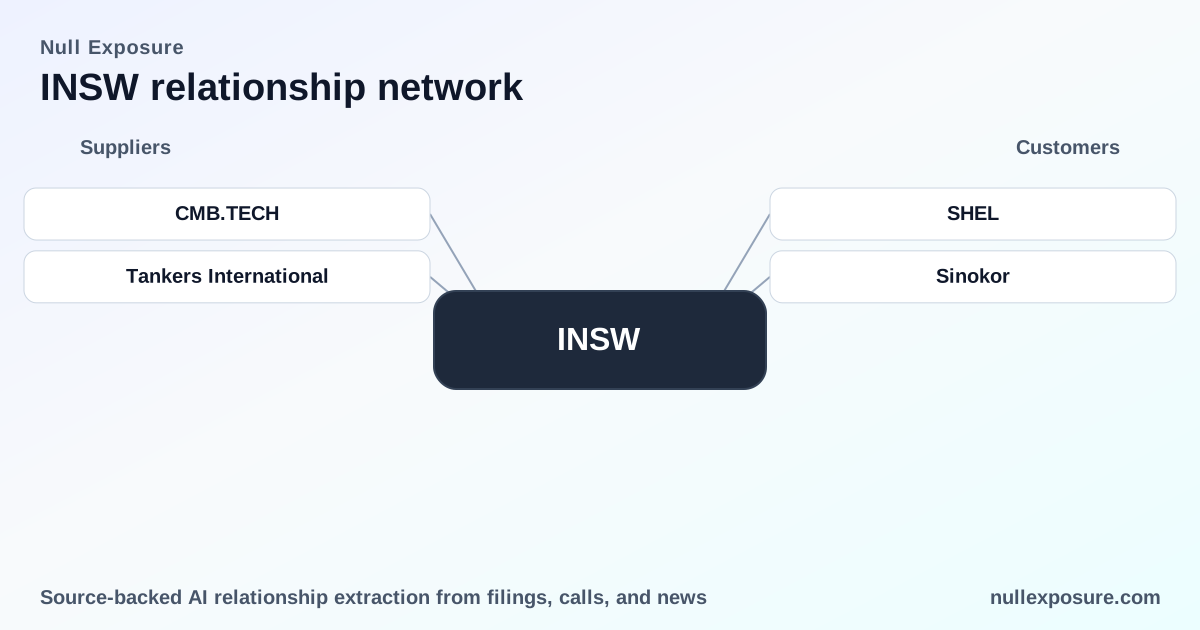
International Seaways (INSW): customer relationships that drive fleet economics
International Seaways owns and operates a global fleet of crude and product tankers and monetizes that fleet through a mix of spot voyages, time charters (including multi-year deals with oil majors), and specialized lightering services. Revenue is generated both from market-exposed voyage charters that convert to daily TCE earnings and from longer-dated time and bareboat charters that lock in cash flow; the resulting business model blends recurring contracted revenue with sizable exposure to freight-rate cyclicality. For a quick primer on how we track counterparties and customer concentration, visit https://nullexposure.com/.
Why customers matter more than ships right now
INSW’s fleet strategy translates directly into counterparty risk and cash‑flow profile. Long-term charters provide predictable cash flow and ease refinancing, while the heavy reliance on spot TCEs amplifies earnings volatility in down markets. Understanding which counterparties hold multi-year economics versus one-off voyage business is essential to forecasting EBITDA and free cash flow.
Active customer relationships from recent coverage
Below are the relationships surfaced in recent public reporting and press — each described in plain English with a concise source note.
Shell — three VLCCs under contracts with profit-share elements
INSW disclosed that three VLCCs are contracted to Shell under arrangements that include a profit-share component, indicating a layered commercial structure beyond simple fixed daily charter hire. According to a Q4 2025 earnings call transcript republished on InsiderMonkey, management referenced these three VLCCs and their profit-share terms (InsiderMonkey, March 2026).
Sinokor — buyer linkage in a recent vessel sale program
News coverage of INSW’s fleet pruning reported that two VLCCs averaging 15 years were linked to South Korean owner Sinokor as part of a disposal program, signaling portfolio rebalancing and second‑hand market engagement. Splash247 covered the sale details in March 2026, noting the linkage to Sinokor and additional MR product tanker sales (Splash247, March 2026).
What the company-level constraints tell an investor about operating posture
The public excerpts and filings around INSW’s contracting and customers reveal a multi-dimensional commercial model that investors should treat as the primary driver of earnings variability and structural resilience.
- Contracting posture: a deliberate mix of long-term and short-term exposure. Company filings indicate material long-term commitments — notably three newbuild VLCCs that commenced seven‑year time charters with an oil major shortly after delivery — alongside significant short-duration voyage charters and spot work. This blend gives INSW some locked-in cash flow while retaining upside to freight rallies.
- Concentration toward large enterprise counterparties and governments. Management explicitly lists oil majors, state-owned oil companies, traders and refinery operators as core customers. That client mix raises credit quality on contracted revenue but also introduces reputational and compliance filters imposed by large counterparties.
- High spot exposure drives volatility. INSW reported that in 2024 roughly 86% of TCE revenues were spot-derived, down from higher levels earlier in the decade but still a dominant source of earnings. Spot dependence amplifies operating leverage to the tanker cycle.
- Geographic reach is global and operationally complex. The fleet operates internationally, exposing INSW to sovereign, political, and regulatory dynamics across regions.
- Relationship roles and service mix. The company functions both as a seller of transportation services (voyage and time charters) and as a provider of specialized services such as lightering; filings treat lightering and certain voyage work as service revenue under ASC 606.
- Contract maturity profile supports medium-term visibility. As of December 31, 2024, INSW had time charter expirations spread through April 2030, providing a runway of contracted earnings for a portion of the fleet while leaving others open to the spot market. Bareboat and long-term time charters create durable revenue tranches for the balance sheet.
Investment implications: upside and what to watch
- Upside: Long-term time charters to creditworthy oil majors (and profit‑share arrangements such as those reported with Shell) create high‑quality cash flow that supports deleveraging and dividend capacity. Newbuilds delivered in 2023 with multi-year employment reduce near-term reinvestment risk and support EBITDA stability.
- Downside / risk: The company’s large residual exposure to spot TCEs—historically >80% of TCE revenue—translates to sharp revenue and EBITDA swings under freight price weakness. Vessel disposals linked to third‑party owners (e.g., the Sinokor-linked sales) reflect active portfolio management but also suggest sensitivity to second‑hand market conditions and age profile of the fleet.
- Credit and counterparty risk: Contracted revenue with large enterprises and governments is a credit positive, but institutional buyers enforce strict environmental and operational standards that influence vetting and future contract awards.
- Operational complexity: Global operations and lightering service lines increase operational revenue diversity but require ongoing capex and crewing discipline.
For a structured view into INSW’s commercial counterparties and how they map to revenue sensitivity, explore our platform at https://nullexposure.com/.
Tactical takeaways for investors and operators
- Treat INSW as a hybrid earnings story: a base of contractual charters that smooth cash flow layered over a high‑volatility, market‑exposed earnings engine. This hybrid model favors investors who can tolerate cyclical swings but value long-term charter cash flow.
- Monitor charter book roll-offs and profit-share disclosures. The incremental disclosure of profit‑share elements (as with Shell) materially changes revenue capture and should be read as an increase in contract sophistication and potential upside participation.
- Watch asset sales and fleet age metrics. Disposals involving older MRs and VLCCs and linkage to buyers like Sinokor provide real-time signals about asset pricing and fleet renewal strategy.
Bottom line
International Seaways runs a dual-mode commercial engine: durable pockets of long-term contracted cash flow coexist with meaningful spot exposure that drives cyclicality. The relationships identified in recent reporting — notably the Shell-linked VLCC profit-share contracts and Sinokor-linked asset sales — underscore both the upside of structured charters and the active fleet management required to navigate tanker markets. Investors evaluating INSW should prioritize charter book composition, counterparty credit quality, and the pace of fleet renewal as the principal levers for valuation and risk.