Intel’s customer map in 2026: who buys chips, who partners on AI, and what it means for investors
Intel Corporation designs and manufactures CPUs, accelerators and packaging services and monetizes through direct sales to OEMs/ODMs, channel distribution, foundry and advanced packaging contracts, and platform partnerships with hyperscalers and telecom providers. The firm combines product sales (chips and systems), foundry manufacturing and IP/collaboration revenues — a mix that drives large enterprise contracts and recurring volume, while retaining the flexibility to serve short‑term purchase orders. For an investor, the key levers are customer concentration, hyperscaler and OEM demand for AI compute, and the maturity of Intel’s foundry and packaging wins. Learn more about how we source and analyze customer relationships at https://nullexposure.com/.
What Intel sells, how customers buy it, and the commercial constraints investors should watch
Intel sells core semiconductor products and platform solutions (CPUs, SoCs, accelerators, packaging and reference designs) into three commercial patterns: (1) large OEM/ODM contracts that produce meaningful receivables, (2) hyperscaler/foundry and packaging agreements that can be commercial and strategic, and (3) short‑notice purchase‑order business via distributors and channel partners. Intel’s filings and press coverage together signal a hybrid contracting posture: there are long‑term supply and design relationships, but a substantial portion of business remains cancellable or variable on short notice.
Key company‑level signals to incorporate into investment models:
- Concentration: Intel disclosed that its top three customers collectively accounted for 43% of net revenue in 2025, a material concentration that amplifies both upside and downside risk (Intel 2025 10‑K).
- Geography: Sales outside the U.S. were ~70% of revenue in 2025, with China alone at ~24%, indicating high APAC exposure (Intel 2025 10‑K).
- Customer types: Revenue comes predominantly from large enterprises, OEMs/ODMs and cloud service providers, with governments and education listed among end users (Intel 2025 10‑K).
- Channels and roles: Intel sells both directly and through distributors/resellers; it serves as a seller, platform provider and service partner to systems OEMs and hyperscalers (Intel 2025 10‑K).
If you want a compact feed of named customer relationships and primary sources, visit https://nullexposure.com/ for the full evidence set.
The named relationships that matter — one by one (plain English summaries and sources)
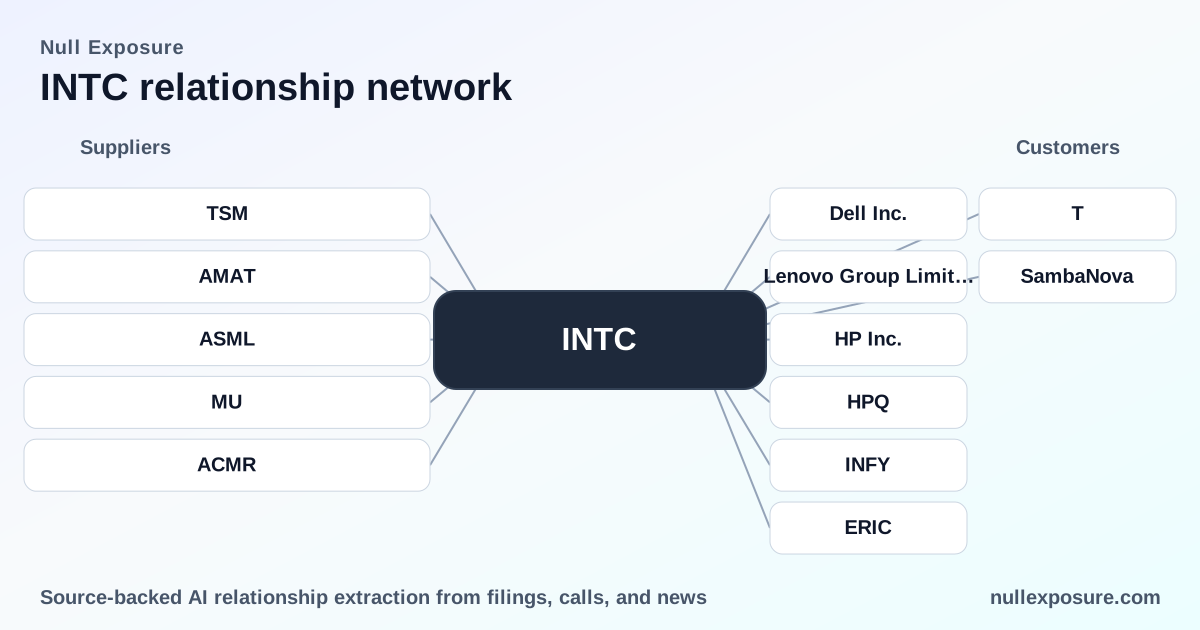
HP Inc.
HP is a named OEM customer in Intel’s FY2025 10‑K and is cited in industry coverage as aligning with Intel on next‑gen AI laptops. Source: Intel FY2025 10‑K; ad‑hoc news coverage, March 2026.
Lenovo Group Limited
Lenovo is listed by Intel in the FY2025 10‑K among customers contributing to sales revenue, reflecting a traditional OEM distribution channel. Source: Intel FY2025 10‑K (FY2025).
Dell Inc.
Dell is a named OEM customer in Intel’s FY2025 filings and is repeatedly referenced in later industry coverage as a buyer of Intel compute for enterprise and data center products. Source: Intel FY2025 10‑K; CNBC coverage FY2026.
Arqit / Arqit Quantum Inc. (ARQQ / ARQQW / ARQ)
Arqit announced that its encryption software is pre‑installed in Intel TDX trusted execution environments on NetSec accelerator cards, showing a software/security integration with Intel hardware. Source: Arqit press releases and earnings comments (Feb–Mar 2026).
Cadence Design Systems (CDNS)
Cadence said it joined the Intel Foundry Accelerator Design Services Alliance, signaling closer design‑services collaboration with Intel’s foundry customers. Source: Cadence earnings call, Q4 2025.
GRRRW
An earnings call cited GRRRW referencing a deepening partnership with Intel (alongside Edgecore, HPE and NVIDIA) as part of a sovereign 5G/edge offering, showing Intel’s role in networking ecosystems. Source: GRRRW earnings call, 2025 Q3.
Tower Semiconductor (TSEM)
Tower disclosed a 2023 agreement for Intel to manufacture 300mm wafers at an Intel New Mexico facility and later discussion about Intel’s intent to withdraw from that agreement; this reflects complex foundry/co‑manufacturing negotiations. Source: Tower Semiconductor press release and CalcalistTech reporting (2025–2026).
PDF Solutions (PDFS)
PDF Solutions licensed Intel’s Tiber AI Studio source code (rebranded Exensio Studio AI), indicating software IP transfers that expand PDFS’s semiconductor data platform capabilities. Source: PDF Solutions press releases and earnings commentary, March 2026.
Tesla (TSLA)
Multiple reports place Tesla as an early customer for Intel’s Terafab 14A foundry complex in Austin, underlining Intel’s strategy to attract vertically integrated automotive and AI chip customers. Source: TechPowerUp and CNBC coverage (April–May 2026).
Infosys (INFY)
Infosys and Intel expanded collaboration to operationalize enterprise AI at scale, combining Intel compute platforms with Infosys’s services fabric. Source: FinViz / Yahoo Singapore coverage, March 2026.
Ericsson (ERIC)
Ericsson and Intel expanded ties around AI‑native networking and future Ericsson silicon using Intel process nodes, and Ericsson is reportedly in advanced talks to take a minority stake in Intel’s NEX business. Source: Finviz and SimplyWall reports, March–May 2026.
AT&T (T)
AT&T participated in a Cloud RAN prototype demonstration where Ericsson ran AI‑native link adaptation software on Intel Xeon 6 SoC hardware, signaling operator deployments of Intel compute in radio networks. Source: bitget / demo coverage, March 2026.
Amazon
Amazon is listed among advanced packaging customers in reporting on Intel’s packaging momentum, showing hyperscaler demand for Intel’s assembly and packaging capabilities. Source: CNBC feature on Intel’s foundry/packaging demand, April 2026.
Cisco
Cisco was named as an advanced packaging customer in the same CNBC coverage, indicating demand from networking equipment OEMs. Source: CNBC, April 2026.
Google (Alphabet)
Google features in reports as a hyperscaler evaluating Intel packaging and compute for AI processors, a strategic signal for Intel’s hyperscaler pipeline. Source: TS2.Tech and CNBC coverage, May & April 2026.
Microsoft
Microsoft was cited among hyperscalers driving demand for Intel compute capacity as part of the broader hyperscaler recovery thesis. Source: CNBC, April 2026.
SpaceX
Press coverage lists SpaceX among advanced packaging customers and as part of joint Terafab arrangements with Intel, illustrating nontraditional hyperscaler and aerospace demand. Source: CNBC, April 2026.
SuperX (SUPX)
SuperX announced AI servers featuring Intel Xeon 6 processors, demonstrating ongoing OEM integration in high‑density AI servers. Source: PR Newswire, March 2026.
Super Micro Computer (SMCI)
Supermicro expanded OCP‑compatible server offerings using dual Intel Xeon 6 processors, reinforcing Intel’s position inside OEM server roadmaps. Source: Supermicro press release / TechPowerUp, May 2026.
Trust Stamp (IDAI)
Trust Stamp (IDAI) stated its platform uses Intel OpenVINO optimizations to run quantized AI models on constrained hardware, showing Intel’s software/hardware ecosystem reach. Source: Proactive Investors, March 2026.
Mercury Systems (MRCY)
Analyst coverage noted Mercury adapts commercial Intel and NVIDIA technology for mission‑critical defense platforms, indicating Intel’s role in defense supply chains. Source: FinancialContent analysis, February 2026.
SambaNova
SambaNova described scaling its AI cloud on Intel Xeon‑based infrastructure, indicating choice of Intel compute for commercial LLM and multimodal workloads. Source: World Business Outlook, March 2026.
UMC
UMC reported collaboration with Intel to accelerate 12nm capacity build and production plans tied to an Intel U.S. fab arrangement for 2027, reflecting cross‑foundry cooperation. Source: Taipei Times coverage, 2025.
xAI (XAIL)
Reports place xAI/SpaceX workstreams inside the Terafab partnership with Intel to design and fabricate high‑performance chips, showing startup/hyperscaler co‑design. Source: CNBC, April 2026.
Apple (AAPL)
Coverage reiterates Apple’s transition away from Intel CPUs to in‑house M‑series silicon; this historical loss remains a strategic competitor dynamic but not a current customer relationship. Source: USA Today, March 2026.
Microchip Technology (MCHP)
Microchip announced a timing module developed in collaboration with Intel to ensure compatibility with Intel Xeon 6 SoC platforms, reflecting component‑level OEM cooperation. Source: Sahm Capital / The Globe and Mail coverage, May 2026.
Amkor Technology (AMCR)
Amkor is identified as a partner on glass substrate development with Intel, showing supply‑chain and packaging ecosystem collaboration. Source: Wccftech, May 2026.
AMD
Industry reports list AMD among potential customers for Intel Foundry services and packaging discussions, indicating competitive and potentially collaborative relationships in the foundry market. Source: TechPowerUp, May 2026.
Brookfield Infrastructure Partners (BIP)
Brookfield appears in reporting about investments in AI infrastructure in partnership with Intel, signaling financial‑strategic collaboration on semiconductor capacity and industrial gas assets. Source: Intellectia.ai commentary, March 2026.
QuickLogic (QUIK)
QuickLogic disclosed a contract to enhance embedded FPGA IP using Intel 18A technology, indicating smaller specialist suppliers leveraging Intel process roadmaps. Source: Investing.com, May 2026.
NATL
A 2024 filing by NATL states dependence on Intel chips and microprocessors, reflecting Intel’s role as a supplier to downstream systems providers. Source: NATL FY2024 10‑K filing.
Investment implications and bottom line
- Revenue mix is both strategic and transactional. Intel combines material long‑term foundry/packaging engagements with a large base of cancellable purchase‑order business. That duality drives volatility in short windows but creates high upside when hyperscaler and OEM orders cascade.
- Concentration and APAC exposure are primary risk factors. With the top three customers representing roughly 43% of revenue and 70% of sales outside the U.S., geoeconomic and customer‑specific demand swings will move margins and working capital materially.
- Strategic wins in foundry and packaging are the valuation lever. Hyperscaler commitments (Google, Microsoft, Amazon), automotive/space clients (Tesla/SpaceX/xAI) and telecom partnerships (Ericsson, AT&T, HPE) are the source of structural upside if Intel sustains execution on 14A/18A and packaging scale.
For a comprehensive, source‑level view of these customer relationships and the underlying filings and press coverage, visit https://nullexposure.com/.