InterGroup (INTG) — customer relationships and what they say about the business model
InterGroup operates a single-asset lodging business: it owns and operates the Hilton San Francisco Financial District and monetizes primarily through room rentals, food & beverage and ancillary services tied to that hotel. Revenue is transaction-driven at the property level, supplemented by a small set of lease arrangements for dedicated event and cultural space; the firm also uses intra-company financing to support operations and capital needs. For investors, the core thesis is simple: InterGroup is a concentrated, owner-operator of a single downtown hotel whose cash flow profile depends on occupancy and F&B performance, while corporate liquidity and capital structure are materially influenced by related-party advances and a renewed unsecured revolving facility. For deeper counterparty intelligence see https://nullexposure.com/.
What the customer map looks like in plain terms
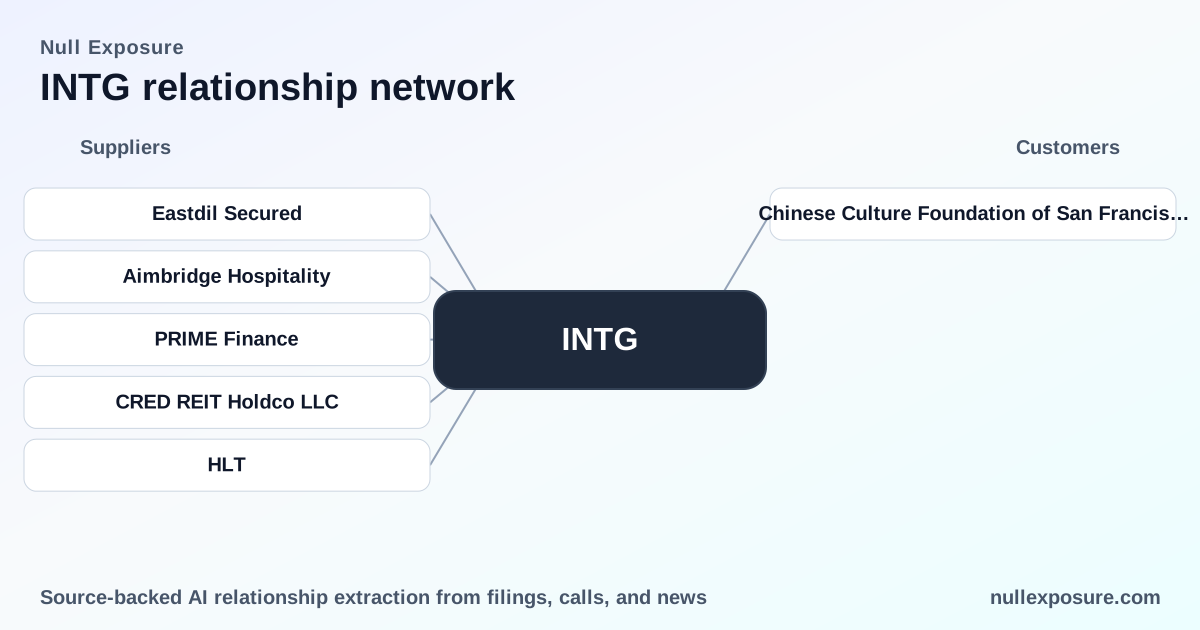
InterGroup’s public disclosures identify a small number of external tenants occupying specialty event space at the hotel rather than a broad retail roster. The most visible customer relationship identified in recent reporting is a long-term lease of third‑floor event space to a community organization, which provides steady, if modest, contracted cash flow and helps diversify revenue away from pure transient room nights.
Chinese Culture Foundation of San Francisco — third‑floor event space lease
The hotel has a lease agreement with the Chinese Culture Foundation of San Francisco for the third-floor space known as the Chinese Culture Center, with a monthly event space fee of $7,000 as of June 30, 2024, providing a predictable ancillary revenue stream tied to events and community programming. This detail is reported in a TradingView news summary of InterGroup’s FY2024 10‑K disclosures. (TradingView report summarizing InterGroup FY2024 10‑K, reported March 2026)
Constraints and company-level signals investors should weigh
InterGroup’s disclosures about financing and revenue recognition reveal a set of operational and financial constraints that shape how customer relationships function inside the business model. These are company-level signals, not attributes of the Chinese Culture Foundation lease specifically.
-
Contracting posture — longer-term financing in place. InterGroup reported that a credit facility was amended in March 2025 to increase availability to $40.0 million and extend maturity to July 31, 2027, indicating a preference for multi-year liquidity arrangements to underpin operations and capital spending. This suggests management favors secured runway over short-term refinancing risk (company filings, fiscal 2025 amendment language).
-
Service provider / related-party lender role. The parent company provides an unsecured revolving loan facility to its majority-owned subsidiary, reflecting an internal capital allocation posture where the parent supplies working capital to operating vehicles rather than relying solely on third-party lenders (company filing language describing intercompany advances).
-
Active, material intra-company advances. During fiscal 2025 and 2024 InterGroup advanced $11.615M and $10.793M, respectively; amounts outstanding were $38.108M and $26.493M at June 30, 2025 and 2024. These are non-trivial flows relative to corporate scale and show the financing relationship is active and ongoing (fiscal 2025/2024 filings).
-
Business segment and revenue recognition posture. Hotel revenue is generated principally from room rentals, packages, F&B and ancillary services (e.g., parking) and is recognized when rooms are occupied or services delivered — a classic lodging revenue model with variable cash flow tied to occupancy cycles (company revenue disclosure).
-
Spend band / exposure scale. The scale of intra-company advances places InterGroup’s related-party financing in the $10M–$100M band, a material exposure that affects balance-sheet leverage and free-cash-flow sensitivity (advances and outstanding balances in fiscal filings).
Taken together, these signals define a company where operational criticality is centered on a single asset, but financial criticality is distributed through related-party funding and a mid-sized revolving facility. That combination elevates the importance of counterparty diligence on both external tenants and internal funding counterparties.
What this means for customer risk and concentration
InterGroup’s customer concentration risk is low in the sense that most revenue comes from open-room inventory rather than a handful of large contracted corporate accounts, but the business is highly concentrated by asset: a single hotel. The Chinese Culture Foundation lease is modest but strategically useful — it provides stable ancillary rental income and community visibility for the property without replacing the primary dependence on transient and group bookings.
- Revenue diversification: The $7,000/month event-space lease is a steady, non-seasonal uplift to revenue but is not large enough to offset volatility in room revenue during demand troughs.
- Tenant criticality: The Chinese Culture Foundation arrangement is low to medium criticality for overall cash flow; loss would be manageable, but numerous such small leases collectively support margin stability.
- Contract maturity and predictability: The lease provides predictable monthly cash receipts (documented as of June 30, 2024), which improves short-term visibility into F&B and event-space utilization for the property.
Financial context and governance signals investors should track
InterGroup’s financials reflect the single-asset profile and concentrated ownership structure that affect negotiation leverage and capital strategy:
- Profitability and scale: Trailing revenue is roughly $68.2M with EBITDA of $15.07M; trailing profit margin is slightly negative on a GAAP basis, signaling sensitivity to operating cost swings and occupancy cycles (latest filings through 2025).
- Ownership concentration: Insider ownership is listed at ~72% while institutional ownership is very low (~2.9%), concentrating control and limiting the influence of broad institutional governance.
- Liquidity and leverage: The amended facility and active intercompany advances place liquidity management at the center of the corporate strategy; investors should monitor covenant compliance, rollover risk after July 31, 2027, and the level of related-party receivables on the consolidated balance sheet.
Practical takeaways for investors and operators
- Focus diligence on both asset performance and intra-group funding dynamics. The hotel’s day-to-day revenue mix (rooms/F&B/events) drives operational valuation, but the capital structure — particularly the unsecured revolving facility and intercompany advances — governs survivability during downturns.
- Small, stable tenant leases matter tactically, not strategically. The Chinese Culture Foundation lease is a positive, predictable cash inflow, but it does not materially change the company’s single-asset concentration profile.
- Governance and ownership concentration are non-trivial. High insider ownership reduces external oversight, making transparent reporting and covenant disclosures essential for an independent investor view.
For a concise, actionable read on counterparty exposure and related-party financing in lodging operators like InterGroup, see https://nullexposure.com/.
Bottom line
InterGroup is a concentrated, hospitality-focused operator whose primary value driver is the Hilton San Francisco Financial District; ancillary lease arrangements such as the Chinese Culture Foundation event-space lease add stable, incremental revenue but do not alter the company’s single-asset risk profile. The larger investment sensitivity comes from intra-company financing and the amended revolving facility, which are material to liquidity and require active monitoring through the July 2027 maturity horizon. Investors should pair asset-level performance analysis with scrutiny of related-party advances and covenant language in upcoming filings.