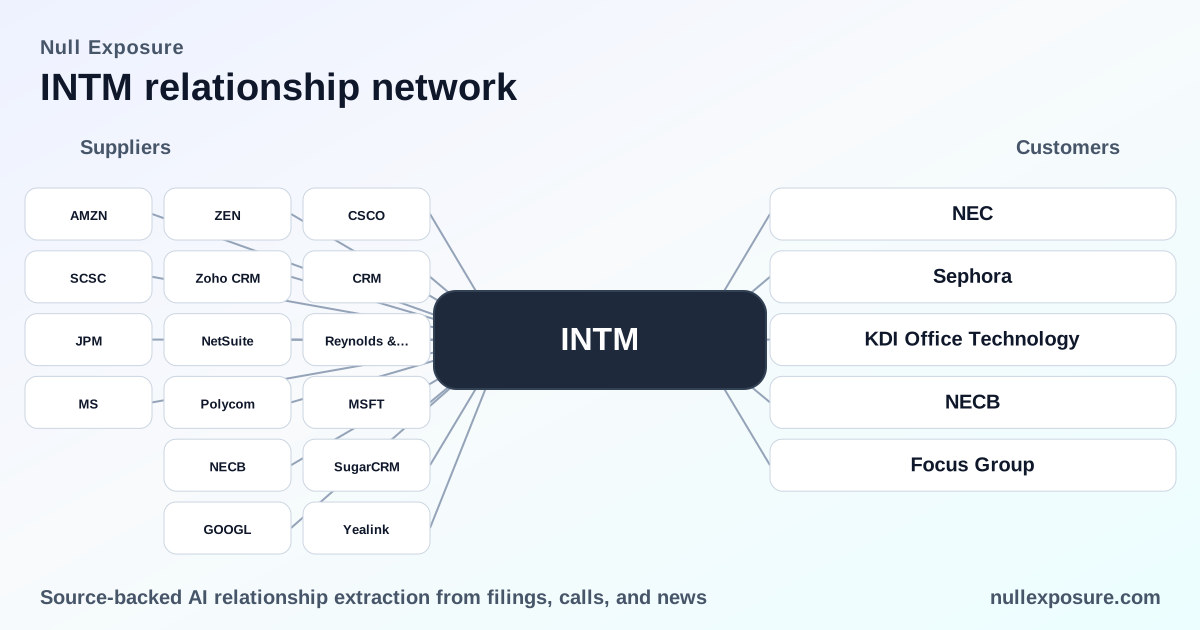
INTM customer map: how Intermedia monetizes partnerships and where risks live
Intermedia (INTM) sells AI-enhanced cloud communications—Unified Communications as a Service (UCaaS) and Contact Center as a Service (CCaaS)—to businesses and channel partners, monetizing through recurring license fees, channel reseller contracts, and managed services tied to platform hosting and support. Revenue flows are a mix of direct subscription ARR and partner-driven wholesale/managed arrangements, with growth driven by exclusive platform deals and a broad service-provider partner program.
If you want a clean, research-ready view of these customer ties and what they imply for operator economics, visit https://nullexposure.com/ for additional context and sourcing.
Quick investor takeaways
- Channel-first commercial model: Intermedia sells both direct and through MSPs/VARs, leaning on partner economics and co-branded deals to scale without equivalent sales expense.
- Anchor partner risk and upside: NEC relationship is both an accelerant—bringing scale through UNIVERGE BLUE—and a concentration risk that increases customer-critical exposure.
- Commercial maturity: The relationship mix shows enterprise brand proof points (Sephora) alongside provider partnerships (123NET, Focus Group, KDI), signaling a balanced go-to-market that can drive volume and margin expansion if churn is controlled.
Customer relationships and what they mean for INTM
NEC / NEC Corp. / NECB — the anchor platform agreement
Intermedia is the underlying provider for NEC’s cloud UC and contact-center solutions and has taken responsibility for NEC’s UNIVERGE BLUE UCaaS and CCaaS operations outside Japan and Australia, positioning Intermedia as NEC’s exclusive cloud communications partner in key regions. This is documented across multiple corporate releases and industry coverage (NoJitter reporting on the NEC handover; PR Newswire announcements across FY2021–FY2024; SiliconANGLE coverage of NEC exiting cloud communications).
Sources: SiliconANGLE (Sept. 25, 2024); NoJitter (Mar. 2024); PR Newswire (FY2021–FY2024).
123NET — regional carrier partnership for product expansion
123NET announced a partnership with Intermedia Intelligent Communications to upgrade its Unified Communications platform in Michigan, framing the deal as a reliability and feature expansion play for regional enterprise and SMB customers. This is positioned as a reseller/partner integration to extend Intermedia’s footprint via a fiber and colocation provider.
Source: Yahoo Finance press release (May 3, 2026).
Sephora — retail brand validation in larger enterprise accounts
Intermedia cites powering major retail brands such as Sephora to illustrate enterprise-grade deployments and channel partner enablement, using that brand reference in go-to-market commentary aimed at MSPs and VARs. This underscores Intermedia’s ability to support major retail communications needs through its platform.
Source: Telecom Reseller interview/features (Sept. 15, 2025).
KDI Office Technology — high-touch partner engagement and advisory role
KDI’s participation on Intermedia’s Marketing Advisory Board reflects a rapidly growing reseller partnership begun in 2023 and illustrates Intermedia’s strategy of co-developing partner programs with top-performing resellers to shape future support and go-to-market initiatives. This is a channel-consolidation signal that supports partner-led scaling.
Source: IndustryAnalysts report (FY2025).
Focus Group — international service-provider adoption
Focus Group, a UK systems integrator, selected Intermedia Intelligent Communications as part of its business technology stack, signaling adoption by independent European service providers and contributing to geographic diversification of Intermedia’s partner base.
Source: PR Newswire release (FY2025).
(For more on how these partner types intersect with Intermedia’s commercial model, see the operating model section below. If you’d like compiled source links and a short diligence pack, visit https://nullexposure.com/.)
What these partnerships reveal about Intermedia’s operating model
Contracting posture and partner economics
Intermedia’s contracts lean toward platform exclusivity and managed-reseller terms in select cases: the NEC relationship is explicitly exclusive in many regions and includes assumption of sales and support obligations. That structure drives recurring revenue but also creates obligations for support capacity and SLAs that scale with partner-sourced customers.
Concentration and customer criticality
The NEC/UNIVERGE BLUE deal is an accelerant for scale yet also a concentration risk: a large, exclusive partner relationship increases single-counterparty exposure and operational reliance on delivering carrier-grade uptime and integration. Concurrently, relationships with carriers like 123NET and integrators such as Focus Group and KDI diversify distribution channels and reduce reliance on direct sales.
Maturity, scalability and go-to-market balance
The mix of marquee brand references (Sephora) and channel partners reflects a mature go-to-market that balances direct enterprise proof points with high-leverage partner distribution. This model supports efficient scaling—partners shoulder local sales, integration, and first-line support—while Intermedia retains platform control and subscription billing.
Investment implications: upside and watch points
- Upside: Exclusive platform arrangements (NEC) accelerate ARR and provide immediate installed base scale; partner wins with regional carriers and international integrators validate product readiness and international rollout capability.
- Watch points: Operational execution risk on support and integration given the managed obligations assumed from NEC; potential margin pressure in wholesale/reseller pricing; and concentration if NEC contributes a large share of revenue without contractual protections visible in public documents cited.
Bottom line: how to read INTM’s customer footprint
Intermedia’s customer list shows a deliberate balance between anchor partner deals that deliver scale and diverse channel relationships that distribute commercial risk and expand market reach. The NEC relationship is the most material signal for both growth and risk. Investors should weigh the revenue acceleration and proof points against the operational commitments those partnerships introduce.
For a concise download of the referenced press releases and coverage used in this review, or to commission a focused partner concentration analysis, go to https://nullexposure.com/.
Bold takeaway: Intermedia monetizes through recurring platform licenses and partner-managed contracts; its NEC exclusivity is the primary growth lever and primary concentration risk.