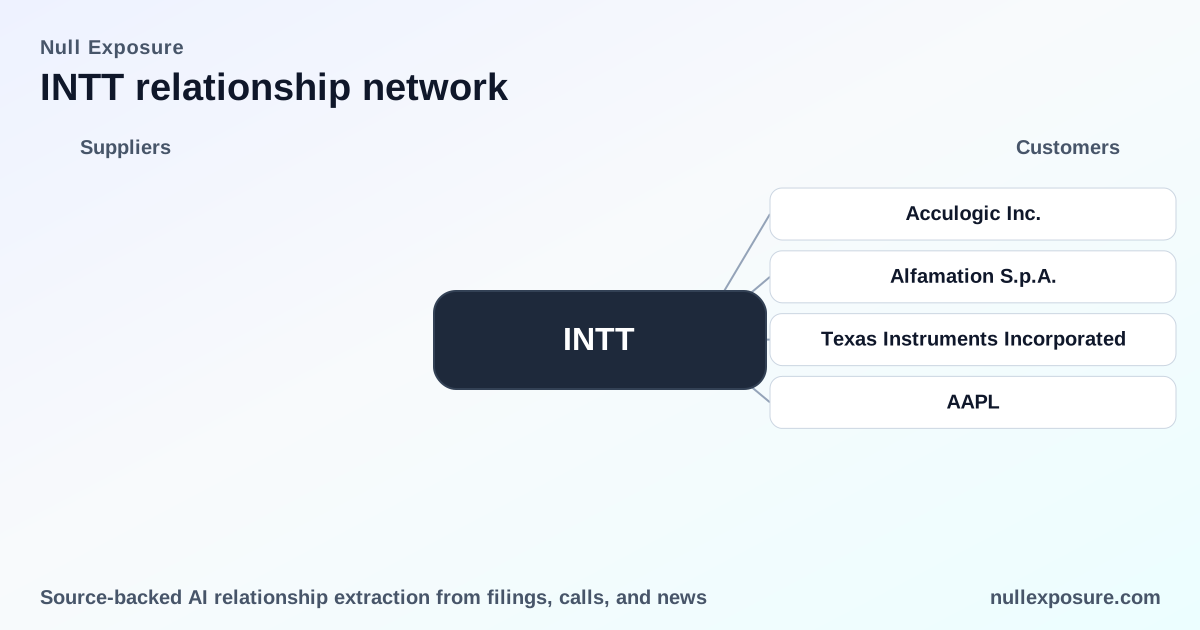
inTEST (INTT) — Customer Relationships That Drive Revenue and Risk
inTEST Corporation sells test and process equipment to semiconductor manufacturers, ATE OEMs and a range of industrial end markets, monetizing through systems sales, aftermarket parts and service, and targeted acquisitions that bring immediate revenue contributions. Revenue is concentrated in the Electronic Test segment and delivered largely through short-term purchase orders and OEM resale channels, so customer wins and a small number of large accounts materially influence quarterly results. For a rapid company overview and relationship monitoring, visit https://nullexposure.com/.
What investors need up front
inTEST markets precision test and process tools used in production, quality assurance and engineering across semiconductors, automotive, medical, aerospace and other industries. The company makes money by selling capital equipment and services, by integrating acquired businesses (notably Alfamation), and by supplying OEM partners who re-sell its technology into large semiconductor customers. That commercial model produces lumpy revenue and sensitivity to a handful of large buyers.
Customer-by-customer breakdown: what the filings and press show
Acculogic Inc.
inTEST’s FY2024 10‑K notes a relationship with Acculogic where Acculogic “significantly increased the amount of functional test capabilities that can be integrated into our flying probe test systems.” This indicates Acculogic is a value-adding partner/customer for functional test integration in inTEST systems. (Source: inTEST FY2024 Form 10‑K)
Alfamation S.p.A.
Following acquisition activity, Alfamation contributed $25.0 million in revenue from the date of acquisition, with a majority coming from the automotive market and some from life sciences, according to the FY2024 10‑K. Alfamation is now a material, near-term revenue contributor and a strategic entry into automotive test markets. (Source: inTEST FY2024 Form 10‑K)
Texas Instruments Incorporated
inTEST discloses that one customer accounted for 13% of consolidated revenue in both 2024 and 2023, with that revenue primarily generated by the Electronic Test segment; Texas Instruments appears listed among reported customers tied to that segment. A single major semiconductor customer represents material revenue concentration for inTEST. (Source: inTEST FY2024 Form 10‑K)
Apple (AAPL)
A Rider University alumni profile cited in news coverage identifies Apple as one of inTEST’s largest customers, describing inTEST equipment used to characterize semiconductors. Apple’s presence underscores inTEST’s exposure to high-volume consumer semiconductor supply chains. (Source: Rider University profile referenced in news coverage; captured in news_sentiment)
Operating model and business constraints investors should read as signals
The company-level disclosures in the 10‑K reveal several structural characteristics that determine how inTEST wins, retains and risks losing customers:
- Contracting posture is short-term. inTEST states its backlog is composed of accepted purchase orders “substantially all of which we expect to deliver in 2025,” indicating limited multi-year locked revenue and sensitivity to order timing.
- Counterparties skew to large enterprise buyers. The company notes it sells to “most of the major semiconductor manufacturers in the world,” signaling enterprise-class counterparties and the procurement processes that come with them.
- Global go-to-market. inTEST explicitly operates worldwide across semiconductors, industrial, automotive, life sciences, defense/aerospace and security.
- Customer concentration is material. One customer representing 13% of consolidated revenue is a clear single‑client risk and is explicitly called out as capable of materially affecting results.
- Multiple commercial roles upstream and downstream. The company functions as a direct seller to end users, a supplier to OEMs (who resell its solutions), and a provider of service and manufacturing support—creating diversified but interdependent revenue channels.
- Relationships are active and production-oriented. Customers use inTEST products principally in production testing and process applications, not only engineering R&D.
- Spend band signals meaningful per-customer dollars. The evidence suggests customers fall in a $10M–$100M annual spend band for affected segments, underscoring that individual accounts can move line items materially.
These constraints are presented as company-level signals drawn from public filings; they are not tied to individual counterparties unless the filing explicitly names them.
Investment implications — growth levers and downside risks
inTEST’s model creates a classic small-cap industrial profile: high operating leverage to a concentrated revenue base, benefits from targeted M&A, and exposure to semiconductor cycle volatility. Relevant datapoints from public disclosure through the latest filings include $113.8M trailing twelve‑month revenue and a market capitalization near $205M, with mixed profitability (gross profit healthy but trailing EPS negative and modest EBITDA).
Key implications:
- Acquisitions like Alfamation accelerate revenue and sector diversification, bringing meaningful near-term dollars and automotive/life-sciences exposure.
- Large single-customer relationships amplify volatility. The 13% customer concentration is both a negotiating asset and a failure point—loss or pull-in of orders materially impacts margins and reported backlog.
- Short-term backlog makes quarterly timing decisive. With the backlog mostly deliverable in the following year, bookings cadence drives near-term earnings outcomes.
- OEM channels create indirect exposure to end-market demand. Selling through ATE OEMs multiplies exposure to semiconductor capital spending cycles while offering broader distribution.
For investors focused on monitoring counterparty flows and acquisition impact, watch order cadence from Electronic Test customers and revenue trajectories from Alfamation. For ongoing surveillance, consider reviewing consolidated filings and customer disclosure updates at https://nullexposure.com/.
Bottom line: where the risk/reward sits
inTEST is a capital-equipment specialist whose revenue is concentrated among large semiconductor and electronics customers, with acquisitions used to expand end-market reach. That strategy produces outsized upside when cycle and customer demand align, and outsized downside when major customers delay or reduce purchases. Investors should weigh the operational benefits of recent acquisitions against the structural risks of customer concentration and short-term contracting.
Bold, actionable takeaway: monitor bookings from Electronic Test customers, the revenue run-rate from Alfamation, and any customer-specific disclosures — these three items will drive the next several quarters of inTEST performance.