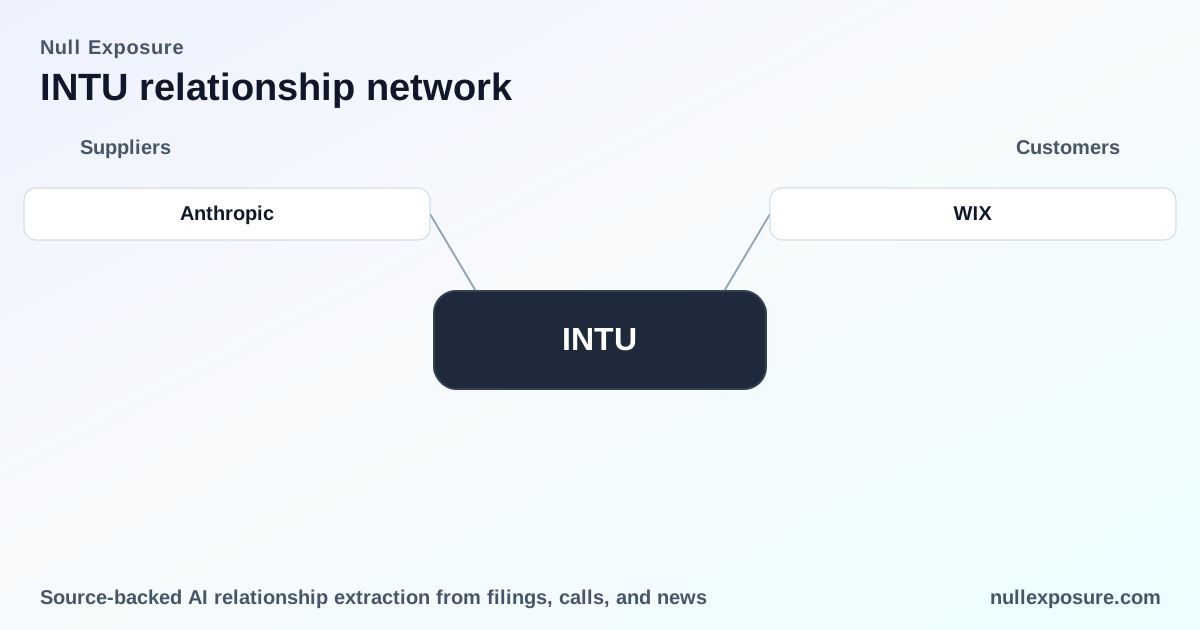
Intuit (INTU) — Customer relationships that convert platform reach into recurring revenue
Intuit operates a multi-product financial-software platform that monetizes through subscription and usage-priced services across consumer and SMB segments — TurboTax, QuickBooks, Mailchimp and adjacent enterprise offerings. The company drives durable cash flow by embedding its bookkeeping, invoicing and payment services into partner ecosystems and marketplaces, converting discovery into paid customers and ongoing service revenue. For investors, the core thesis is simple: scale in distribution plus sticky accounting workflows = recurring monetization and margin leverage. Learn more at https://nullexposure.com/.
How Intuit sells and why that matters to portfolio risk
Intuit’s commercial model is a hybrid of subscription and consumption-based contracts, sold directly and through partners, aimed at individuals, small businesses and mid-market customers. The company’s disclosures characterize its revenue mix as predominantly services-led with software underpinnings — an operating posture that implies:
- Contracting posture: Predominantly subscription but with material usage-priced lines (credit referrals, transaction fees), which aligns revenue to activity and keeps acquisition economics flexible.
- Customer concentration and criticality: A broad base of individuals and SMBs reduces single-counterparty concentration risk, while integrated accounting and payments create high operational criticality for customers once onboarded.
- Maturity and segments: Intuit’s customer relationships span immaturity (new marketplace-originated customers) to mature, mission-critical accounts (mid-market and enterprise clients using Intuit Enterprise Suite).
- Geography: The business is primarily North American with expanding global distribution, so revenue sensitivity is skewed to the U.S. economy but benefits from incremental international adoption.
These company-level signals drive predictable recurring cash flow while exposing Intuit to competitive distribution shifts and marketplace dynamics.
Relationship map: every partner and customer mention (short summaries and sources)
Below are concise, plain-English summaries for each relationship item in the public record, with a direct source for verification.
WIX — Simply Wall St (How Wix is quietly rewiring its small-business moat) — FY2026
Intuit expanded a partnership with Wix to connect Wix websites to QuickBooks Online, enabling site-originated bookkeeping and tighter website-to-finance integrations for service SMBs. Source: Simply Wall St article (March 10, 2026) — https://simplywall.st/stocks/us/software/nasdaq-wix/wixcom/news/how-wix-wix-is-quietly-rewiring-its-small-business-moat-with
WIX — Simply Wall St (Deeper QuickBooks Online integration) — FY2026
Wix integrated QuickBooks Online more deeply so small businesses can manage finances and site operations within a single workflow, increasing Intuit’s channel-led customer acquisition. Source: Simply Wall St (March 10, 2026) — https://simplywall.st/stocks/us/software/nasdaq-wix/wixcom/news/deeper-quickbooks-online-integration-could-be-a-game-changer
WIX — Yahoo Finance / Singapore (Wix, Intuit deepen partnership) — FY2026
A public write-up summarized that Wix users can now access QuickBooks on Intuit’s platform, making business operations more seamless for storefronts and service providers. Source: Yahoo Finance (March 10, 2026) — https://sg.finance.yahoo.com/news/wix-intuit-deepen-partnership-unlock-140000429.html
Anthropic — CFO Brew (Intuit CTO interview) — FY2026
Intuit’s CTO described willingness to appear in AI marketplaces like Anthropic’s Claude Cowork, where Intuit services (invoicing, CRM, payments) can be called by third-party UIs to onboard new small businesses. Source: CFO Brew interview with Intuit CTO Alex Balazs (April 14, 2026) — https://www.cfobrew.com/stories/2026/04/14/intuit-cto-alex-balazs-saas-pocalypse
WIX — CPA Practice Advisor (Wix and Intuit expand partnership) — FY2026
CPA Practice Advisor reported that Wix users can now leverage QuickBooks on the Intuit platform to sync online presence with financial performance, reinforcing distribution via website builders. Source: CPA Practice Advisor (Feb 19, 2026) — https://www.cpapracticeadvisor.com/2026/02/19/wix-and-intuit-expand-partnership-to-integrate-smb-financial-performance-and-online-presence/178329/
WIX — InsiderMonkey (Partnership announcement) — FY2026
InsiderMonkey covered the February 17, 2026 collaboration between Intuit and Wix, highlighting strategic alignment around AI-enabled SMB services. Source: InsiderMonkey (March 10, 2026) — https://www.insidermonkey.com/blog/wix-com-wix-and-intuit-partnership-to-accelerate-ai-integration-across-finance-and-website-tools-1703347/?amp=1
Humble House Foods — Intuit Enterprise blog (AI-native ERP snapshot) — FY2026
An Intuit case study describes Humble House Foods using Intuit Enterprise Suite to achieve consolidated operational visibility across manufacturing, wholesale and retail. Source: Intuit Enterprise Blog (IDC Info Snapshot) — https://www.intuit.com/enterprise/blog/erp/ai-native-erp-idc-info-snapshot/
Rhodes Companies — Intuit Enterprise blog (customer case) — FY2026
Rhodes Companies migrated from nine siloed books to a single Intuit Enterprise instance, cutting month-end close time by half and improving reporting agility. Source: Intuit Enterprise Blog (IDC Info Snapshot) — https://www.intuit.com/enterprise/blog/erp/ai-native-erp-idc-info-snapshot/
HRB (H&R Block) — Macworld (tax software comparison) — FY2026
Macworld noted interoperability and import features between tax software products, including TurboTax and prior-year returns that incorporate H&R Block and Quicken data. Source: Macworld (2025 tax season coverage) — https://www.macworld.com/article/3109616/if-your-2025-taxes-are-complicated-use-this-hr-tax-software-for-state-and-federal-for-35.html
OLB (iStores AI) — GlobeNewswire via The Globe and Mail (press release) — FY2026
A press release described iStores AI offering a QuickBooks plugin that syncs invoicing with order management to remove manual accounting work for merchants. Source: GlobeNewswire press release (March 17, 2026) — https://www.theglobeandmail.com/investing/markets/markets-news/ACCESS%20Newswire/37173240/olb-group-launches-istores-com-an-ai-platform-to-address-16-8-trillion-projected-2028-ecommerce-market-ai-powered-platform-eliminates-traditional-barriers-with-instant-online-stores-and-same-day-merchant-approval/
Fire & Ice — Intuit Enterprise blog (case study) — FY2026
Intuit published a case study showing Fire & Ice resolved multi-entity accounting issues using Intuit Enterprise on October 25, 2024, highlighting multi-entity consolidation capability. Source: Intuit Enterprise Blog (case study excerpt) — https://www.intuit.com/enterprise/blog/erp/ai-native-erp-idc-info-snapshot/
Wix.com Ltd. — Simply Wall St (duplicate coverage) — FY2026
A second Simply Wall St reference reiterates the February 2026 expansion with Wix to connect websites and QuickBooks Online, underscoring repeated press coverage of the same channel deal. Source: Simply Wall St (March 10, 2026) — https://simplywall.st/stocks/us/software/nasdaq-wix/wixcom/news/how-wix-wix-is-quietly-rewiring-its-small-business-moat-with
Four Points RV Resorts — Intuit Enterprise blog (customer case) — FY2026
A published customer review explains why Four Points chose Intuit Enterprise Suite over NetSuite for consolidated multi-entity management and simplified month-end processes. Source: Intuit Enterprise Blog (case study) — https://www.intuit.com/enterprise/blog/erp/ai-native-erp-idc-info-snapshot/
OpenAI — CFO Brew (Intuit CTO interview) — FY2026
Intuit described organic inbound flows from OpenAI’s marketplace where early-stage businesses use general AI tools and then convert to QuickBooks when they need deeper financial management. Source: CFO Brew (April 14, 2026) — https://www.cfobrew.com/stories/2026/04/14/intuit-cto-alex-balazs-saas-pocalypse
FEFA Financial — Intuit Enterprise blog (customer case) — FY2026
FEFA Financial scaled on Intuit Enterprise Suite without a full ERP migration, demonstrating the product’s fit for finance organizations seeking incremental modernization. Source: Intuit Enterprise Blog — https://www.intuit.com/enterprise/blog/erp/ai-native-erp-idc-info-snapshot/
WIX — GlobeNewswire / press release (Wix and Intuit deepen partnership) — FY2026
A formal press release by Wix and Intuit announced an expanded partnership to deliver integrated financial and online presence capabilities to small businesses. Source: GlobeNewswire press release (Feb 17, 2026) — https://www.globenewswire.com/de/news-release/2026/02/17/3239375/0/en/Wix-and-Intuit-Deepen-Partnership-to-Unlock-Growth-Opportunities-for-Small-Businesses.html?f=22&fvtc=5&fvtv=46361616
PGY (Pagaya Technologies) — Globe and Mail transcript excerpt — FY2025
A transcript referenced Pagaya’s role in enabling partner-originated customer flows for affiliate channels (Credit Karma, LendingTree), which contextually connects to Intuit’s broader partner referral ecosystem. Source: Globe and Mail transcript excerpt (FY2025) — https://www.theglobeandmail.com/investing/markets/stocks/PGY/pressreleases/36025428/pagaya-pgy-q3-2025-earnings-call-transcript/
Strategic takeaways for investors
- Partner distribution is material. Multiple, independently sourced announcements (Wix press release, Simply Wall St, Yahoo) confirm Intuit’s strategy to embed QuickBooks into website and marketplace flows, improving CAC and LTV dynamics.
- Enterprise and mid-market traction validates upsell. Intuit Enterprise case studies (Rhodes, Four Points, FEFA, Fire & Ice) show a pathway from basic QuickBooks adoption to higher‑value enterprise licensing and services.
- Revenue mix supports resilience. The firm’s reliance on subscription plus usage fees and affiliate-driven credit and referral revenue produces both stability and growth optionality.
If you want a concise, investor-ready map of Intuit’s partner-driven customer funnel and contract posture, visit https://nullexposure.com/ for structured relationship intelligence.
Bottom line
Intuit’s customer relationships span marketplaces, website platforms and direct enterprise engagements, converting discovery into recurring subscriptions and usage fees. For investors, the company’s moat is distribution-to-finance integration — once merchants link their commerce to QuickBooks, the economics tilt heavily in Intuit’s favor.