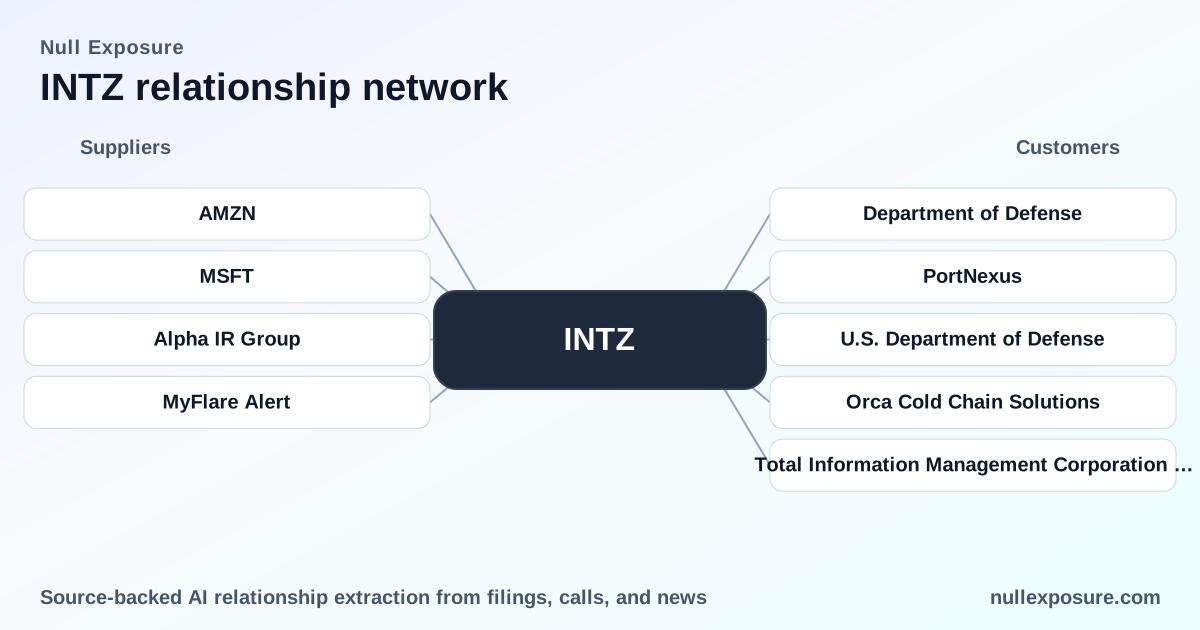
INTZ customer relationships: what drives revenue and where risks concentrate
Intrusion Inc (INTZ) sells cybersecurity products and services—hardware units, consulting, and a growing subscription SaaS product called INTRUSION Shield—and monetizes through a mix of product shipments, monthly SaaS fees, and professional services. Government customers account for a dominant share of revenue, while channel partners broaden distribution into education, law enforcement and commercial supply chains, creating a hybrid go-to-market that combines direct government contracting with reseller-led commercial adoption. For a deeper read on relationship signals and commercial traction, visit https://nullexposure.com/.
How the customer base shapes the business model
Intrusion runs a bifurcated operating model: large, mission-critical government contracts on one side and reseller/partner-driven commercial deployments on the other. Key operating-model signals from company disclosures and recent commentary:
- Government concentration is material. Management disclosed that sales to U.S. government customers represented 83.8% of revenues in 2024, signaling revenue vulnerability to federal funding cycles and appropriations.
- Subscription-first product strategy. INTRUSION Shield is sold on a subscription (SaaS) basis, shifting revenue mix toward recurring monthly fees as adoption grows.
- Services remain a revenue backbone. The company still derives most sales from consulting services, indicating a mixed margin profile and reliance on billable work.
- Channel and reseller participation. The company transacts with distributors and resellers under standard net-30 terms, reflecting a channel-dependent expansion approach in non‑government segments.
- Ramping product line. Management describes Shield opportunities in the pipeline and early paid proof-of-value deployments, consistent with a ramping commercial stage for Shield.
- Geographic focus: North America. End-user customers are primarily U.S. federal, state and local entities and domestic enterprises.
These characteristics create a highly cyclical revenue profile with upside if Shield converts pipeline into recurring contracts, and downside if government funding lags.
The customer roster that matters (documented relationships)
PortNexus
Intrusion licenses network- and endpoint-protection components of INTRUSION Shield to PortNexus for embedding in PortNexus’s MyFlare platform, which targets education and law‑enforcement endpoints; management highlights strong partner-driven deployment momentum and new programs such as P.O.S.S.E. to protect sheriffs and law enforcement. (Sources: Q2 2025 and Q3 2025 earnings call comments; InsiderMonkey and Investing.com coverage, FY2025–FY2026.)
Department of Defense / U.S. Department of Defense
Intrusion has an awarded contract with the U.S. Department of Defense under which it shipped over 230 Shield devices as part of a critical infrastructure rollout, and management attributes sequential revenue increases in Q3 2025 to the DoD award. This is a direct, material government procurement tied to both product shipments and consulting services. (Sources: Q3 2025 earnings call; The Globe and Mail reporting on FY2025 results.)
U.S. Department of War / Department of War (as referenced in coverage)
Company commentary and analyst write‑ups referenced a significant government contract extension whose incremental funding was delayed, and management explicitly cited delayed government funding as the primary reason for a sequential revenue decline in Q4 2025. Coverage treated this as the same class of government client that drives material revenue swings. (Sources: Investing.com transcript and AlphaStreet coverage of Q4 2025; Bitget reporting, FY2026.)
Orca Cold Chain Solutions
After a pilot, Orca Cold Chain Solutions committed to a three‑year purchase of Intrusion’s applied threat intelligence, positioning Intrusion’s offerings within supply-chain security for temperature‑sensitive logistics. This is a commercial win executed through partnerships and multi‑year procurement. (Source: Laotian Times reporting on FY2024 partnership announcements.)
Total Information Management Corporation (TIM)
TIM functions as a solution partner and reseller in the Orca engagement: under the agreement, TIM will provide Intrusion’s advanced threat detection and prevention solutions to Orca, enabling channel-led delivery into a commercial supply-chain customer. (Source: Laotian Times report, FY2024.)
What these relationships imply for investors
- Revenue concentration and volatility are the dominant risk/return factor. With U.S. government customers representing the lion’s share of 2024 revenue, quarterly results are sensitive to federal procurement timing and funding cycles. The Q4 2025 drop tied to delayed incremental funding illustrates this exposure.
- Subscription economics provide durable upside if Shield scales. Shield is sold as a SaaS subscription, which improves revenue visibility and lifetime value if recurring adoption follows early proof‑of‑value wins.
- Channel partnerships accelerate commercial reach but dilute direct control. Relationships with PortNexus and TIM/Orca expand addressable markets (education, law enforcement, cold‑chain logistics) but rely on partners to execute deployments and upsell.
- Product mix drives margin complexity. The business recognizes revenue from hardware shipments, SaaS subscriptions, and consulting, resulting in mixed margin dynamics—professional services underpin near-term cash but compress gross margins versus pure SaaS.
- Operational posture is transactional and contract-driven. Sales operate under purchase orders and contracts with typical net‑30 payment terms for distributors and resellers; this increases the importance of contract structure, renewal terms, and government billing timelines.
Key financial context: Intrusion reported TTM revenue of roughly $7.1 million with negative EBITDA and EPS in the most recent data, underlining that commercial traction for Shield must scale to offset government timing risk and to drive profitability.
Bottom line: where the upside and downside live
Intrusion’s path to durable growth is clear and binary: convert current Shield proofs and partner embeds into stable, recurring subscriptions across public‑sector and commercial endpoints, while managing the revenue lumpiness tied to government procurements. The most actionable catalyst is conversion of PortNexus deployments and multi‑year partner agreements (like TIM/Orca) into recurring ARR; the largest near-term risk remains federal funding cadence that produced meaningful quarter-to-quarter swings in 2025.
For a consolidated view of client signals, contract types and channel activity that matter to underwriting INTZ, explore additional coverage at https://nullexposure.com/.
Bold claim summary: government concentration is material, Shield is subscription-first and ramping, and channel partnerships are the fastest route to commercial scale—each is a lever for valuation upside or downside depending on execution and funding timing.