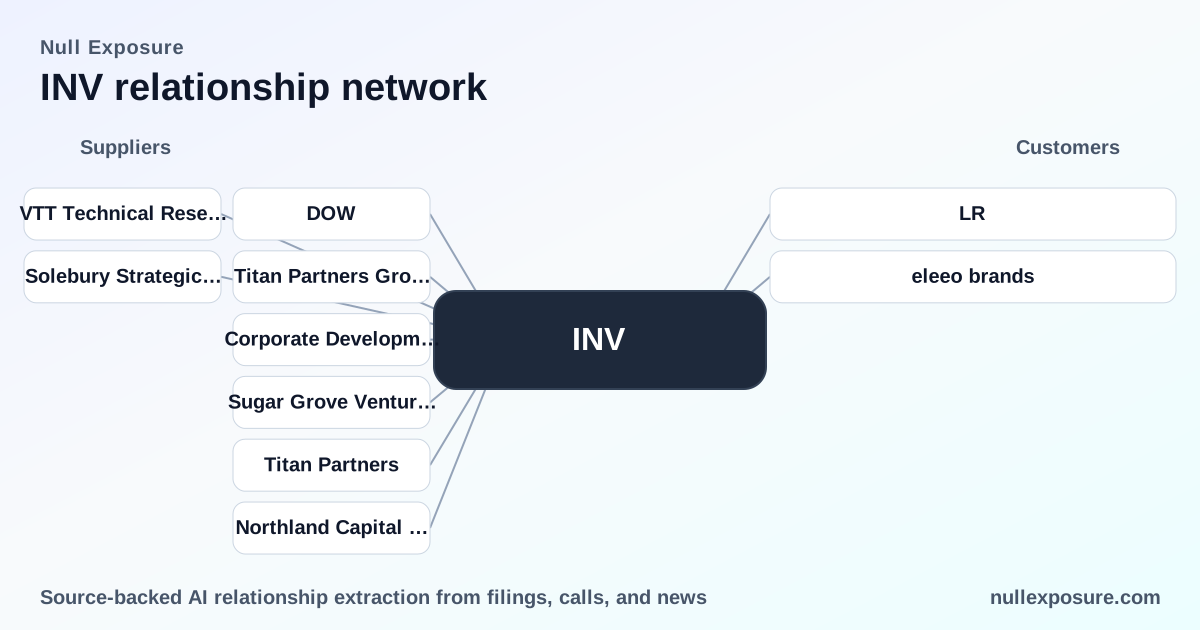
Innventure (INV) customer relationships: what investors need to know
Innventure funds and operates technology companies spun out or licensed from multinational corporations, generating revenue through management fees, consulting, carried interest and direct product sales from its operating subsidiaries. The firm’s model blends asset-management-style monetization with operating-company revenue, creating a hybrid exposure to recurring fee income and early-stage product commercialization. For a concise view of how these customer ties translate into near-term cash flow and concentration risk, read on — or visit https://nullexposure.com/ for further research tools and filings.
High-level thesis: monetization, posture and what that implies for revenue risk
Innventure captures value in three ways: management and advisory fees from related funds and portfolio companies, carried interest from successful exits, and product/service sales as its subsidiaries commercialize technology. Its contracting posture includes framework-style agreements that give Innventure optional, staged capital or equity-sale mechanics rather than firm, long-term off-take obligations — a structure that preserves flexibility but concentrates execution risk on a small number of counterparties. The company reports extreme revenue concentration (97.8% of revenue tied to major customers), a global addressable footprint for its chemical and hardware products, and a mix of roles as both service provider and seller of hardware and chemical products.
Key operating signals:
- Contracting posture: framework agreements and standby equity purchase mechanisms are in use, giving the company optional liquidity levers rather than guaranteed proceeds (company filings on SEPA/Yorkville).
- Counterparty mix: products and services target large enterprises through to small businesses, reflecting a broad TAM but concentrated revenue realization.
- Criticality and concentration: materiality is high — >97% revenue concentration — creating outsized dependence on a handful of counterparties.
- Maturity spectrum: relationships span pilot proof-of-concept pilots to active, revenue-generating contracts, particularly in data-center hardware and chemicals.
Customer relationship breakdown — concise investor summaries
Legrand (reported buyer; entry 1)
Innventure disclosed that one of its units sold 822,195 Series B-1 units to Legrand for $30.0 million, signaling a direct corporate sale from an Innventure operating vehicle to a multinational electrical and digital building systems company; the transaction is recorded in FY2026 SEC filings and reported via Reuters/TradingView in March 2026. (TradingView / Reuters, Mar 10, 2026)
LR (duplicate Legrand entry; entry 2)
The dataset contains a duplicate entry referencing LR, which is the same Legrand transaction described above: 822,195 Series B-1 units sold for $30 million, filed in FY2026. The duplicate confirms the same buyer/transaction in the news feed. (TradingView / Reuters, Mar 10, 2026)
eleeo brands (AeroFlexx product partnership)
Innventure’s AeroFlexx business announced a partnership with eleeo brands to launch the Boogie Bubbling Vapor Bath product, reflecting AeroFlexx’s route-to-market for consumer-facing packaged products and the company’s strategy to commercialize sustainable liquid packaging via brand partners. This relationship shows Innventure acting as both product developer and go-to-market enabler for consumer products in FY2026. (The Globe and Mail press release / Innventure statement, reported Mar 2026)
YA II PN, Ltd (standby equity / resale context)
In an S-3 filing, Innventure stated that resales of registered stock will not generate proceeds for the company except for possible voluntary issuances under its Standby Equity Purchase Agreement with YA II PN, Ltd or from cash warrant exercises, indicating YA II acts as a financing counterparty under a framework liquidity agreement rather than a direct commercial customer. (TradingView summary of Innventure S-3 filing, May 2026)
How these relationships translate to business model constraints
Collectively, the relationship evidence and contractual excerpts paint a firm with high concentration, mixed counterparty types, and optional financing arrangements rather than firm long-term purchase contracts.
- Concentration risk is structural. The company reports 97.8% revenue concentration among major customers; this is a material probability driver for quarter-to-quarter revenue volatility and a gating factor for valuation until diversification occurs.
- Contracting posture favors flexibility over guaranteed cash flow. The presence of framework SEPA-style provisions (including an explicit Purchased Put Option under the Yorkville agreement) gives Innventure capital optionality but without the same cash-flow certainty as firm offtake contracts.
- Counterparties span the enterprise spectrum. The business pursues large multinationals and smaller brands alike — a strategy that widens addressable market but concentrates realized revenue where proof points and pilot-to-scale transitions succeed.
- Revenue mix includes services and hardware/chemicals. Innventure earns management and consulting fees and sells products (e.g., AeroFlexx consumer offerings, Accelsius NeuCool hardware and Refinity chemical products), meaning margin profiles will vary by segment and depend on successful commercialization.
Investment implications — what investors should track
- Top-line sensitivity: With nearly all revenue coming from a handful of customers, monitor quarterly disclosures for churn or growth among those counterparties and for any updates to the Legrand unit sale structure.
- Conversion of pilots to contracts: Accelsius’s pilot and ramping-stage deployments are critical; conversion rates from pilot to repeat purchases will materially affect near-term revenue growth and margin uplift.
- Financing optionality vs. dilution risk: Standby equity lines (e.g., YA II PN, Ltd) and resale registrations provide liquidity pathways but also create potential dilution; track S-3 filings and any exercises or voluntary purchases.
- Proof of scaleback on concentration: Management must demonstrate a pipeline of diversified customers or repeat orders from large partners to re-rate valuation multiples given current EV/Revenue and Price/Book metrics.
What to watch next and where to find updates
- New or expanded off-take or licensing agreements with multinational chemical or packaging customers (e.g., Dow, BASF, others referenced in company commentary).
- Progress updates on Accelsius NeuCool deployments and AeroFlexx consumer rollouts with brand partners such as eleeo.
- SEC filings related to the Legrand transaction, S-3 resale activity, and any draws/exercises under the YA II standby purchase agreement.
For regular filing summaries and relationship monitoring, visit https://nullexposure.com/ — the site aggregates the precise filings and news flow needed for active due diligence.
Conclusion: Innventure’s hybrid asset-operator model offers asymmetric upside when pilots convert to scalable sales, but current revenue concentration and framework-style contracting create material near-term execution risk. Investors must prioritize customer diversification, conversion metrics from pilot to scale, and clarity on financing mechanics to assess valuation trajectory.