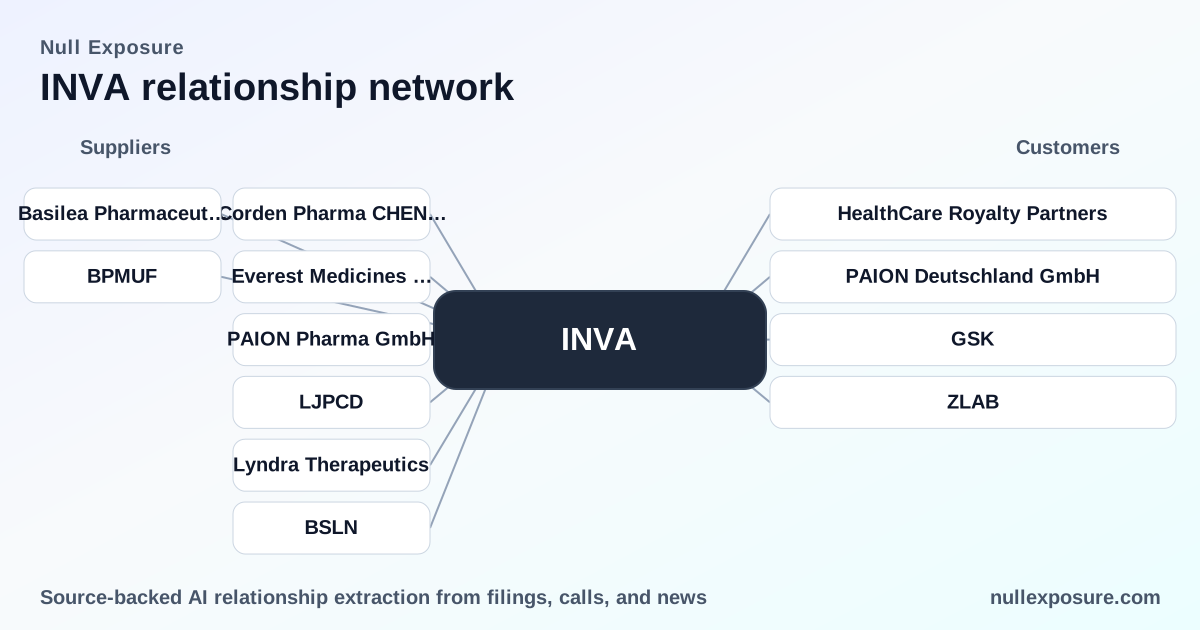
Innoviva (INVA) — customer relationships that drive cash and define risk
Innoviva monetizes intellectual property and marketed pharmaceutical assets primarily through royalty streams and product supply agreements. The company holds royalty rights on respiratory products marketed by global pharma partners and sells product inventory under short-term supply arrangements for commercial launches; this hybrid model produces high free cash flow and concentrated counterparty exposure. For a focused investor view of customer counterparties and what they imply for revenue durability, read on.
Visit our research hub for more company relationship intelligence: https://nullexposure.com/
Executive thesis: steady royalty cash, concentrated partner risk
Innoviva’s business model is cash flow–centric: recurring royalties from large pharma partners fund operations and capital returns, while tactical supply agreements (e.g., interim inventory sales) supplement revenue. The dominant commercial counterparty relationship is with GlaxoSmithKline (GSK) for long‑acting inhaled respiratory products; smaller, targeted arrangements with specialty distributors and regional licensees support international commercialization and product launches. The result is a high-margin, low‑operating‑expense profile but material counterparty concentration and geography concentration in the U.S. that investors must price into valuation and downside scenarios.
How to read Innoviva’s customer map
- Royalties from established global marketers (GSK) deliver the majority of recurring cash flows and determine valuation sensitivity. (See company disclosures and 2026 media coverage.)
- Short-term supply contracts support launch activity and are accounted as product sales rather than financing instruments; these create episodic revenue bumps and working capital timing risk. (See 10‑K language on interim supply with Zai Lab.)
- Regional licensees and distributors (PAION in EMEA; Zai/Everest in APAC) convert Innoviva’s IP into localized commercialization and mark clear geographic segmentation of revenue rights.
Relationship roll‑call — who Innoviva sells to or collects royalties from
Below are every customer relationship returned in the results, with concise plain‑English summaries and source citations.
GlaxoSmithKline (GSK) / Glaxo Group Limited
Innoviva receives royalties from GSK on sales of RELVAR/BREO ELLIPTA and ANORO ELLIPTA, which anchor the company’s royalty portfolio and produce the majority of operating cash flow. Multiple company press excerpts and earnings commentary in FY2026 reiterate that GSK‑licensed respiratory assets are core to Innoviva’s revenue. (See Innoviva press releases and MarketScreener / BioSpace coverage, FY2025–FY2026.)
Zai Lab (ZLAB)
Zai Lab is a customer under an Amended Zai Agreement and interim supply agreement: Innoviva recognized license and other revenue from the Amended Zai Agreement in FY2024 and entered an interim supply agreement in June 2024 under which Zai Lab purchased XACDURO inventory for commercial launch. The arrangement is treated as customer revenue under ASC 606. (See Innoviva 2024 Form 10‑K; Zai Lab 2024 filing noting it sources XACDURO from Innoviva, FY2024–FY2025.)
PAION Deutschland GmbH (PAION)
PAION Deutschland GmbH is the exclusive commercial partner for GIAPREZA and XERAVA in the PAION Territory (EEA, UK, Switzerland) under a license granted by La Jolla, which Innoviva acquired; PAION markets those products on behalf of La Jolla in Europe and Great Britain. This indicates EMEA commercialization is managed via regional licensees rather than direct Innoviva sales. (See Innoviva 2024 Form 10‑K, FY2024.)
HealthCare Royalty Partners (HCR)
As part of the La Jolla acquisition, Innoviva recorded the fair value of a deferred royalty obligation tied to a royalty financing agreement with HealthCare Royalty Partners, reflecting a structured financing relationship linked to royalty cash flows rather than a traditional customer contract. This is documented in Innoviva’s 2024 Form 10‑K disclosures. (See Innoviva 2024 Form 10‑K, FY2024.)
Operating constraints and what they signal for investors
Innoviva’s relationship evidence yields several company‑level operating signals that shape risk and upside.
- Contracting posture — short‑term / tactical supply: Innoviva executed an interim supply agreement with Zai Lab in June 2024 to provide XACDURO inventory for launch; this is a short‑term, transaction‑based commercial posture that generates near‑term product revenue rather than long‑dated service income (10‑K language, FY2024).
- Geographic concentration — U.S.‑heavy sales: Innoviva reported that ~83% of net product sales in 2024 were from U.S. customers (and 91% in prior years), signaling material domestic concentration and exposure to U.S. market dynamics and reimbursement trends (10‑K, FY2023–FY2024). EMEA and APAC commercialization is handled by licensees such as PAION and Everest/Zai arrangements, which shifts execution risk to partners (10‑K licensing excerpts).
- Relationship roles — distributor and licensee network: Hospitals and healthcare organizations typically purchase through specialty distributors in the U.S., which Innoviva treats as customers for accounting, while regional licensees carry development and commercialization obligations outside the U.S. (10‑K disclosures). This mix reduces Innoviva’s operating footprint but increases counterparty and partner execution risk.
- Relationship maturity and cash profile — royalty‑anchored, active license revenue: The royalty model with large, established marketers produces persistent, high‑margin cash flows; concurrently, the Amended Zai Agreement generated license revenue recognized in FY2024 and had receivables as of year‑end, indicating active, revenue‑generating licensing in addition to royalties (10‑K, FY2024).
Investment implications — risk, valuation, and governance
- Concentration risk is the dominant valuation lever. The GSK relationship is the primary driver of free cash flow; market commentary in FY2026 highlighted roughly $400M of revenue and high free cash flow derived primarily from GSK‑licensed drugs (MarketScreener / Bitget coverage, FY2026).
- Low operating base but counterparty execution exposure. Innoviva’s lean operating model limits fixed cost leverage but places execution and regulatory risk in the hands of marketing partners and licensees. Investor focus should be on royalty trajectory, partner sales trends, and the cadence of short‑term supply agreements.
- Capital allocation flexibility. High operating margins and strong cash conversion give Innoviva freedom for buybacks, payouts, or opportunistic M&A; recent management commentary in FY2026 outlined a buyback program and growth catalysts tied to the royalty portfolio (MarketBeat / BioSpace, FY2026).
Bottom line
Innoviva is a royalty and supply‑driven healthcare holding with a cash‑heavy, partner‑dependent revenue base. Key investment questions are centered on GSK sales trends, maintenance or expansion of license agreements in EMEA/APAC, and the frequency and scale of short‑term supply deals like the Zai Lab arrangement. For a deeper dive into counterparty disclosures and to monitor changes in Innoviva’s customer map, visit our research portal: https://nullexposure.com/
Bold takeaways: royalty cash flow concentration (GSK) dominates valuation, U.S. geographic concentration creates single‑market sensitivity, and short‑term supply contracts provide tactical revenue but increase working‑capital variability.