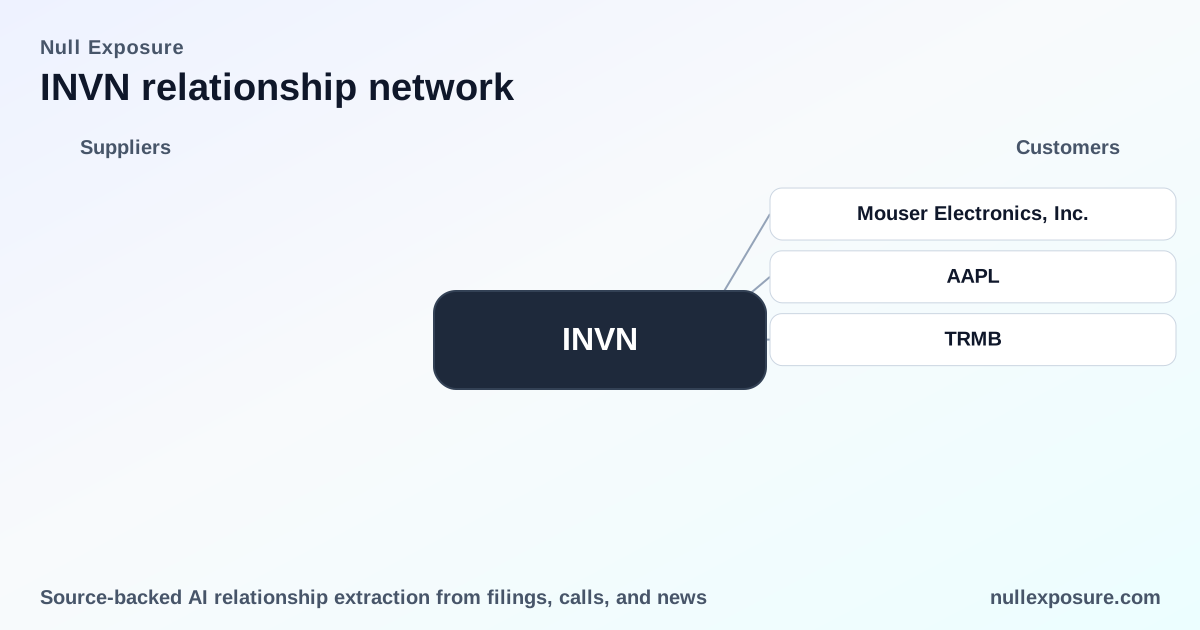
InvenSense (INVN): Customer Map and Commercial Implications for Investors
InvenSense operates as a developer and supplier of motion sensors, microphones, and inertial measurement modules, monetizing through product sales to OEMs, distribution channels, and system integrators while benefiting from TDK’s global scale after integration into the TDK group. Revenue derives from component sales, development kits, and module integrations that feed smartphone, consumer electronics, automotive and industrial navigation stacks. For investors, the company’s value driver is the combination of intellectual property in MEMS sensors and access to large OEM customers and distributors that convert design wins into recurring volume.
If you want a compact, searchable presentation of the customer relationships covered here, visit the Null Exposure homepage for more context and source links: https://nullexposure.com/.
What this customer map tells investors in plain terms
InvenSense’s commercial posture is OEM-driven and distribution-augmented. The firm sells into two commercial channels simultaneously: direct engagements with large device makers and partnership routes through major electronic distributors and module integrators. That structure accelerates adoption through prototype and developer kits while concentrating risk where major OEM design wins determine volume.
- Contracting posture: Product-level contracts and design wins dominate; many engagements are transactional but can convert to long-lived supply once an OEM embeds a sensor or IMU into a product line.
- Concentration: Historical relationships with Apple and Samsung, and current integration into automotive and navigation stacks, signal customer concentration risk when design wins are tied to a few large partners.
- Criticality: Sensors and IMUs are critical subsystems in phones, wearables, and precision navigation; losing or winning a design slot materially affects revenues.
- Maturity: The product set ranges from commodity sensors sold via distributors to higher-value IMU modules used in precision navigation, indicating a mix of mature commodity sales and higher-margin embedded module sales.
Learn more about how we compile and cross-check customer signals at https://nullexposure.com/ (overview and subscription options).
Relationship-by-relationship — what each mention means for INVN
Below I cover every relationship reported in the available signals. Each entry is one to two sentences with the original reporting source cited.
-
Mouser Electronics — DK-42686-P development kit (BisInfotech, Mar 10, 2026). Mouser added the TDK InvenSense DK-42686-P development kit to its catalog, which positions InvenSense to accelerate prototyping and adoption among engineers and manufacturers that purchase through NPI distributors (https://www.bisinfotech.com/mouser-electronics-begins-stocking-tdk-invensense-dk-42686-p-imu-development-kit/).
-
Nintendo — InvenSense chips in the 3DS (The Globe and Mail, FY2011; reported May 3, 2026). iFixit’s teardown attribution showed InvenSense components inside Nintendo’s 3D handheld, demonstrating an early history of InvenSense supplying motion sensing chips to consumer gaming OEMs (https://www.theglobeandmail.com/technology/gaming/gaming-news/nintendos-3ds-contains-toshiba-fujitsu-chips-ifixit/article569235/).
-
Mouser Electronics — IAM-20680HV motion tracking sensor (BisInfotech, Mar 10, 2026). Mouser listed the IAM-20680HV motion sensor from TDK InvenSense, signaling ongoing channel distribution of newer motion-tracking products aimed at rapid prototyping and low-volume purchase flows (https://www.bisinfotech.com/mouser-adds-tdk-invensense-iam-20680hv-sensor/).
-
Mouser Electronics — DK-42686-P kit (ElectronicsMedia.info, Mar 10, 2026). A separate trade outlet similarly reported Mouser stocking the DK-42686-P kit, reinforcing distributor-backed go-to-market for InvenSense developer hardware (https://www.electronicsmedia.info/2025/12/22/tdk-invensense-dk-42686-p-kit/).
-
Trimble — integrated precision navigation solution (GuruFocus, May 2026). Trimble announced a solution that pairs its ProPoint Go engine and RTX correction service with TDK’s SmartAutomotive IMU module from InvenSense, indicating InvenSense’s modules are being positioned into high-precision navigation stacks for automotive and surveying applications (https://www.gurufocus.com/news/2941558/trimble-trmb-partners-with-invensense-for-enhanced-navigation-solution-trmb-stock-news).
-
Apple Inc. — InvenSense as a supplier referenced in TDK acquisition talks (Yahoo Finance, 2016 filing coverage; reported May 3, 2026). Reporting on TDK’s discussions to acquire InvenSense noted that InvenSense produces motion sensors used by Apple, confirming historical and strategic supply relationships with leading smartphone OEMs (https://finance.yahoo.com/news/exclusive-japans-tdk-talks-buy-164851803.html).
-
AAPL (WCCFTech rumor) — iPhone 6 OIS module rumor (WCCFTech, FY2014; cited Mar 10, 2026). Press coverage referenced market rumors that InvenSense was involved in producing optical image stabilization (OIS) gyroscopes for an iPhone generation, which historically drove stock movement and signaled potential high-volume smartphone exposure (https://wccftech.com/iphone-6-ois-gyroscope/).
-
Apple — same WCCFTech report (FY2014; Mar 10, 2026). The repeated reporting frame links InvenSense product activity to Apple device content in investor narratives, underscoring the company’s recurring association with high-value OEM design cycles (https://wccftech.com/iphone-6-ois-gyroscope/).
-
Trimble (Finviz) — joint announcement with TDK/InvenSense (Finviz, Mar 2026). Financial wire coverage reiterated Trimble’s collaboration with InvenSense modules and TDK branding, confirming the corporate-level integration of InvenSense products into Trimble’s precision-navigation offerings (https://finviz.com/news/86653/trimble-and-tdk-join-forces-to-accelerate-precision-navigation).
-
TRMB (Finviz duplicate) — Trimble mention with ticker (Finviz, Mar 2026). A second Finviz entry underscores investor-facing dissemination of the Trimble–InvenSense integration and its read-across to Trimble’s ticker (https://finviz.com/news/86653/trimble-and-tdk-join-forces-to-accelerate-precision-navigation).
-
Samsung Electronics Co — cited in acquisition reporting (Yahoo Finance, 2016; May 3, 2026). Reporting of earlier acquisition talks noted InvenSense as a motion-sensor supplier to Samsung, documenting another large OEM relationship historically important to revenues and strategic positioning (https://finance.yahoo.com/news/exclusive-japans-tdk-talks-buy-164851803.html).
-
AONDevices, Inc. — microphone platform collaboration (GlobeNewswire, Jan 2, 2026). AONDevices and TDK InvenSense announced a combined platform pairing AONDevices’ AON1100 M3 processor with InvenSense’s T5838 MEMS microphone, signaling product-level partnerships that extend InvenSense’s reach into always-on voice and sound detection markets (https://www.globenewswire.com/news-release/2026/01/02/3212166/0/en/aondevices-and-tdk-invensense-unveil-super-low-power-always-on-voice-and-sound-detection-platform-powered-by-the-aon1100-m3-processor.html).
Key takeaways and investor implications
-
Distribution and developer kits are a deliberate route to accelerate design wins. Multiple entries showing Mouser stocking InvenSense kits and sensors confirm a two-pronged approach: prototype enablement through distributors and volume conversion via OEM partnerships. This reduces friction in customer evaluation cycles and drives adoption velocity.
-
Large OEM exposure is both an asset and a concentration risk. Historic and reported ties to Apple and Samsung, plus integration into Trimble’s navigation stack, provide addressable volume and pricing leverage but also concentrate revenue risk around a handful of major device platforms.
-
Product breadth spans commodity sensors to differentiated IMUs and microphones. The portfolio mix supports diversified end-markets—smartphones, gaming, automotive navigation, and always-on voice—allowing investors to value InvenSense as a multi-market component supplier with pockets of higher-margin module revenue.
-
Partnership announcements indicate strategic vertical moves. Collaborations with AONDevices and Trimble show management is moving beyond component sales into closer-integrated module and platform offerings that command a higher share of system value.
For a focused dataset of customer signals and source-level links to aid due diligence, visit the Null Exposure homepage: https://nullexposure.com/.
Investors should weigh the upside from recurring OEM design wins and platform integrations against the downside of customer concentration and the commoditization pressures in MEMS sensing.